•  
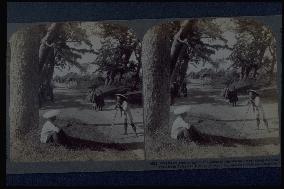
A scene of people taking a rest at Suzukawa,Tokaido Road

A scene of people taking a rest at Suzukawa,Tokaido Road

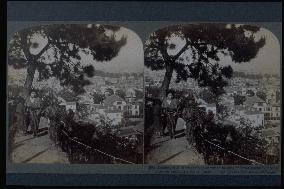
The Tokaido Highway near Suzukawa in Fuji City, facing west. One man is resting under the pine tree and another leaning on a pole. Pine trees line the highway, and houses with thatched roofs are visible in the background. This photograph was taken by the American stereograph photograph company, Underwood & Underwood, either in 1896 or between 1903 and 1904.==Date:1904, Place:Shizuoka, Photo:Underwood, (Credit:Nagasaki University Library/Kyodo News Images) [Cabinet Number97‐98‐0]

  •  
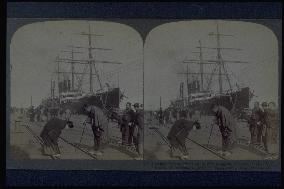
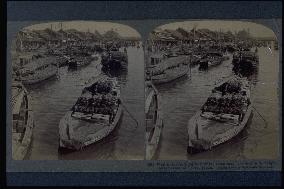
Welcoming the passengers arriving in the port

Welcoming the passengers arriving in the port

Stereograph produced by Underwood & Underwood Co., depicting the great iron pier completed in 1894. According to the inscription on the back, the ship is the China owned by Pacific Mail S.S. Co. Copyright 1904.==Date:1904, Place:Yokohama, Photo:Underwood, (Credit:Nagasaki University Library/Kyodo News Images) [Cabinet Number97‐96‐0]

  •  
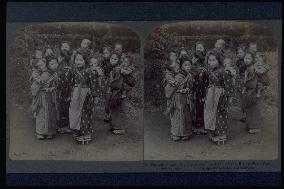
Children baby-sitting

Children baby-sitting

Stereograph produced by Underwood & Underwood Co. The inscription on the back notes with surprise that Japanese girls seem to move around with ease as if not carrying anything on their backs and that, despite of all the movement, the babies remain quiet. Copyright 1904.==Date:1904, Place:Yokohama, Photo:Underwood, (Credit:Nagasaki University Library/Kyodo News Images) [Cabinet Number97‐94‐0]

  •  
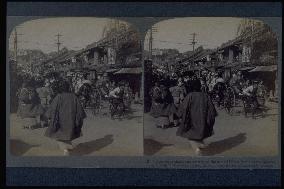
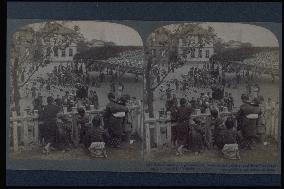
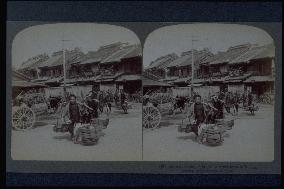
A street and a crowd,Batsu-cho,Yokohama

A street and a crowd,Batsu-cho,Yokohama

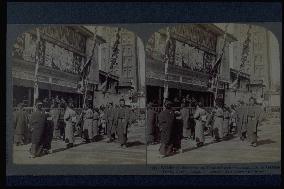
This is a stereograph sold by Underwood & Underwood Co. Noge is one of the neighborhoods surrounding Yokohama. Shops selling commodities line the street, with signs advertising dried seaweed and tea. The main residences and villas of wealthy merchants as well as government residences are visible on the hill in the rear. Copyright 1904.==Date:1904, Place:Yokohama, Photo:Underwood, (Credit:Nagasaki University Library/Kyodo News Images) [Cabinet Number97‐95‐0]

  •  
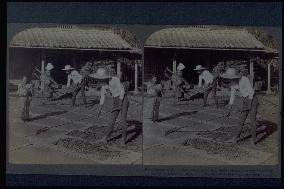
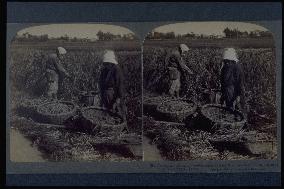
Farmers drying millet

Farmers drying millet

Stereograph produced by Underwood & Underwood Co. The inscription on the back states that the photograph was taken near Yokohama. Farmers are spreading millet on the mats to dry.==Date:1904, Place:Yokohama, Photo:Underwood, (Credit:Nagasaki University Library/Kyodo News Images) [Cabinet Number97‐88‐0]

  •  
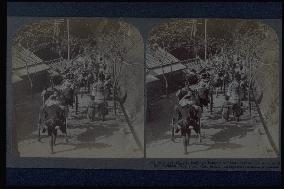
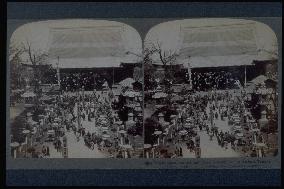
Visitors to Daijingu (Grand) Shrine

Visitors to Daijingu (Grand) Shrine

Stereograph produced by Underwood & Underwood Co. After Tensho Kodaijingu was established as a guardian shrine of Yokohama in 1870, the hill was renamed Mt. Ise after Ise Shinto Shrine in Mie Prefecture. This photograph portrays people going on rickshaw to the shrine and people walking back. Copyright 1904.==Date:1904, Place:Yokohama, Photo:Underwood, (Credit:Nagasaki University Library/Kyodo News Images) [Cabinet Number97‐92‐0]

  •  
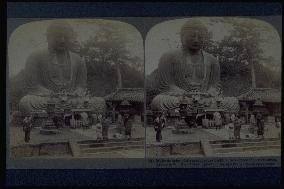
Daibutsu (the Great Buddha) of Kamakura

Daibutsu (the Great Buddha) of Kamakura

The bronze lanterns on both sides of the statue were donated in January 1712 and still exist today. Behind them are the two stones presumed to be foundations of the former Great Buddha building. The label under the caption on the lower right border of the stereograph reads Copyright 1904 by Underwood & Underwood, indicating that the photograph was taken around 1904.==Date:1904, Place:Kamakura, Photo:Underwood, (Credit:Nagasaki University Library/Kyodo News Images) [Cabinet Number97‐86‐0]

  •  
Children playing in a schoolyard

Children playing in a schoolyard

A stereograph by Underwood & Underwood Co. The caption on the back of the photograph explains that school buildings in small Japanese towns were usually one-story buildings but that in Yokohama, an international business city near Tokyo, educational reforms had been instituted. Copyright 1904. D75==Date:1904, Place:Yokohama, Photo:Underwood, (Credit:Nagasaki University Library/Kyodo News Images) [Cabinet Number97‐93‐0]

  •  
Harvesting millet

Harvesting millet

Stereograph produced by Underwood & Underwood Co. The inscription on the back states that the photograph was taken a few miles north of Yokohama. A telegraph pole is visible on the right. Copyright 1904.==Date:1904, Place:Yokohama, Photo:Underwood, (Credit:Nagasaki University Library/Kyodo News Images) [Cabinet Number97‐89‐0]

  •  
Honmoku Point and a jinrikisha

Honmoku Point and a jinrikisha

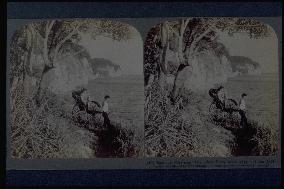
Stereograph produced by Underwood & Underwood Co. depicting the Negishi Bay side of Honmoku Peninsula. There are three valleys on the peninsula, and the tip was called Treaty Point by Perry. The inscription on the back says that the peninsula was called Mikado Cliff by foreigners. Copyright 1904.==Date:1904, Place:Yokohama, Photo:Underwood, (Credit:Nagasaki University Library/Kyodo News Images) [Cabinet Number97‐87‐0]

  •  
A fishing boat returning at sunset

A fishing boat returning at sunset

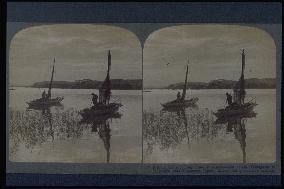
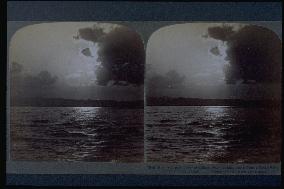
This is the mouth of the Rokugo River. This stereograph was sold in 1904 by Underwood & Underwood Co. The caption on the back reports that many Japanese artists like to draw this landscape and that so many people visit the area on festival days that the railway had to schedule a special train service.==Date:1904, Place:Tamagawa, Photo:Underwood, (Credit:Nagasaki University Library/Kyodo News Images) [Cabinet Number97‐90‐0]

  •  
Mt. Fuji seen from Lake Motosu

Mt. Fuji seen from Lake Motosu

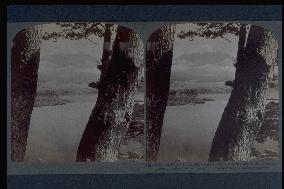
Stereograph depicting Mt. Fuji from the northwestern side of Lake Motosu, one of the five lakes at the foot of Mt. Fuji (#3338). The caption says, The beautiful Fuji, beloved by artists and poets, seen from the N.W. through pines at Lake Motosu, Japan . When seen through its special viewing apparatus, the stereograph creates a three-dimensional optical illusion.==Date:1904, Place:Yamanashi, Photo:Underwood, (Credit:Nagasaki University Library/Kyodo News Images) [Cabinet Number97‐82‐0]

  •  
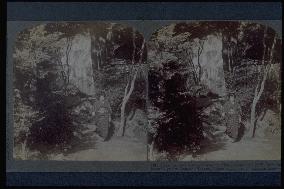
The Tamadare Falls

The Tamadare Falls

Judging from the condition of the trees, this appears to be the Tamadare Waterfall before it was incorporated as Takinomae Park in 1891. The young woman is possibly an employee of a nearby inn. The volume of water is abundant and this photo shows the force of the falls before the Great Kanto Earthquake of 1923, when half of the fall was destroyed. Currently the falls, which are in the garden of Tenseien Hotel, are open to the public. A stereograph.==Date:1904, Place:Hakone, Photo:Underwood, (Credit:Nagasaki University Library/Kyodo News Images) [Cabinet Number97‐85‐0]

  •  
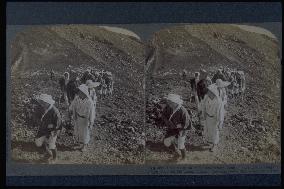
Climing Mt. Fuji

Climing Mt. Fuji

Pilgrims at the top of Mt. Fuji. There are two craters at the summit (one large, one small), and the caldera surrounds them. Pilgrims came to pray at the shrines located along the path at the summit and to see morning light, which was considered sacred. This photograph was taken by the American stereograph company, Underwood & Underwood, either in 1896 or between 1903 and 1904.==Date:1904, Place:Shizuoka Yamanashi, Photo:Underwood, (Credit:Nagasaki University Library/Kyodo News Images) [Cabinet Number97‐81‐0]

  •  
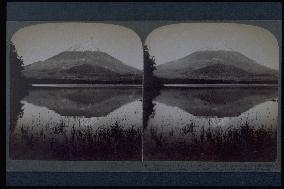
Mt. Fuji topped with snow,seen from Lake Shoji

Mt. Fuji topped with snow,seen from Lake Shoji

Southeastern view of Mt. Fuji from Shojiko, one of the five lakes of Fuji in Yamanashi Prefecture. The mountain is snow-capped and the upside-down Fuji and Mt. Omuro are visible on the lake surface. This was taken by the American stereograph company Underwood & Underwood Co., either in 1896 or between 1903 and 1904.==Date:1904, Place:Yamanashi, Photo:Underwood, (Credit:Nagasaki University Library/Kyodo News Images) [Cabinet Number97‐83‐0]

  •  
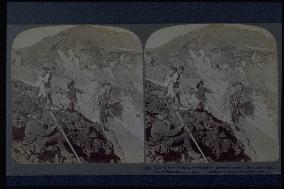
The volcanic crater of Mt. Fuji

The volcanic crater of Mt. Fuji

The summit of Mt. Fuji. There are two craters of different sizes. This was taken from Kusu Shinto Shrine, facing Kengamine. Three climbers are looking at one of the craters. The rock in the centre is Toraiwa, and the cliff of Dainaiin crater is visible. This photograph was taken by the American stereograph company, Underwood & Underwood, either in 1896 or between 1903 and 1904.==Date:1904, Place:Shizuoka Yamanashi, Photo:Underwood, (Credit:Nagasaki University Library/Kyodo News Images) [Cabinet Number97‐80‐0]

  •  
A cargo boat on the Nihonbashi River

A cargo boat on the Nihonbashi River

View of Nihonbashi River looking west, taken from Nihonbashi Bridge. The river is busy with cargo boats. Mt. Fuji was visible from this spot on clear days. The left side of the river is Nishi-gashi (west riverside), and the bridge visible in the far right is Nishi (West) Bridge. This was a transitional period when land transportation was replacing water transportation, but at this time the canal still played a major role in transporting goods. This stereograph was published in 1904 in a book-shaped case.==Date:1904, Place:Tokyo, Photo:Underwood, (Credit:Nagasaki University Library/Kyodo News Images) [Cabinet Number97‐78‐0]

  •  
A cargo carrier

A cargo carrier

Three thousand ryo a day falls where it must. This senryu poem means that everyday people spend three thousand ryo (monetary unit in the Edo Period), one thousand in the fish market in the morning, one thousand in the theatres during the daytime, and one thousand in the Yoshiwara pleasure quarter in the evening. There was a fish market on the east side of the northern edge of Nihonbashi Bridge during the Edo Period. The man in this photograph is selling fish he just bought at the fish market. Probably taken near Nihonbashi. Since there was no refrigeration then, fish had to be sold within a day and people ate fresher fish than today. This stereograph is dated 1904.==Date:1904, Place:Tokyo, Photo:Underwood, (Credit:Nagasaki University Library/Kyodo News Images) [Cabinet Number97‐77‐0]

  •  
Sensoji Temple

Sensoji Temple

This Kannon-do was rebuilt by the third shogun Tokugawa Iemitsu in 1649. The style of construction is koran mitesaki-zukuri. The photograph captures a flock of pigeons flying from Niomon (gate). The building burned down in an air raid on March 10, 1945. The present-day Kannon-do was erected on October 17, 1958. Taken by Herbert George Ponting. Stereograph published in 1904.==Date:1904, Place:Tokyo, Photo:Underwood, (Credit:Nagasaki University Library/Kyodo News Images) [Cabinet Number97‐69‐0]

  •  
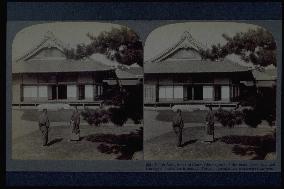
The residence of Okuma Shigenobu

The residence of Okuma Shigenobu

The residence of Okuma Shigenobu in Totsuka Village (present day Totsuka-machi, Shinjuku Ward). The noted statesman lived in a Western-style mansion in Iida-machi (present day Kudan 1-chome) but later moved into the residence of the former lord of the Takamatsu Clan, Matsudaira Yorisato, located next to Tokyo Polytechnic School. After acquiring the house, he made some extensions and modifications and filled in the garden pond shown in photograph #4005. This is a stereograph sold by Underwood & Underwood Co.==Date:1904, Place:Tokyo, Photo:Underwood, (Credit:Nagasaki University Library/Kyodo News Images) [Cabinet Number97‐74‐0]

  •  
The residence of Okuma Shigenobu

The residence of Okuma Shigenobu

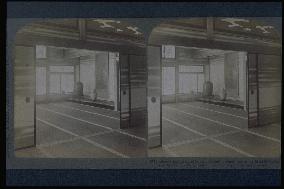
A scroll is hanging in the alcove, and a large vase has been placed in front. When Okuma Shigenobu died in 1922, his house and garden were donated to Waseda University in accordance with his will. The garden is about 33,960 square metres in area. Okuma Hall is now located on the site of the house. The Rihga Royal Hotel Waseda was opened in the northern part of the garden in 1994. This stereograph was published in 1904.==Date:1904, Place:Tokyo, Photo:Underwood, (Credit:Nagasaki University Library/Kyodo News Images) [Cabinet Number97‐73‐0]

  •  
Asakusa Tower and theatres

Asakusa Tower and theatres

Egawa Taiseikan, famous for its girls doing acrobatics on balance balls. Some of the girls are looking out onto the street. Formerly rice paddies owned by Sensoji Temple, the Asakusa Sixth District was filled in with soil from the digging of Oike in 1883 and became the largest entertainment district in Japan after the mid-Meiji Period. The tower in the background is Ryounkaku, also called Asakusa Junikai (Twelve Stories). An introduction to the tower is written on the white signboard to the right. This stereograph dates from 1904.==Date:1904, Place:Tokyo, Photo:Underwood, (Credit:Nagasaki University Library/Kyodo News Images) [Cabinet Number97‐68‐0]

  •  
Bonsai (miniature trees)

Bonsai (miniature trees)

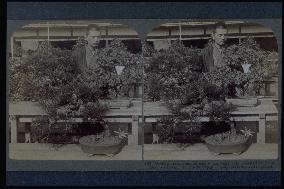
Statesman Okuma Shigenobu obviously liked plants because there were three greenhouses at his residence. A Tokyo magazine reported in 1907 that, There is a second greenhouse attached to the house, with one main room and two annexed rooms containing rare tropical plants. As seen in this photograph, Okuma enjoyed Japanese bonsai as well as tropical plants. This is a stereograph from 1904.==Date:1904, Place:Tokyo, Photo:Underwood, (Credit:Nagasaki University Library/Kyodo News Images) [Cabinet Number97‐71‐0]

  •  
Taiko-bashi (drum) Bridge at Kameido Shrine

Taiko-bashi (drum) Bridge at Kameido Shrine

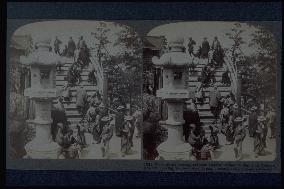
Stereograph published in 1904. Although the bridge is the same as in photographs #5001and #2215, the stone lantern in the foreground is larger. Gentlemen wearing Western-style suits and hats are visible among the worshippers, a sign of the times. Frequently a notice was posted on the parapets urging the elderly, ladies and children not to cross the bridge because of the danger (from Saishin Tokyo Hanjoki published in 1903).==Date:1904, Place:Tokyo, Photo:Underwood, (Credit:Nagasaki University Library/Kyodo News Images) [Cabinet Number97‐66‐0]

  •  
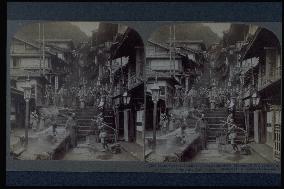
Ikaho Spa

Ikaho Spa

The Ikaho hot spring resort has preserved its old appearance to this day. Two-story inns stand side by side on both sides of the stone stairs leading to the source of the hot spring at Ikaho Shinto Shrine. This is a stereograph that captures the higher part of the town.==Date:1904, Place:Gunma, Photo:Underwood, (Credit:Nagasaki University Library/Kyodo News Images) [Cabinet Number97‐64‐0]

  •  
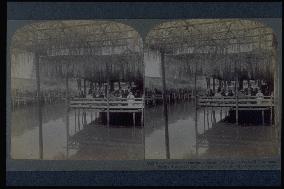
A wisteria trellis at Kameido Shrine

A wisteria trellis at Kameido Shrine

These wisteria terraces were all destroyed during World War II air raids. The wisteria trees of today were planted one by one from around 1950 by the local people. The wisteria blossoms at Kameido Tenjin Shrine are said to be the best in Tokyo, and they were chosen as one of the New Best One Hundred Scenes of Tokyo. This stereograph was published in 1904 in a book-shaped case.==Date:1904, Place:Tokyo, Photo:Underwood, (Credit:Nagasaki University Library/Kyodo News Images) [Cabinet Number97‐67‐0]

  •  
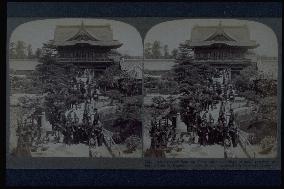
Kameido Shrine

Kameido Shrine

View of the Romon Gate from Taiko-bashi (Drum Bridge) located just through the torii gate at the entrance of the shrine. The five girls in hakama trousers are perhaps praying to pass a school examination. Three bridges span Shinji Pond: Taiko-bashi, Hira-bashi, and Taiko-bashi. They are said to represent the past, present, and future. This stereograph was published in 1904 by Underwood & Underwood Co.==Date:1904, Place:Tokyo, Photo:Underwood, (Credit:Nagasaki University Library/Kyodo News Images) [Cabinet Number97‐65‐0]

  •  
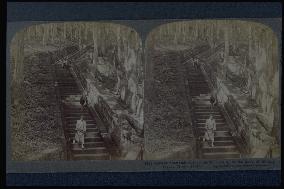
Stone steps on the approach to the Okusha,Toshogu Shrine,Nikko

Stone steps on the approach to the Okusha,Toshogu Shrine,Nikko

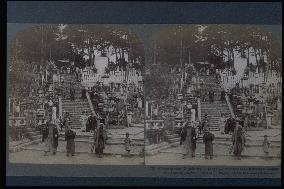
This is a stereograph of the stone steps leading to the Okusha (inner shrine) containing the tomb of Tokugawa Ieyasu. Visitors reach these steps after passing under the famous Nemurineko (sleeping cat) carving in the east corridor of the main hall at Nikko Toshogu and going through Sakashita Gate. Each step is made from a solid slab of stone.==Date:1904, Place:Nikko, Photo:Underwood, (Credit:Nagasaki University Library/Kyodo News Images) [Cabinet Number97‐58‐0]

  •  
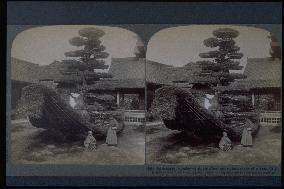
The Land-boat Pine Tree,Kinkakuji Temple

The Land-boat Pine Tree,Kinkakuji Temple

Stereograph of Rikushu-no-matsu (Land Boat Pine) of Rokuonji Temple taken from the west side of the hojo (head priest's quarters), facing west-northwest. It is said that this pine was planted by Yoshimitsu Ashikaga. The branches were formed to look like a boat. On the left is the ohjoin (large study), and the roof of the kuri is visible on the right. Two boys wearing hakama are facing each other. Taken in 1904.==Date:1904, Place:Kyoto, Photo:Underwood, (Credit:Nagasaki University Library/Kyodo News Images) [Cabinet Number97‐41‐0]

  •  
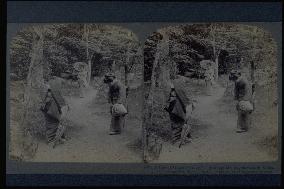
The garden of Kinkakuji Temple

The garden of Kinkakuji Temple

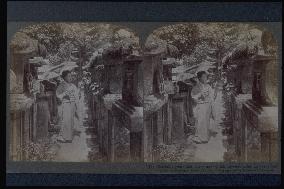
Stereograph depicting two women in kimono on the past to the Rokuonji temple garden. Holding closed Japanese-style parasols, they face each other and bow, exchanging morning greetings. There is another woman further back wearing kimono and holding a parasol. Taken in 1904.==Date:1904, Place:Kyoto, Photo:Underwood, (Credit:Nagasaki University Library/Kyodo News Images) [Cabinet Number97‐40‐0]

  •  
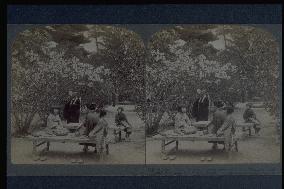
Seeing cherry blossoms in the Imperial Park

Seeing cherry blossoms in the Imperial Park

Stereograph showing people enjoying the cherry blossoms at Nin'naji Temple. A five-story pagoda is visible in the background. Two girls sit facing each other on the platform while enjoying tea. A Buddhist priest is looking at the cherry blossoms. The cherry trees at Nin'naji Temple are of the nioizakura (fragrant cherry) variety. They bloom from the bottom like azaleas and later in the season than other cherry trees. Taken in 1904.==Date:1904, Place:Kyoto, Photo:Underwood, (Credit:Nagasaki University Library/Kyodo News Images) [Cabinet Number97‐38‐0]

  •  
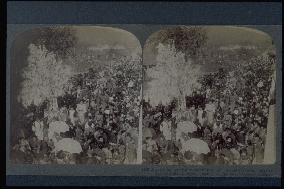
A procession of Shinto carrying the sacrement

A procession of Shinto carrying the sacrement

Stereograph depicting the annual festival at Fushimi Inari Shrine. A procession carrying a sacred image is crossing Kamogawa River at Shichijo Ohashi Bridge. The bridge is busy with people coming and going. The Kyoto Imperial Museum, built in 1895, is visible on the east side of Kamogawa River, but streetcar tracks laid on the bridge in 1913 are not visible. Taken in 1904.==Date:1904, Place:Kyoto, Photo:Underwood, (Credit:Nagasaki University Library/Kyodo News Images) [Cabinet Number97‐34‐0]

  •  
A stone lantern and a woman,Kasuga Shrine

A stone lantern and a woman,Kasuga Shrine

A woman pointing at stone lanterns. The exact location of the photo cannot be determined. However, as there are many stone lanterns, it is definately within shrine precincts. It is a stereograph, and the photo was possibly taken around the same time as catalogue #4957, by the same photographer. The woman is wearing kimono, Japanese-style chignon, and holding a parasol.==Date:1904, Place:Nara, Photo:Underwood, (Credit:Nagasaki University Library/Kyodo News Images) [Cabinet Number97‐25‐0]

  •  
A woman on the jinrikisha,Kasuga Shrine

A woman on the jinrikisha,Kasuga Shrine

This photo captures a scene with a woman on a rickshaw feeding deer. It is hard to pinpoint the exact location, but it is probably the shrine approach of Kasuga Taisha, as stone lanterns are in the background. The woman is wearing kimono, Japanes-style chignon, and is holding a parasol. The rickshaw man is wearing zori sandals and a hat. This is a stereograph.==Date:1904, Place:Nara, Photo:Underwood, (Credit:Nagasaki University Library/Kyodo News Images) [Cabinet Number97‐21‐0]

  •  
A view of the city of Kobe from Mt. Suwa

A view of the city of Kobe from Mt. Suwa

Like #4949 and #4950, this is a stereograph made by the American company Underwood & Underwood. View from Mt. Suwa facing southwest. The cylindrical building on the right is science building of Eiwa Girls School (present-day Kobe Jogakuin School before relocation) completed in 1893. The caption saying that the company obtained the publishing rights in 1904 indicates that the photograph was taken between 1893 and 1904.==Date:1904, Place:Kobe, Photo:Underwood, (Credit:Nagasaki University Library/Kyodo News Images) [Cabinet Number97‐15‐0]

  •  
Stone steps of Kurodani Konkai Komyoji Temple

Stone steps of Kurodani Konkai Komyoji Temple

Stereograph depicting the stairs of Kurodani Komyoji Temple, taken from the stone bridge Gokuraku-bashi. Gravestones flank both sides of the stairs. Worshippers who seem to have finished praying are coming down the stairs. Monju Pagoda rises behind the trees above the stairs. The wooden signboard on the right says Gobyo (Mausoleum) . Taken in 1904.==Date:1904, Place:Kyoto, Photo:Underwood, (Credit:Nagasaki University Library/Kyodo News Images) [Cabinet Number97‐17‐0]

  •  
The Seto Inland Sea seen from Harima

The Seto Inland Sea seen from Harima

Like #4950 and #4951, this is a stereograph made by the American company Underwood & Underwood. It shows the mountains in the western part of Hyogo Prefecture seen from Harima bay. Many foreigners visiting Japan enjoyed the scenery of the Seto Inland Sea while traveling between Nagasaki and Kobe or Osaka. This photograph was taken sometime before 1904.==Date:1904, Place:Kobe, Photo:Underwood, (Credit:Nagasaki University Library/Kyodo News Images) [Cabinet Number97‐13‐0]

  •  
Soribashi bridge at Sumiyoshi Shrine

Soribashi bridge at Sumiyoshi Shrine

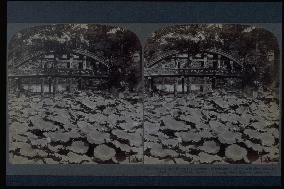
This stereograph depicts Soribashi Bridge and the lotus pond. The parapets of Yorubehashi seem different from those depicted in photograph #4595, indicating that this photograph was taken sometime later. Latter half of the Meiji Period.==Date:1904, Place:Osaka, Photo:Underwood, (Credit:Nagasaki University Library/Kyodo News Images) [Cabinet Number97‐11‐0]

  •  
Bamboo grooves near Kiyomizudera Temple

Bamboo grooves near Kiyomizudera Temple

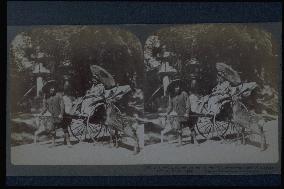
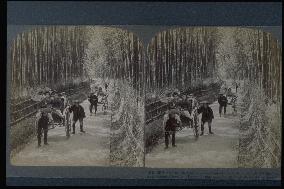
Stereograph depicting rickshaws on the Gojo-zaka slope surrounded by bamboo groves. The two women, one with a parasol, are passengers on the rickshaw pulled by the man with an amigasa hat. Bamboo fencing made of bamboo grass tied to bamboo poles prevents the bamboo from encroaching upon the path. Taken prior to 1909, when the slope was expanded to a width of 7.2 meters. Taken by Herbert G. Ponting in 1904.==Date:1904, Place:Kyoto, Photo:Underwood, (Credit:Nagasaki University Library/Kyodo News Images) [Cabinet Number97‐1‐0]

  •  
A master and his attendants

A master and his attendants

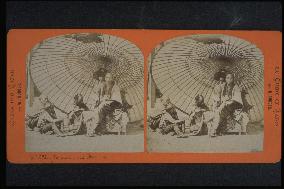
This is a stereograph designed by Wilhelm Burger for the French market entitled China and Japan. A master with one of his geta clogs removed relaxes under a huge umbrella. His servants sit on the ground waiting for him.==Date:unknown, Place:unknown, Photo:Wilhelm Burger, (Credit:Nagasaki University Library/Kyodo News Images) [Cabinet Number70‐23‐0]

  •  
A priest

A priest

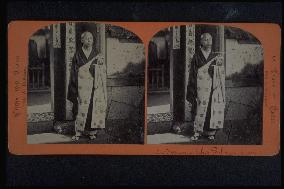
A priest standing in front of a temple gate. He is holding a long fan and wearing a priest's robe and long kesa. This is a stereograph taken in Nagasaki by Wilhelm Burger. A photograph depicting the same scene was taken by F. Beato. Probably taken in the mid-Meiji Period.==Date:unknown, Place:Nagasaki, Photo:Wilhelm Burger, (Credit:Nagasaki University Library/Kyodo News Images) [Cabinet Number70‐27‐0]

  •  
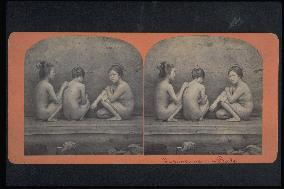
Women taking a bath

Women taking a bath

This stereograph is included in East Asian Series by Wilhelm Burger and captures young women bathing. They are scrubbing their bodies, but the scene appears to be staged.==Date:unknown, Place:unknown, Photo:Wilhelm Burger, (Credit:Nagasaki University Library/Kyodo News Images) [Cabinet Number70‐24‐0]

  •  
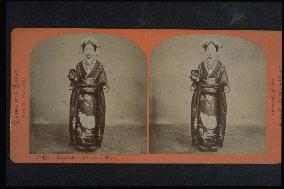
A girl with hair ornaments

A girl with hair ornaments

The woman has her hair arranged in warikarako style (like marumage for married women), with floral hairpins, kogai pins and karako-chirimen crepe on the head. She is wearing a furisode kimono, and the collar of her undergarment is revealed to a considerable degree. This is a stereograph taken in Nagasaki by Wilhelm Burger.==Date:unknown, Place:Nagasaki, Photo:Wilhelm Burger, (Credit:Nagasaki University Library/Kyodo News Images) [Cabinet Number70‐25‐0]

  •  
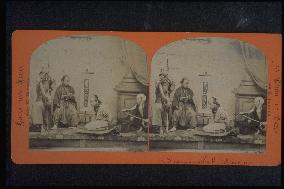
Interrogating a criminal

Interrogating a criminal

This is a stereograph by Wilhelm Burger entitled China and Japan. The German caption reads Scene of a Japanese Trial. This is a staged photograph of a play entitled The Woman Killer taken in a studio in 1868.==Date:unknown, Place:unknown, Photo:Wilhelm Burger, (Credit:Nagasaki University Library/Kyodo News Images) [Cabinet Number70‐19‐0]

  •  
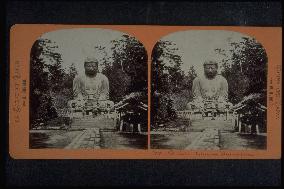
Daibutsu (the Great Buddha) of Kamakura

Daibutsu (the Great Buddha) of Kamakura

This stereograph entitled No.301 Daibuts-Statue in Kamakura is thought to have been taken in the beginning of the Meiji Period because there are bronze lotus petals in front of the statue. The stone paved approach is the same as that in photograph #5372. The monument in the photograph, which carries the inscription Donated Stone Pavement was made in 1780, so it is likely that this stone pavement was laid at the same time.==Date:unknown, Place:Kamakura, Photo:Wilhelm Burger, (Credit:Nagasaki University Library/Kyodo News Images) [Cabinet Number70‐22‐0]

  •  
A priest and samurai warriors

A priest and samurai warriors

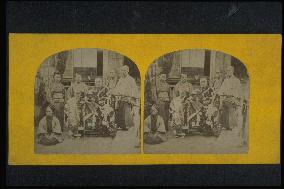
This is a stereograph taken at the end of the Edo Period. On the back is written (in pen), Priest; the Head Priest of the Temple. This was taken by Rossier in the early 1860's, possibly in Nagasaki.==Date:unknown, Place:unknown, Photo:Pierre Rossier, (Credit:Nagasaki University Library/Kyodo News Images) [Cabinet Number70‐11‐0]

  •  
The precincts of Kofukuji Temple

The precincts of Kofukuji Temple

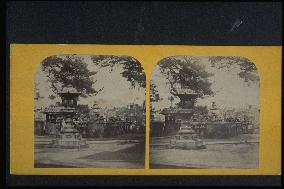
This stereograph captures the bronze lantern at Kofukuji Temple around 1868. When viewed through a special viewer, the two images merge to form a three-dimensional photograph.==Date:unknown, Place:Nagasaki, Photo:Pierre Rossier, (Credit:Nagasaki University Library/Kyodo News Images) [Cabinet Number70‐5‐0]

  •  
The gate to Takanawa Tozenji Temple,the British Legation

The gate to Takanawa Tozenji Temple,the British Legation

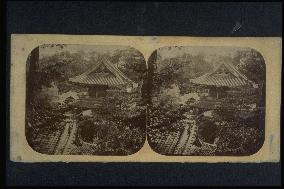
This stereograph bears the caption View taken from the United States Legation, at Yedo and is said to depict Tempukuji Temple in Azabu, but this is incorrect. The temple is actually Tozenji, located in present-day Takanawa 3-chome. The Shogunate concluded a treaty pact with Great Britain (Anglo-Japanese Treaty of Commerce) in 1858, and Tozenji Temple was designated as the site of the British Legation. This was taken by Swiss Pierre Rossier at the end of the Edo Period. This is a side view of the sanmon gate, also seen in photographs #3420 and #3443.==Date:1859, Place:Tokyo, Photo:Pierre Rossier, (Credit:Nagasaki University Library/Kyodo News Images) [Cabinet Number70‐7‐0]

  •  
The bell tower at Kofukuji Temple

The bell tower at Kofukuji Temple

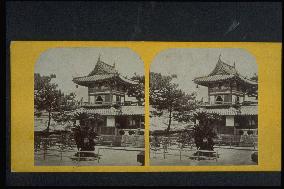
This stereograph captures the bell tower at Kofukuji Temple, taken at the beginning of the Meiji Period. Destroyed by fire in 1663, it was rebuilt in 1691 and repaired in 1730. The building is presently a prefecturally designated Cultural Asset.==Date:unknown, Place:Nagasaki, Photo:Pierre Rossier, (Credit:Nagasaki University Library/Kyodo News Images) [Cabinet Number70‐4‐0]

  •  
Samurai warriors greeting each other

Samurai warriors greeting each other

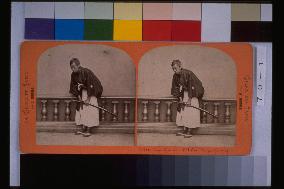
The scene of samurai exchanging greetings is recreated, with the two bowing deeply in the official attire of haori coat with family crest and hakama trousers. The Western-style handrail in the back was a fixture of the Ueno Hikoma studio in Nagasaki, where this stereograph seems to have been taken by Wilhelm Burger.==Date:Middle Meiji (1883-1897), Place:Nagasaki, Photo:Wilhelm Burger, (Credit:Nagasaki University Library/Kyodo News Images) [Cabinet Number70‐1‐0]

  • Main
  • Top
  • Editorial
  • Creative
  • About Us
  • About ILG
  • Terms of use
  • Company
  • BEHIND
  • Price List
  • Single Plan
  • Monthly Plan
  • Services
  • Shooting
  • Rights Clearance
  • Support
  • FAQ
  • How To Buy
  • Contact Us
  • Become a Partner

© KYODO NEWS IMAGES INC

All Rights Reserved.

  • Editorial
  • Olympics
  • News
  • Sports
  • Japan
  • Tech
  • Royal
  • Disaster
  • NorthKorea
  • Old Japan
  • SNS
  • Creative
  • Food
  • Japan
  • Landscape
  • Animal
  • Popular
  • #Ukraine
  • #China
  • #coronavirus
  • #N. Korea
  • #Thailand
  • #Russia
  • #Ukraine
  • #China
  • #coronavirus
  • #N. Korea
  • #Thailand
  • #Russia
  • Food
  • Japan
  • Landscape
  • Animal
  • Olympics
  • News
  • Sports
  • Japan
  • Tech
  • Royal
  • Disaster
  • NorthKorea
  • Old Japan
  • SNS