•  
Tsurugaoka Hachimangu shrine

Tsurugaoka Hachimangu shrine

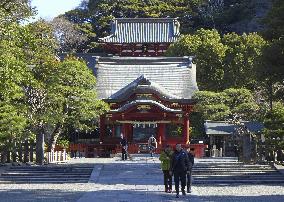
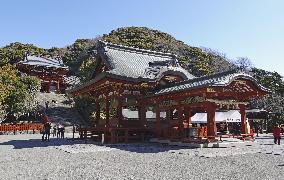
Photo taken on March 13, 2024, shows Tsurugaoka Hachimangu shrine in Kamakura near Tokyo.

  •  
Tsurugaoka Hachimangu shrine

Tsurugaoka Hachimangu shrine

Photo taken on March 13, 2024, shows Tsurugaoka Hachimangu shrine in Kamakura near Tokyo.

  •  
Tsurugaoka Hachimangu shrine

Tsurugaoka Hachimangu shrine

Photo taken on March 13, 2024, shows Tsurugaoka Hachimangu shrine in Kamakura near Tokyo.

  •  
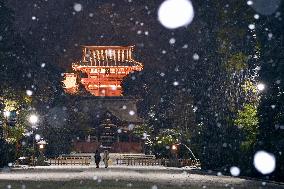
Snowfall in Tokyo region

Snowfall in Tokyo region

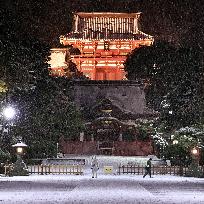
Photo taken on Feb. 5, 2024, shows Tsurugaoka Hachimangu shrine in the snow in Kamakura near Tokyo.

  •  
Snowfall in Tokyo region

Snowfall in Tokyo region

Photo taken on Feb. 5, 2024, shows Tsurugaoka Hachimangu shrine in the snow in Kamakura near Tokyo.

  •  
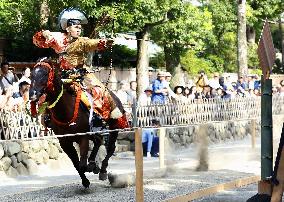
Traditional mounted archery performed in Kamakura, Japan

Traditional mounted archery performed in Kamakura, Japan

KAMAKURA, Japan - An archer on a running horse shoots an arrow at a wooden target at the Tsurugaoka Hachiman-gu shrine in a show of traditional "Yabusame" Japanese archery in Kamakura, southwest of Tokyo, on Sept. 16, 2014. The martial art dates back to the beginning of the Kamakura period some 800 years ago.

  •  
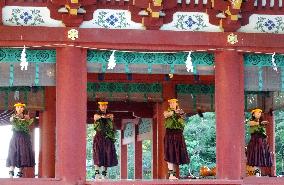
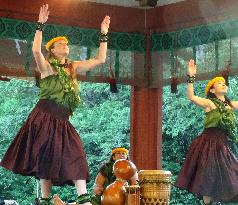
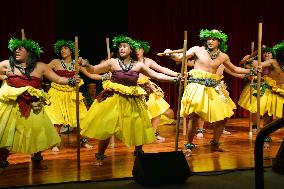
Hula dance performance at Tsurugaoka Hachimangu in Kamakura

Hula dance performance at Tsurugaoka Hachimangu in Kamakura

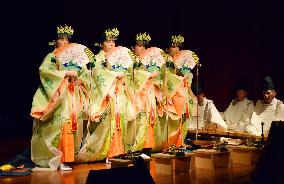
YOKOHAMA, Japan - People from the Hawaiian island of Kauai dance a hula on the Maiden, a stage for dance and music performances, at the Tsurugaoka Hachimangu shrine in Kamakura, Kanagawa Prefecture, south of Tokyo, on May 17, 2014.

  •  
Hula dance performance at Tsurugaoka Hachimangu in Kamakura

Hula dance performance at Tsurugaoka Hachimangu in Kamakura

YOKOHAMA, Japan - People from the Hawaiian island of Kauai dance a hula on the Maiden, a stage for dance and music performances, at the Tsurugaoka Hachimangu shrine in Kamakura, Kanagawa Prefecture, south of Tokyo, on May 17, 2014.

  •  
Buddhist, Shinto joint service for disaster victims

Buddhist, Shinto joint service for disaster victims

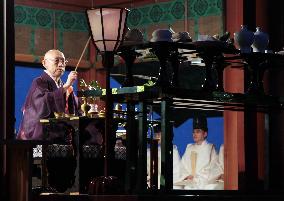
KAMAKURA, Japan - A Buddhist priest (L) conducts a ritual for the victims of the March 11 earthquake and tsunami at a memorial service held jointly by Tsurugaoka Hachimangu Shinto shrine and Todaiji Buddhist temple in Kamakura, Kanagawa Prefecture, on June 12, 2011. On the right are Shinto priests taking part in the rite.

  •  
Interfaith gathering after disaster

Interfaith gathering after disaster

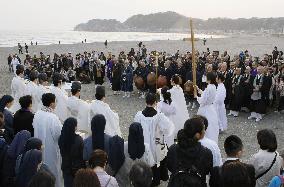
KAMAKURA, Japan - People associated with Shinto, Buddhism and Christianity pray to calm the sea at the Yuigahama beach in Kamakura, Kanagawa Prefecture, on April 11, 2011, a month after the March 11 quake and tsunami disaster. They gathered at the Tsurugaoka Hachimangu shrine in the city the same day to pray for disaster victims and recovery.

  •  
Interfaith gathering after disaster

Interfaith gathering after disaster

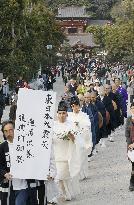
KAMAKURA, Japan - Shinto priests and Buddhist monks walk to a beach while soliciting donations for quake and tsunami relief from the Tsurugaoka Hachimangu shrine in Kamakura, Kanagawa Prefecture, on April 11, 2011, a month after the historic earthquake and tsunami disaster. They gathered at the shrine the same day to pray for victims of the March 11 earthquake and tsunami and recovery from the disaster.

  •  
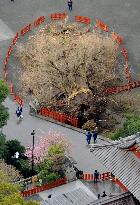
Ginkgo tree at Tsurugaoka Hachimangu falls down

Ginkgo tree at Tsurugaoka Hachimangu falls down

TOKYO, Japan - A ginkgo tree, believed to be 1,000 years old, in the premises of the Tsurugaoka Hachimangu shrine in Kamakura, Kanagawa Prefecture, is seen fallen down on March 10, 2010. A security guard found the fallen-down tree, which was some 30 meters high and 6.8 meters around, at around 4:40 a.m. after hearing a sound like a thunderbolt.

  •  
Ginkgo tree at Tsurugaoka Hachimangu falls down

Ginkgo tree at Tsurugaoka Hachimangu falls down

TOKYO, Japan - A ginkgo tree, believed to be 1,000 years old, in the premises of the Tsurugaoka Hachimangu shrine in Kamakura, Kanagawa Prefecture, is seen fallen down on March 10, 2010. A security guard found the fallen-down tree, which was some 30 meters high and 6.8 meters around, at around 4:40 a.m. after hearing a sound like a thunderbolt.

  •  
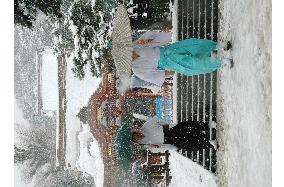
45 hurt, traffic disrupted as snow hits central, eastern Japan

45 hurt, traffic disrupted as snow hits central, eastern Japan

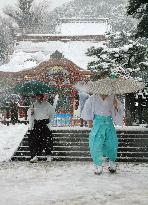
KAMAKURA, Japan - Two priests walk in the snow-coated premises of Tsurugaoka Hachimangu Shrine in Kamakura, south of Tokyo, on Feb. 3. At least 45 people were injured in Tokyo and Chiba Prefecture and traffic was disrupted as a low-pressure system heading east-northeast dumped heavy snow in wide areas of the Pacific side of central and eastern Japan.

  •  
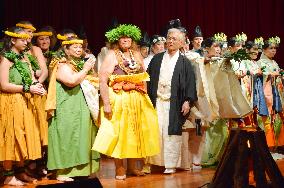
Shinto dance, hula jointly performed in Honolulu

Shinto dance, hula jointly performed in Honolulu

Photo taken Oct. 7, 2015, in Honolulu, Hawaii, shows performers of a traditional hula (L) and Shinto music and dance from Japan's Tsurugaoka Hachimangu shrine in the ancient city of Kamakura, near Tokyo, (R). They have continued exchanges for the past seven years. (Kyodo) ==Kyodo

  •  
Shinto dance, hula jointly performed in Honolulu

Shinto dance, hula jointly performed in Honolulu

Photo taken Oct. 7, 2015, in Honolulu, Hawaii, shows a performance of a traditional hula. The performance was also joined by Shinto music and dance from Japan's Tsurugaoka Hachimangu shrine in the ancient city of Kamakura, near Tokyo. (Kyodo) ==Kyodo

  •  
Shinto dance, hula jointly performed in Honolulu

Shinto dance, hula jointly performed in Honolulu

Photo taken Oct. 7, 2015, in Honolulu, Hawaii, shows a performance of Shinto music and dance from Japan's Tsurugaoka Hachimangu shrine in an old city of Kamakura, near Tokyo. The performance was also joined by a group of dancers of a traditional hula. (Kyodo) ==Kyodo

  •  
45 hurt, traffic disrupted as snow hits central, eastern Japan

45 hurt, traffic disrupted as snow hits central, eastern Japan

KAMAKURA, Japan - Two priests walk in the snow-coated premises of Tsurugaoka Hachimangu Shrine in Kamakura, south of Tokyo, on Feb. 3. At least 45 people were injured in Tokyo and Chiba Prefecture and traffic was disrupted as a low-pressure system heading east-northeast dumped heavy snow in wide areas of the Pacific side of central and eastern Japan. (Kyodo)

  •  
The Kaguraden and honden (inner sanctuary),Tsurugaoka Hachimangu Shrine

The Kaguraden and honden (inner sanctuary),Tsurugaoka Hachimangu Shrine

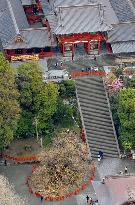
On the left is the Kaguraden of Tsurugaoka Hachimangu (lower hall of worship). At the top of the stairs is the main shrine of Hachimangu. There are 62 steps in total. The Hachimangu that Yoritomo moved from Tsurugaoka is said to have been located under the staircase, but it was burned in a fire in 1193 and moved to the present higher location in November of the same year. The building on the left is the Kaguraden. The woman standing in front is probably visiting the shrine for worship.==Date:unknown, Place:Kamakura, Photo:Ogawa Kazumasa, (Credit:Nagasaki University Library/Kyodo News Images) [Cabinet Number10‐16‐0]

  •  
A mikoshi (portable shrine) of Tsurugaoka Hachimangu Shrine

A mikoshi (portable shrine) of Tsurugaoka Hachimangu Shrine

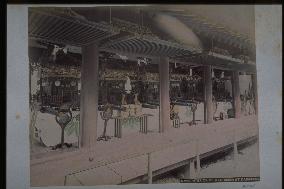
Interior view of the kairo (cloister) of the Upper Shrine. The cloister was rebuilt in 1828 and is now a National Important Cultural Asset. A beautiful design is painted under the eaves. Renovated in the beginning of the Showa Period, this building remains as a valuable source of information about the designs used from the Edo Period. The mikoshi (portable shrines) were made during the Momoyama or Edo Period, and seven of them remain as Prefectural Tangible Ethnological Assets.==Date:unknown, Place:Kamakura, Photo:unknown, (Credit:Nagasaki University Library/Kyodo News Images) [Cabinet Number93‐41‐0]

  •  
Tsurugaoka Hachimangu Shrine

Tsurugaoka Hachimangu Shrine

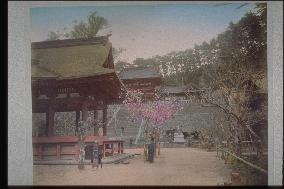
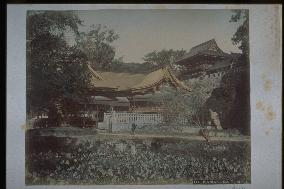
View of Wakamiya Shrine from the east. The Jogu Romon (upper shrine gate) and cloister are visible above. The roof thatched with bark shingles was rebuilt in 1624. The upper shrine, constructed in the early Edo Period, was destroyed by fire in 1821 and reconstructed with a bronze roof in 1828. Wakamiya Shrine and Jogu Romon are both Important Cultural Assets. The date of the photograph is unknown.==Date:unknown, Place:Kamakura, Photo:unknown, (Credit:Nagasaki University Library/Kyodo News Images) [Cabinet Number93‐36‐0]

  •  
A lotus pond at Tsurugaoka Hachimangu Shrine

A lotus pond at Tsurugaoka Hachimangu Shrine

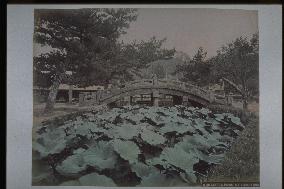
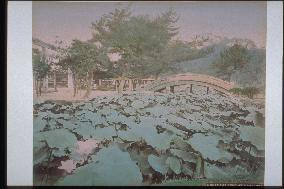
The photograph is labeled A B6 LOTUS POND AT KAMAKURA. Date unknown. View of the stone bridge from the east. The Sanno-torii (Third Gate) is visible behind the building on the left. This bridge is mentioned in books from the Edo Period. It was referred to as Akahashi (Red Bridge). There is a wooden bridge behind it. The stone bridge was destroyed by the Great Kanto Earthquake of 1923.==Date:unknown, Place:Kamakura, Photo:unknown, (Credit:Nagasaki University Library/Kyodo News Images) [Cabinet Number93‐40‐0]

  •  
Tsurugaoka Hachimangu Shrine

Tsurugaoka Hachimangu Shrine

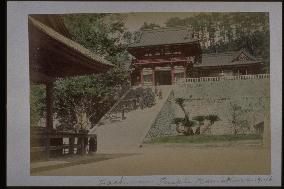
The photograph bears the handwritten label Hachiman Temple Kamakura 92-16. A group of students is descending the stairs. The area at the bottom of the stairs resembles that in a photograph owned by the Abe family (former feudal lords of the Fukuyama Clan) taken around 1893, indicating that this photograph was taken between 1887 and 1892.==Date:unknown, Place:Kamakura, Photo:unknown, (Credit:Nagasaki University Library/Kyodo News Images) [Cabinet Number92‐16‐0]

  •  
Tsurugaoka Hachimangu Shrine

Tsurugaoka Hachimangu Shrine

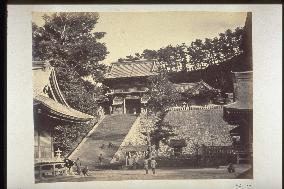
No tablet is visible on the Jogu Romon (upper shrine gate). Although the stone stairs remain in front of the Kaguraden on the left, the shitomi (storm door) on the side and mune (junction at the top of the roof) have been removed, indicating that this photograph was taken soon after the demolition of the buildings.==Date:unknown, Place:Kamakura, Photo:unknown, (Credit:Nagasaki University Library/Kyodo News Images) [Cabinet Number87‐29‐0]

  •  
A lotus pond at Tsurugaoka Hachimangu Shrine

A lotus pond at Tsurugaoka Hachimangu Shrine

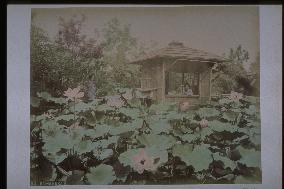
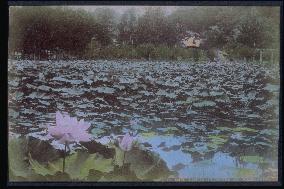
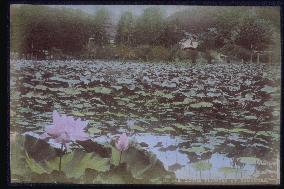
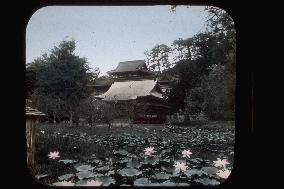
There is a delicate-looking hut in the middle of the pond brimming with lotus leaves and flowers. Aside from the label B6 KAMAKURA at the bottom, there is little in the photograph to prove that this is indeed the pond at Tsurugaoka Hachimangu Shrine.==Date:unknown, Place:Kamakura, Photo:unknown, (Credit:Nagasaki University Library/Kyodo News Images) [Cabinet Number85‐17‐0]

  •  
Tsurugaoka Hachimangu Shrine

Tsurugaoka Hachimangu Shrine

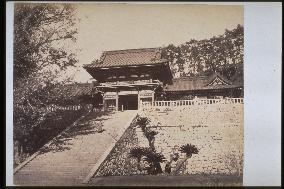
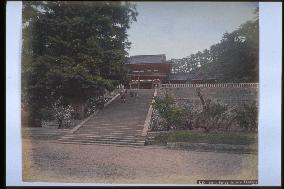
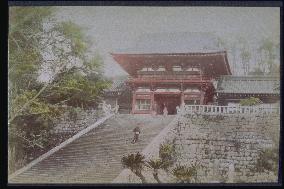
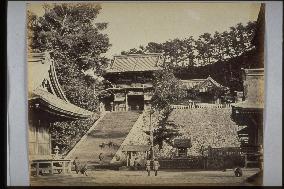
Labeled L17 HACHIMAN(B), the photograph depicts the Jogu Romon (upper shrine gate). The tablet on the gate reads Hachiman-gu. Since the view from the bottom of the stairs is similar to that in a photograph taken in 1893 and no artillery monument can be seen, this photograph is thought to have been taken between 1887 and 1892.==Date:unknown, Place:Kamakura, Photo:A. Farsari, (Credit:Nagasaki University Library/Kyodo News Images) [Cabinet Number82‐17‐0]

  •  
Tsurugaoka Hachimangu Shrine

Tsurugaoka Hachimangu Shrine

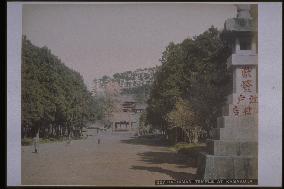
The stone lantern in the foreground was donated by the sugar wholesalers of Edo in 1862, and it still stands at present. A wooden torii gate stands in the centre, and behind it are the Kaguraden and the Jogu Romon (upper shrine gate). An illustration in the February 11, 1865 issue of The Illustrated London News and the art of Renjo Shimooka indicate that the Niomon gate at the torii existed until the end of the Edo Period. This photograph may have been taken around the beginning of the Meiji Period.==Date:unknown, Place:Kamakura, Photo:unknown, (Credit:Nagasaki University Library/Kyodo News Images) [Cabinet Number80‐19‐0]

  •  
Tsurugaoka Hachimangu Shrine

Tsurugaoka Hachimangu Shrine

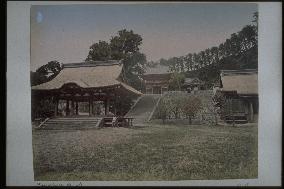
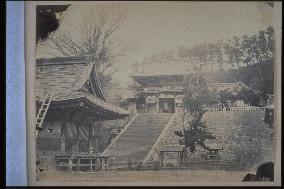
A pattern similar to that in photograph #4749 is visible under the eave of the Jogu Romon (upper shrine gate). The cleansing basin is located on the right side, at the foot of the stone stairs. Kora-Myojin Shrine is behind it. Neither were in existence after the first years of the Meiji Period. The absence of a tablet on the Romon gate of the upper shrine and the time-worn appearance of the Kaguraden roof indicate that this was taken around the same time as photograph #3073.==Date:unknown, Place:Kamakura, Photo:R. Stillfried, (Credit:Nagasaki University Library/Kyodo News Images) [Cabinet Number78‐12‐0]

  •  
Tsurugaoka Hachimangu Shrine

Tsurugaoka Hachimangu Shrine

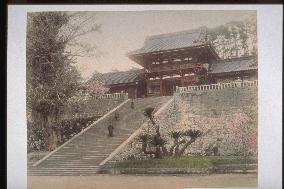
This is part of the Ogawa Kazumasa (1860-1929) Collection. Ogawa was born in the Oshi district (present-day Gyoda City in Saitama Prefecture). He later ran a photographic printing business. Although it is not clear when he visited Kamakura, the details depicted indicate that the photograph was taken around the same time as photograph #4674, or between 1887 and 1892.==Date:unknown, Place:Kamakura, Photo:Ogawa Kazumasa, (Credit:Nagasaki University Library/Kyodo News Images) [Cabinet Number67‐33‐0]

  •  
Himeishi Daimyojin Shrine

Himeishi Daimyojin Shrine

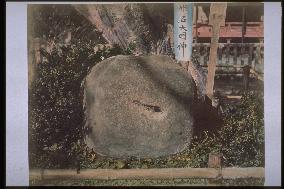
The photograph and mount bear the labels Himeishi Daimyojin and ..at the Temple of KAMAKURA respectively. An illustrated map from the year 1850 shows the Himeishi (Princess Stone) in the Tsurugaoka Hachimangu Shrine precincts. It also resembles, in terms of its shape and markings, the Masakoishi (Masako Stone) located today on Benten Island in the shrine pond, but the exact details are unclear. This photograph may be the work of Stillfried. The date is unknown.==Date:unknown, Place:Kamakura, Photo:unknown, (Credit:Nagasaki University Library/Kyodo News Images) [Cabinet Number64‐76‐0]

  •  
A shrine in Kamakura

A shrine in Kamakura

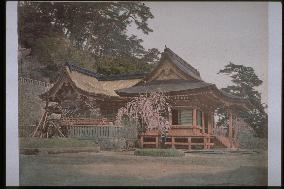
Wakamiya Shrine is also depicted in photograph #4744. Tsurugaoka Hachiman-gu Shrine was established at the site of present-day Wakamiya Shrine in 1180. The building in this photograph is the one rebuilt in 1624 and now registered as an Important Cultural Asset. Thatched previously with bark shingles, the roof was covered in bronze after the Great Kanto Earthquake of 1923. This photograph may have been taken by Stillfried.==Date:unknown, Place:Kamakura, Photo:unknown, (Credit:Nagasaki University Library/Kyodo News Images) [Cabinet Number64‐45‐0]

  •  
The Kaguraden and honden (inner sanctuary),Tsurugaoka Hachimangu Shrine

The Kaguraden and honden (inner sanctuary),Tsurugaoka Hachimangu Shrine

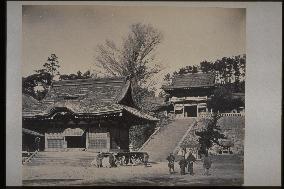
The building on the left seems to the Rinzo (sutra repository), which was later demolished. Since there is no tablet visible on the Romon gate and the square foundation stones are placed next to the Kaguraden, this photograph is thought to have been taken around 1870 when the temple buildings were demolished. Taken by Felix Beato.==Date:unknown, Place:Kamakura, Photo:F. Beato, (Credit:Nagasaki University Library/Kyodo News Images) [Cabinet Number62‐32‐0]

  •  
The honden (inner sanctuary),Tsurugaoka Hachimangu Shrine

The honden (inner sanctuary),Tsurugaoka Hachimangu Shrine

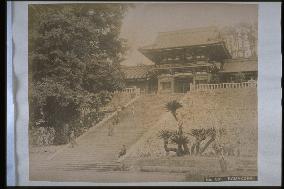
Labeled No. 1025. Shinto Temple Hachiman Kamakura, this was taken around the same time as photograph #4674. Unlike the appearance of this spot today, only a few cycad trees are growing on the raised terrace under the stone wall.==Date:unknown, Place:Kamakura, Photo:unknown, (Credit:Nagasaki University Library/Kyodo News Images) [Cabinet Number61‐25‐0]

  •  
Tsurugaoka Hachimangu Shrine

Tsurugaoka Hachimangu Shrine

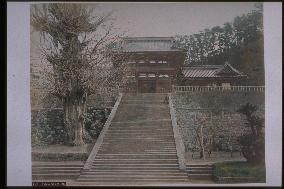
The photograph is labeled No. 531 KAMAKURA. The huge gingko tree (presently designated as a Natural Monument by Kanagawa Prefecture) famous for the legend of the assassination of the third shogun, Minamoto Sanetomo (1192-1219), is on the left. A cycad tree is growing on the opposite side. The date is the same as that of photograph #4674.==Date:unknown, Place:Kamakura, Photo:unknown, (Credit:Nagasaki University Library/Kyodo News Images) [Cabinet Number59‐79‐0]

  •  
Wakamiya-sha,Tsurugaoka Hachimangu Shrine

Wakamiya-sha,Tsurugaoka Hachimangu Shrine

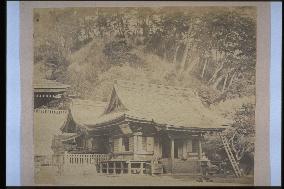
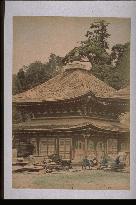
A fire ladder is leaning against the roof of the Wakamiya Shrine. The Kagura-den roof visible next to the shrine is slightly damaged. A photograph in the September 1st, 1871 issue of The Far East shows the temple in a similar condition immediately following the demolition of buildings. Consequently, this photograph was probably taken around the same time.==Date:unknown, Place:Kamakura, Photo:unknown, (Credit:Nagasaki University Library/Kyodo News Images) [Cabinet Number59‐7‐0]

  •  
Tsurugaoka Hachimangu Shrine

Tsurugaoka Hachimangu Shrine

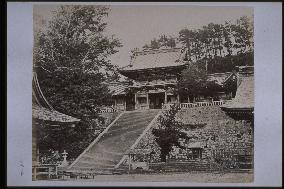
The words Hachimangu-ji (Hachiman Shrine Temple) are inscribed on the tablet at the Jogu Romon (upper shrine gate). Tsurugaoka-Hachiman Shrine was a combination Shinto shrine and Buddhist temple until the end of the Edo period in 1868, when the temple was abolished in response to a government edict. This photograph was probably taken just before the temple buildings were removed.==Date:unknown, Place:Kamakura, Photo:unknown, (Credit:Nagasaki University Library/Kyodo News Images) [Cabinet Number55‐19‐0]

  •  
Approach to Tsurugaoka Hachimangu Shrine

Approach to Tsurugaoka Hachimangu Shrine

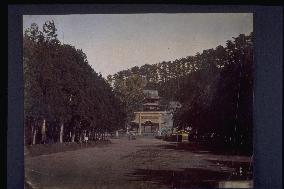
Tsurugaoka Hachimangu and San-no-Torii(The 3rd torii gate) is located behind. The road extended toward shrine is Dankazura.==Date:unknown, Place:Kamakura, Photo:unknown, (Credit:Nagasaki University Library/Kyodo News Images) [Cabinet Number55‐17‐0]

  •  
A lotus pond at Tsurugaoka Hachimangu Shrine

A lotus pond at Tsurugaoka Hachimangu Shrine

This is the same as photograph #2253. Date unknown. It is said to be the work of Tamamura Kozaburo (1856-?), a resident of Yokohama during the Meiji Period who identified himself as a photographer and retailer of photographic prints. His shop was located at Benten-dori 1-chome (present-day Naka Ward, Yokohama City). The dates of his visits and association with Kamakura are not known.==Date:unknown, Place:Kamakura, Photo:Tamamura Kozaburo, (Credit:Nagasaki University Library/Kyodo News Images) [Cabinet Number48‐132‐0]

  •  
A lotus pond at Tsurugaoka Hachimangu Shrine

A lotus pond at Tsurugaoka Hachimangu Shrine

The photograph is labeled No.53B. LOTUS FLOWERS AT KAMAKURA. A wooden torii gate is visible on the right. The red building on the left is Wakamiya, indicating that the building above it is the Jogu cloister. The riding trail said to have surrounded the pond during the Meiji Period is not evident in this photograph. This photograph is included in the Tamamura Kozaburo Collection. The date of the photograph is not known.==Date:unknown, Place:Kamakura, Photo:Tamamura Kozaburo, (Credit:Nagasaki University Library/Kyodo News Images) [Cabinet Number48‐106‐0]

  •  
Tsurugaoka Hachimangu Shrine

Tsurugaoka Hachimangu Shrine

Two artillery monuments are visible at the base of the stone wall. Although absent in the 1893 collection of the Abe family (lords of the former Fukuyama Clan), these monuments appear in a copper-plate print of Kamakura made in 1896, indicating that they were installed to commemorate victory in the Sino-Japanese War. The photograph was probably taken, therefore, sometime after 1893. This photograph is included in the Collection of Tamamura Kozaburo (1856-?).==Date:unknown, Place:Kamakura, Photo:Tamamura Kozaburo, (Credit:Nagasaki University Library/Kyodo News Images) [Cabinet Number48‐93‐0]

  •  
Tsurugaoka Hachimangu Shrine

Tsurugaoka Hachimangu Shrine

Tsurugaoka Hachimangu Shrine==Date:unknown, Place:Kamakura, Photo:unknown, (Credit:Nagasaki University Library/Kyodo News Images)

  •  
A lotus pond at Tsurugaoka Hachimangu Shrine

A lotus pond at Tsurugaoka Hachimangu Shrine

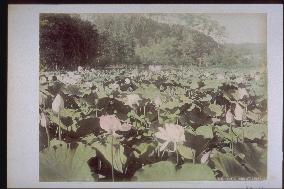
The lotuses of the Tsurugaoka Hachimangu bloom filling the photo, and a mountain can be seen to the rear. A torii can be seen faintly to the right rear.==Date:unknown, Place:Kamakura, Photo:Kusakabe Kinbei, (Credit:Nagasaki University Library/Kyodo News Images) [Cabinet Number40‐12‐0]

  •  
Tsurugaoka Hachimangu Shrine

Tsurugaoka Hachimangu Shrine

The Tsurugaoka Hachimangu seen from the Wakamiyaoji. The main building can be seen in the distance, and trees grow on both sides.==Date:unknown, Place:Kamakura, Photo:unknown, (Credit:Nagasaki University Library/Kyodo News Images) [Cabinet Number37‐67‐0]

  •  
Tsurugaoka Hachimangu Shrine

Tsurugaoka Hachimangu Shrine

Tsurugaoka Hachimangu is a shrine in Yukinoshita, Kamakura. It was built by Minamoto Yoritomo in 1180. The main building and corridor are built on the stone foundation, and part of the hall is seen below. (Identical to the photo numbered 36-14.)==Date:unknown, Place:Kamakura, Photo:F. Beato, (Credit:Nagasaki University Library/Kyodo News Images) [Cabinet Number36‐14‐0]

  •  
A lotus pond at Tsurugaoka Hachimangu Shrine

A lotus pond at Tsurugaoka Hachimangu Shrine

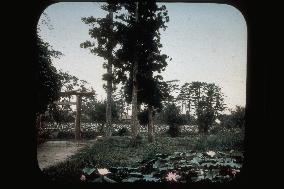
The lotus pond of Tsurugaoka Hachimangu Shrine. Three large trees stand in the centre, and to their left is a torii.==Date:unknown, Place:Kamakura, Photo:unknown, (Credit:Nagasaki University Library/Kyodo News Images) [Cabinet Number31‐36‐0]

  •  
A lotus pond at Tsurugaoka Hachimangu Shrine

A lotus pond at Tsurugaoka Hachimangu Shrine

The lotus pond at Tsurugaoka Hachimangu Shrine stretches in the front and the hall can be seen beyond the pond. In the distance a small portion of the main building can be seen a step above.==Date:unknown, Place:Kamakura, Photo:unknown, (Credit:Nagasaki University Library/Kyodo News Images) [Cabinet Number31‐13‐0]

  •  
The honden (inner sanctuary),Tsurugaoka Hachimangu Shrine

The honden (inner sanctuary),Tsurugaoka Hachimangu Shrine

Tsurugaoka Hachimangu is a shrine in Yukinoshita, Kamakura. Minamoto Yoritomo built the shrine in 1180. Over the stone walls is the main building and corridor, and a step below is seen part of the hall to the right and left. (Same as the photo numbered 36-14)==Date:unknown, Place:Kamakura, Photo:F. Beato, (Credit:Nagasaki University Library/Kyodo News Images) [Cabinet Number28‐14‐0]

  •  
A lotus pond at Tsurugaoka Hachimangu Shrine

A lotus pond at Tsurugaoka Hachimangu Shrine

The flowers in the lotus pond at Tsurugaoka Hachimangu Shrine fill the picture. To the right rear is a stone bridge over the pond, and a large tree stands by it.==Date:unknown, Place:Kamakura, Photo:Ogawa Kazumasa, (Credit:Nagasaki University Library/Kyodo News Images) [Cabinet Number25‐28‐0]

  •  
Pricincts of tsurugaoka hachimangu shrine

Pricincts of tsurugaoka hachimangu shrine

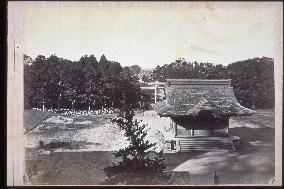
The hall of Tsurugaoka Hachimangu Shrine with thatched roofing stands to the right, and a torii can be seen in the distance one step below. A lotus pond is at the left rear, and beyond that is a forest.==Date:unknown, Place:Kamakura, Photo:unknown, (Credit:Nagasaki University Library/Kyodo News Images) [Cabinet Number24‐41‐0]

  •  
A block of a temple

A block of a temple

This may be the Rinzo of Tsurugaoka Hachimangu which was removed as a result of the separation of Shintoism and Buddhism. The Rinzo was located to the left of the Kagura hall, and scriptures were stored there. The dismantling has begun, and lumber is piled up nearby.==Date:unknown, Place:unknown, Photo:unknown, (Credit:Nagasaki University Library/Kyodo News Images) [Cabinet Number13‐28‐0]

  • Main
  • Top
  • Editorial
  • Creative
  • About Us
  • About ILG
  • Terms of use
  • Company
  • BEHIND
  • Price List
  • Single Plan
  • Monthly Plan
  • Services
  • Shooting
  • Rights Clearance
  • Support
  • FAQ
  • How To Buy
  • Contact Us
  • Become a Partner

© KYODO NEWS IMAGES INC

All Rights Reserved.

  • Editorial
  • Olympics
  • News
  • Sports
  • Japan
  • Tech
  • Royal
  • Disaster
  • NorthKorea
  • Old Japan
  • SNS
  • Creative
  • Food
  • Japan
  • Landscape
  • Animal
  • Popular
  • #Ukraine
  • #Russia
  • #coronavirus
  • #N. Korea
  • #China
  • #Thailand
  • #Ukraine
  • #Russia
  • #coronavirus
  • #N. Korea
  • #China
  • #Thailand
  • Food
  • Japan
  • Landscape
  • Animal
  • Olympics
  • News
  • Sports
  • Japan
  • Tech
  • Royal
  • Disaster
  • NorthKorea
  • Old Japan
  • SNS