•  
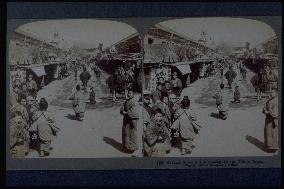
Asakusa-dori Avenue

Asakusa-dori Avenue

Like photograph #2276, this is a northern view from the entrance of Nakamise, the present location of Kaminarimon (Thunder Gate). The shopping area between Kaminarimon and Niomon is called Nakamise. Legend has it that the priests of Sensoji Temple asked the local people to keep the temple grounds clean and in return gave them permission to set up shops there. Buildings of brick construction were erected in 1885 in imitation of the Ginza Street. Probably taken around 1896.==Date:1904, Place:Tokyo, Photo:Underwood, (Credit:Nagasaki University Library/Kyodo News Images) [Cabinet Number97‐99‐0]

  •  
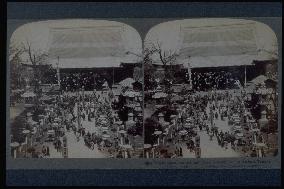
Sensoji Temple

Sensoji Temple

This Kannon-do was rebuilt by the third shogun Tokugawa Iemitsu in 1649. The style of construction is koran mitesaki-zukuri. The photograph captures a flock of pigeons flying from Niomon (gate). The building burned down in an air raid on March 10, 1945. The present-day Kannon-do was erected on October 17, 1958. Taken by Herbert George Ponting. Stereograph published in 1904.==Date:1904, Place:Tokyo, Photo:Underwood, (Credit:Nagasaki University Library/Kyodo News Images) [Cabinet Number97‐69‐0]

  •  
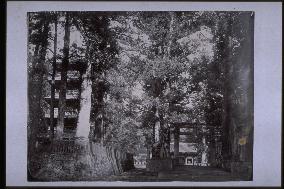
The approach to Toshogu Shrine,Nikko

The approach to Toshogu Shrine,Nikko

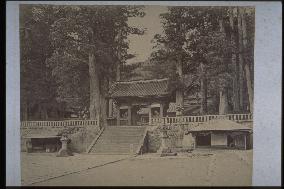
The precincts of Toshogu Shrine are viewed from the Omote-sando approach. The five-story pagoda is on the left, while the stone torii is in the right foreground. The Omotemon (Niomon) is visible in the back. Passing through the gate, visitors enter the dazzling world of Nikko Toshogu, replete with opulent works of art and architectural wonders.==Date:unknown, Place:Nikko, Photo:R. Stillfried, (Credit:Nagasaki University Library/Kyodo News Images) [Cabinet Number96‐101‐0]

  •  
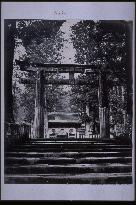
The torii,Taiyuin Shrine,Nikko

The torii,Taiyuin Shrine,Nikko

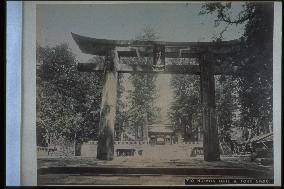
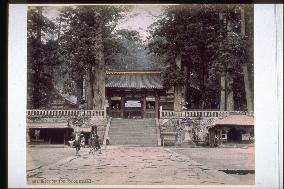
This is the stone torii gate dedicated by Kuroda Nagamasa at the front gate (Niomon) to Toshogu Shrine in Nikko. It is nine meters tall, and the pillars are 1.2 metres in diameter. This is the largest granite torii gate in Japan. Today a plaque with the words Tosho Daigongen written by Emperor Gomizuno'o is affixed to the gate, but it is not visible in this photograph.==Date:unknown, Place:Tokyo, Photo:R. Stillfried, (Credit:Nagasaki University Library/Kyodo News Images) [Cabinet Number96‐103‐0]

  •  
The Karamon Gate,Taiyuin Shrine,Nikko

The Karamon Gate,Taiyuin Shrine,Nikko

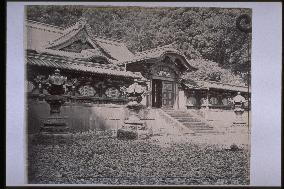
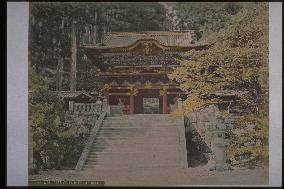
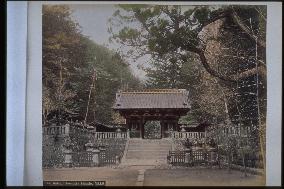
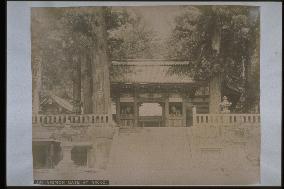
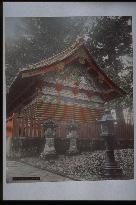
This is Karamon (Chinese Gate) at Taiyuin, the mausoleum of the third shogun Tokugawa Iemitsu. Taiyuin is the posthumous Buddhist name of Iemitsu conferred by Emperor Gokomyo. The gates at Taiyuin are Niomon, then Nitenmon, then Yashamon, and finally Karamon. Karamon is 3m tall and has a 1.8-meter wide facade. It is the smallest structure in the precinct. However, the gate is embellished with elaborate craftsmanship, creating a graceful and sophisticated atmosphere.==Date:unknown, Place:Nikko, Photo:unknown, (Credit:Nagasaki University Library/Kyodo News Images) [Cabinet Number96‐99‐0]

  •  
The Todaimon(Niomon)Gate, Ishiyama-dera Temple

The Todaimon(Niomon)Gate, Ishiyama-dera Temple

The Todaimon(Niomon)Gate, Ishiyama-dera Temple==Date:about 1875, Place:Shiga, Photo:R. Stillfried, (Credit:Nagasaki University Library/Kyodo News Images)

  •  
The Jogyo-do and the Hokke-do,Rinnoji Temple

The Jogyo-do and the Hokke-do,Rinnoji Temple

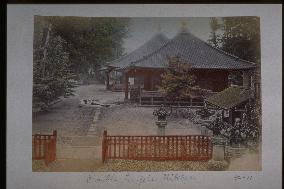
Hokkedo (foreground) and Jogyodo are viewed from in front of Niomon Gate at Taiyuin. The buildings connected by outside corridor, called Futatsudo (the two shrines), are examples of a rare style seen only at Rinoji Temple and Mt. Hiei. Amida-nyorai and Madarajin are enshrined at Jogyodo, while Fugen-bosatsu, Kishimojin and Jurasetsu-nyo are enshrined at Hokkedo.==Date:unknown, Place:Nikko, Photo:unknown, (Credit:Nagasaki University Library/Kyodo News Images) [Cabinet Number92‐11‐0]

  •  
The front entrance to Toshogu Shrine,Nikko

The front entrance to Toshogu Shrine,Nikko

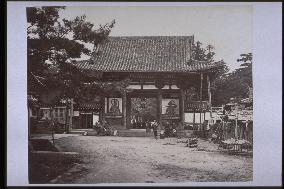
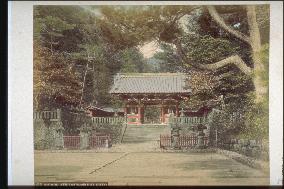
This gate was called Niomon because statues of the Nio guardian deities were placed there until 1871, when Shinto and Buddhism were officially separated and the statues were transferred to Taiyuin Mausoleum. Subsequently, the gate was called Omotemon (Front Gate). The chrysanthemum banner hanging at the gate hides the komainu (guardian dogs), if they are in fact there.==Date:unknown, Place:Nikko, Photo:unknown, (Credit:Nagasaki University Library/Kyodo News Images) [Cabinet Number91‐25‐0]

  •  
The Karamon Gate,Taiyuin Shrine,Nikko

The Karamon Gate,Taiyuin Shrine,Nikko

This is Karamon (Chinese Gate) at Taiyuin, the mausoleum of the third shogun Tokugawa Iemitsu. Taiyuin is the posthumous Buddhist name of Iemitsu conferred by Emperor Gokomyo. The gates at Taiyuin are Niomon, then Nitenmon, then Yashamon, and finally Karamon. Karamon is 3m tall and has a 1.8-meter wide facade. It is the smallest structure in the precinct. However, the gate is embellished with elaborate craftsmanship, creating a graceful and sophisticated atmosphere.==Date:unknown, Place:Nikko, Photo:unknown, (Credit:Nagasaki University Library/Kyodo News Images) [Cabinet Number90‐41‐0]

  •  
The Nitenmon Gate,Taiyuin Shrine,Nikko

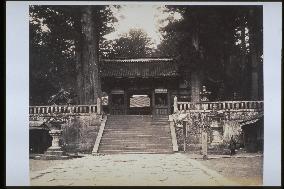
The Nitenmon Gate,Taiyuin Shrine,Nikko

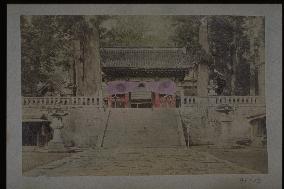
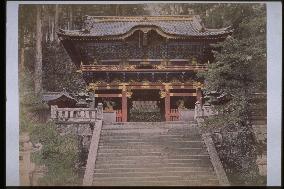
Nitenmon is located beyond Niomon in the precincts of Taiyuin, the mausoleum of third shogun Tokugawa Iemitsu. A plaque inscribed with the word Taiyuin by Emperor Gomizunoo is affixed to the upper part of the gate. Two of the four celestial guardians, Jikokuten and Komokuten, are enshrined at the front part of the gate while the other two, Fujin and Raijin, were placed on the back . This is the largest gate at Nikko-Sannai.==Date:unknown, Place:Nikko, Photo:unknown, (Credit:Nagasaki University Library/Kyodo News Images) [Cabinet Number88‐21‐0]

  •  
The Nitenmon Gate,Taiyuin Shrine,Nikko

The Nitenmon Gate,Taiyuin Shrine,Nikko

Nitenmon is located beyond Niomon in the precincts of Taiyuin, the mausoleum of third shogun Tokugawa Iemitsu. A plaque inscribed with the word Taiyuin by Emperor Gomizunoo is affixed to the upper part of the gate. Two of the four celestial guardians, Jikokuten and Komokuten, are enshrined at the front part of the gate while the other two, Fujin and Raijin, were placed on the back . This is the largest gate at Nikko-Sannai.==Date:unknown, Place:Nikko, Photo:unknown, (Credit:Nagasaki University Library/Kyodo News Images) [Cabinet Number87‐22‐0]

  •  
Niomon Gate,Taiyuin Shrine,Nikko

Niomon Gate,Taiyuin Shrine,Nikko

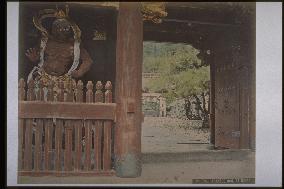
The Niomon stands at the entrance to Taiyuin, the mausoleum of third shogun Tokugawa Iemitsu. Taiyuin is the posthumous name bequeathed by Emperor Gokomyo after Iemitsu's death. The gate is 3.2m high and is protected by the two Nio statues Mitsushaku Kongo and Naraen Kongo, the latter being visible here.==Date:unknown, Place:Nikko, Photo:A. Farsari, (Credit:Nagasaki University Library/Kyodo News Images) [Cabinet Number82‐43‐0]

  •  
Niomon Gate,Taiyuin Shrine,Nikko

Niomon Gate,Taiyuin Shrine,Nikko

The Niomon stands at the entrance to Taiyuin, the mausoleum of third shogun Tokugawa Iemitsu. Taiyuin is the posthumous name bequeathed by Emperor Gokomyo after Iemitsu's death. The gate is 3.2m high and is protected by the two Nio statues Mitsushaku Kongo and Naraen Kongo, the latter being visible here.==Date:unknown, Place:Nikko, Photo:A. Farsari, (Credit:Nagasaki University Library/Kyodo News Images) [Cabinet Number82‐42‐0]

  •  
The Nitenmon Gate,Taiyuin Shrine,Nikko

The Nitenmon Gate,Taiyuin Shrine,Nikko

Nitenmon is located beyond Niomon in the precincts of Taiyuin, the mausoleum of third shogun Tokugawa Iemitsu. A plaque inscribed with the word Taiyuin by Emperor Gomizunoo is affixed to the upper part of the gate. Two of the four celestial guardians, Jikokuten and Komokuten, are enshrined at the front part of the gate while the other two, Fujin and Raijin, were placed on the back . This is the largest gate at Nikko-Sannai.==Date:unknown, Place:Nikko, Photo:Tamamura Kozaburo, (Credit:Nagasaki University Library/Kyodo News Images) [Cabinet Number80‐47‐0]

  •  
The god of wind at Niomon Gate,Taiyuin Shrine,Nikko

The god of wind at Niomon Gate,Taiyuin Shrine,Nikko

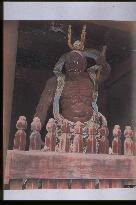
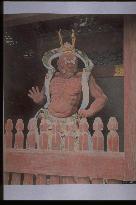
Naraen-Kongo is one of the two Nio (guardian deities) at Niomon, the entrance gate to Taiyuin. Taiyuin is both the posthumous name give to third shogun Tokugawa Iemitsu by Emperor Gokomyo and the name of his mausoleum. The other Nio statue is Mitsushaku-Kongo.==Date:unknown, Place:Nikko, Photo:Tamamura Kozaburo, (Credit:Nagasaki University Library/Kyodo News Images) [Cabinet Number80‐46‐0]

  •  
Tsurugaoka Hachimangu Shrine

Tsurugaoka Hachimangu Shrine

The stone lantern in the foreground was donated by the sugar wholesalers of Edo in 1862, and it still stands at present. A wooden torii gate stands in the centre, and behind it are the Kaguraden and the Jogu Romon (upper shrine gate). An illustration in the February 11, 1865 issue of The Illustrated London News and the art of Renjo Shimooka indicate that the Niomon gate at the torii existed until the end of the Edo Period. This photograph may have been taken around the beginning of the Meiji Period.==Date:unknown, Place:Kamakura, Photo:unknown, (Credit:Nagasaki University Library/Kyodo News Images) [Cabinet Number80‐19‐0]

  •  
The Sanmon Gate at Sensoji Temple

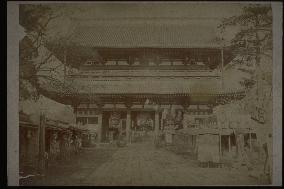
The Sanmon Gate at Sensoji Temple

The sanmon (front gate) at Sensoji Temple was called Niomon because statues of the guardian deities Kongo Rikishi were installed on both the right and left (present-day Hozomon). Statues of Monju Bosatsu (Manjusri Bodhisattva) and Shiten (four angels) are installed on the second floor of the gate building. The plaque Sensoji is based on calligraphy by the head priest of the Tendai Sect, Ryosho Hoshin-o. This photograph was taken before brick buildings were erected in the Nakamise commercial area in 1885.==Date:unknown, Place:Tokyo, Photo:unknown, (Credit:Nagasaki University Library/Kyodo News Images) [Cabinet Number72‐123‐0]

  •  
The front entrance to Toshogu Shrine,Nikko

The front entrance to Toshogu Shrine,Nikko

This gate was called Niomon because statues of the Nio guardian deities were placed there until 1871, when Shinto and Buddhism were officially separated and the statues were transferred to Taiyuin Mausoleum. Subsequently, the gate was called Omotemon (Front Gate). The chrysanthemum banner hanging at the gate hides the komainu (guardian dogs), if they are in fact there.==Date:unknown, Place:Nikko, Photo:unknown, (Credit:Nagasaki University Library/Kyodo News Images) [Cabinet Number71‐19‐0]

  •  
The front entrance to Toshogu Shrine,Nikko

The front entrance to Toshogu Shrine,Nikko

This gate was called Niomon because statues of the Nio guardian deities were placed there until 1871, when Shinto and Buddhism were officially separated and the statues were transferred to Taiyuin Mausoleum. Subsequently, the gate was called Omotemon (Front Gate). Until the Nio statues were returned in 1897, the komainu (guardian dogs), previously in the back, were placed in front as seen in this photograph.==Date:unknown, Place:Nikko, Photo:Ogawa Kazumasa, (Credit:Nagasaki University Library/Kyodo News Images) [Cabinet Number67‐43‐0]

  •  
Sensoji Temple

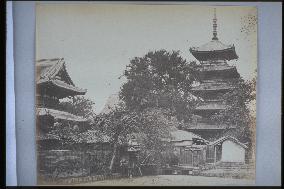
Sensoji Temple

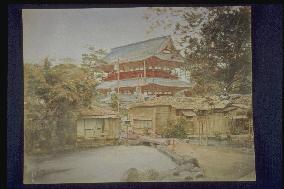
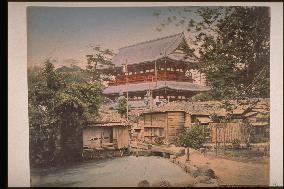
The five-story pagoda and Niomon (gate) seen from Benten Pond. Taken by Felix Beato, this is one of the oldest existing photographs of Sensoji Temple. Benten Shinto Shrine dedicated to the deity Benzaiten is simpler and looks slightly different from the one portrayed in photographs #2414 and 4440. The one in this photograph is older. Legend has it that the huge gingko tree in the centre grew from a pair of chopsticks left behind by Minamoto Yoritomo. The tree unfortunately perished in the air raids of 1945.==Date:unknown, Place:Tokyo, Photo:F. Beato, (Credit:Nagasaki University Library/Kyodo News Images) [Cabinet Number62‐34‐0]

  •  
The Nitenmon Gate,Taiyuin Shrine,Nikko

The Nitenmon Gate,Taiyuin Shrine,Nikko

Nitenmon is located beyond Niomon in the precincts of Taiyuin, the mausoleum of third shogun Tokugawa Iemitsu. A plaque inscribed with the word Taiyuin by Emperor Gomizunoo is affixed to the upper part of the gate. Two of the four celestial guardians, Jikokuten and Komokuten, are enshrined at the front part of the gate while the other two, Fujin and Raijin, were placed on the back . This is the largest gate at Nikko-Sannai.==Date:unknown, Place:Nikko, Photo:unknown, (Credit:Nagasaki University Library/Kyodo News Images) [Cabinet Number61‐22‐0]

  •  
Stone steps up to Mt. Maya

Stone steps up to Mt. Maya

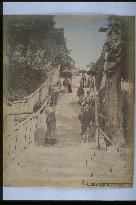
One of the major temples of the Shingon Sect of Buddhism, Butsumo Mayasan Toritenjoji Temple was located on the hillside of Mt. Maya (alt. 700m). The main hall, Bunin-do, and Ema-do (the building on the upper left) stood about 400 steps up from the niomon gate. This photograph was taken around the same time as photograph #2802 (Odaki Waterfall of Nunobiki).==Date:unknown, Place:Kobe, Photo:unknown, (Credit:Nagasaki University Library/Kyodo News Images) [Cabinet Number56‐22‐0]

  •  
Asakusa Kannon Shrine seen from the twelve-level Ryounkaku,Asakusa

Asakusa Kannon Shrine seen from the twelve-level Ryounkaku,Asakusa

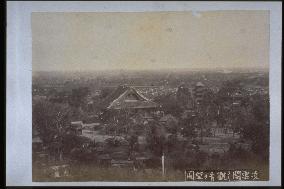
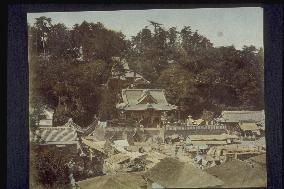
Sensoji Temple seen from Ryounkaku. There are many photographs of Ryounkaku, but few photographs were taken from that building. Kannon-do is in the centre, with the five-story pagoda and Niomon (gate) to the right. The area in front and to the left of Kannon-do was commonly called Okuyama. Street performers made presentations there. The building in the left foreground is Hana Yashiki (Flower House). The five-story Okuyamakaku (Ho'okaku) is visible. This was probably taken soon after the construction of Ryounkaku in 1890.==Date:unknown, Place:Tokyo, Photo:unknown, (Credit:Nagasaki University Library/Kyodo News Images) [Cabinet Number55‐38‐3]

  •  
The Niomon Gate,Taiyuin Shrine,Nikko

The Niomon Gate,Taiyuin Shrine,Nikko

The Niomon Gate,Taiyuin Shrine,Nikko==Date:unknown, Place:Nikko, Photo:unknown, (Credit:Nagasaki University Library/Kyodo News Images)

  •  
The front entrance to Toshogu Shrine,Nikko

The front entrance to Toshogu Shrine,Nikko

This gate was called Niomon after the statues of Nio guardians placed here until 1871, when Shintoism and Buddhism were separated. After the statues were transferred to Taiyuin, the gate came to be called Omotemon (Front Gate). Before 1897, when the Nio statues were re-installed, the komainu (guardian dogs), formerly at the back, were placed in front as shown here.==Date:unknown, Place:Nikko, Photo:unknown, (Credit:Nagasaki University Library/Kyodo News Images) [Cabinet Number54‐22‐0]

  •  
The Kamijinko (sacred storehouse),Toshogu Shrine,Nikko

The Kamijinko (sacred storehouse),Toshogu Shrine,Nikko

The Shimojinko, built in wedge-log style, is the first building visible to the right after Omotemon (Niomon) at Nikko Toshogu. Shimojinko is one of three storage buildings, along with Kamijinko and Nakajinko. The costumes for the 1000 Samurai Procession Festival and other accessories are stored in these buildings.==Date:unknown, Place:Nikko, Photo:unknown, (Credit:Nagasaki University Library/Kyodo News Images) [Cabinet Number54‐19‐0]

  •  
Niomon Gate and the torii,Taiyuin Shrine, Nikko

Niomon Gate and the torii,Taiyuin Shrine, Nikko

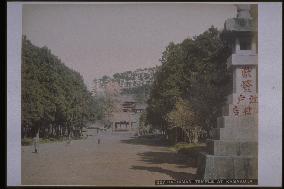
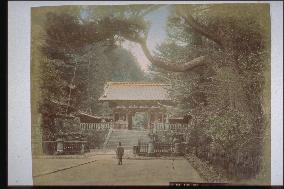
The great torii gate at the entrance to Nikko Toshogu Shrine is seen with Omotemon in the background. Visitors arrived here from the Omote-sando approach. The torii gate was donated by Kuroda Echizennokami Nagamasa in 1618. Nine metres high, it is the largest stone torii gate built during the Edo Period. Situated just to the left, outside the photograph, is the five-story pagoda.==Date:unknown, Place:Nikko, Photo:unknown, (Credit:Nagasaki University Library/Kyodo News Images) [Cabinet Number54‐9‐0]

  •  
The front entrance to Toshogu Shrine,Nikko

The front entrance to Toshogu Shrine,Nikko

Omotemon is viewed from the open space in front of the five-story pagoda. This gate was called Niomon because statues of the Nio guardian deities were placed there until 1871, when Shinto and Buddhism were officially separated and the statues were transferred to Taiyuin Mausoleum. Subsequently, the gate was called Omotemon (Front Gate). Until the Nio statues were returned in 1897, the komainu (guardian dogs), previously in the back, were placed in front as seen in this photograph.==Date:unknown, Place:Nikko, Photo:unknown, (Credit:Nagasaki University Library/Kyodo News Images) [Cabinet Number53‐30‐0]

  •  
The Two Venerable Images of Buddha,Sensoji Temple

The Two Venerable Images of Buddha,Sensoji Temple

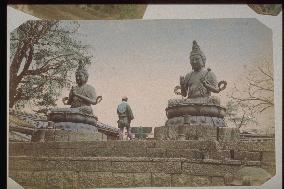
These two statues were built by Takase Zenbei of Tatebayashi by order of Ota Kyuemon Masayoshi and donated to Sensoji Temple in 1687. Standing 2.5 meters tall including the lotus base, the statues are usually referred to as Nurebotoke (Wet Buddha). They survived the Great Earthquake of 1923 and also the air raids of 1945, but the Main Hall, Niomon, and Sutra Repository were all destroyed in the latter.==Date:unknown, Place:Tokyo, Photo:unknown, (Credit:Nagasaki University Library/Kyodo News Images) [Cabinet Number51‐40‐0]

  •  
Nakamise-dori Street,Asakusa

Nakamise-dori Street,Asakusa

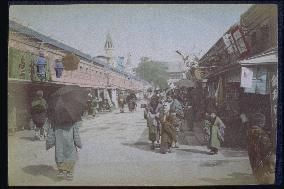
Niomon (present-day Hozomon) is visible in the centre at the entrance to Asakusa Nakamise. The shop on the left is Bairindo, which sold grilled rice cakes. The towers on the left and right are Kyoeikan and Baien, respectively, both early retail stores. Otaki Katsusaburo opened Kyoeikan in 1894. The clock tower had disappeared by the time of the construction of an extension in 1921. Taken around 1897.==Date:unknown, Place:Tokyo, Photo:Tamamura Kozaburo, (Credit:Nagasaki University Library/Kyodo News Images) [Cabinet Number48‐129‐0]

  •  
The main approach to Toshogu Shrine,Nikko

The main approach to Toshogu Shrine,Nikko

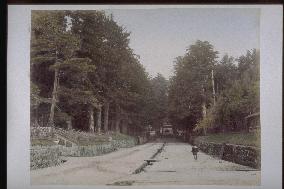
The Omote-sando approach to Nikko Toshogu is viewed from Nakayama Street. The ditch in the centre no longer exists. At the end of the approach is Toshogu. The stone torii and Omotemon (Niomon) can be seen in the cedar grove. The Hyakumonozoroe Sennin Gyoretsu (1,000 Samurai Procession Festival) passes along this approach. The Sanbutsu-do of Rinoji Temple is to the left.==Date:unknown, Place:Nikko, Photo:unknown, (Credit:Nagasaki University Library/Kyodo News Images) [Cabinet Number47‐23‐0]

  •  
The Todaimon (Niomon) Gate, Ishiyama-dera Temple

The Todaimon (Niomon) Gate, Ishiyama-dera Temple

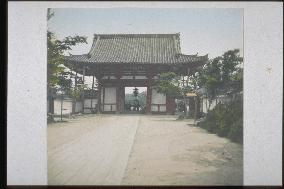
The photo was taken from within the temple, but several people can be seen under the gate.==Date:unknown, Place:Shiga, Photo:unknown, (Credit:Nagasaki University Library/Kyodo News Images) [Cabinet Number46‐151‐0]

  •  
Niomon gate of sensoji temple

Niomon gate of sensoji temple

The view of the eastern gate of Sensoji from the back. There are two statues by the gate, but these were formerly the statues of Toyoiwamanomikoto and Kushiiwamanomikoto, but were changed to statues of Zochoten and Jikokuten from the abolishment of the mixture of Buddhist and Shinto deities.==Date:unknown, Place:Tokyo, Photo:unknown, (Credit:Nagasaki University Library/Kyodo News Images) [Cabinet Number37‐43‐0]

  •  
Naritasan Shinshoji Temple

Naritasan Shinshoji Temple

In the center of the photo is the Naritasen Shinshoji Temple Niomon Gate. The main hall (former main hall and present-day Shaka-do) can be seen encircled by trees.==Date:unknown, Place:Narita, Photo:unknown, (Credit:Nagasaki University Library/Kyodo News Images) [Cabinet Number37‐29‐0]

  •  
The Niomon Gate,Taiyuin Shrine,Nikko

The Niomon Gate,Taiyuin Shrine,Nikko

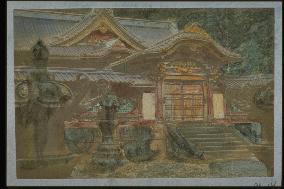
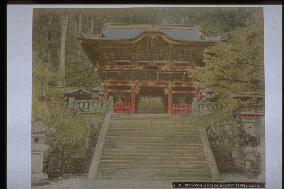
The front gate of Daiyuin, which enshrines the tomb of the Shogun Iemitsu, is called Niomon because a pair of Kongo Rikishi statues are placed in it. It resembles the front gate of Toshogu, with an eight-legged and red-painted gate, but it is done in Buddhist style rather than in a mixture of Shinto and Buddhist styles as in Toshogu. Daiyuin is solemn with its red, black and gold colouring.==Date:unknown, Place:Nikko, Photo:Ogawa Kazumasa, (Credit:Nagasaki University Library/Kyodo News Images) [Cabinet Number8‐8‐0]

  •  
The Niomon Gate,Taiyuin Shrine,Nikko

The Niomon Gate,Taiyuin Shrine,Nikko

The front gate of the Daiyuin which enshrines the tomb of the Shogun Tokugawa Iemitsu has a pair of Kongorikishi statues, and is called Niomon. It is very similar to the front gate of Toshogu and is painted red with 8 legs, but it is done in Buddhist style, contrary to the Toshogu which is done in a mixed style of Shintoism and Buddhism. Daiyuin has a solemn appearance with red, black and gold used.==Date:unknown, Place:Nikko, Photo:Ogawa Kazumasa, (Credit:Nagasaki University Library/Kyodo News Images) [Cabinet Number7‐5‐0]

  •  
The front entrance to Toshogu Shrine,Nikko

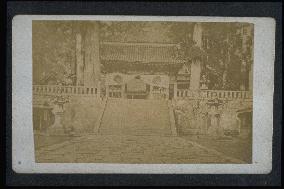
The front entrance to Toshogu Shrine,Nikko

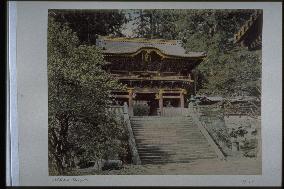
Going through the Ichino Torii from the Omote Sando (front approach), visitors see the red painted Toshogu front gate above the stone steps. At present, the Nio statue is placed to the left and right of the front, and Komainu (Korean dog) to the right and left of the rear. The front is done in the style of a temple, and the back in the style of a shrine. Under the Shintoism Buddhism division order issued in 1871, the front statue of Nio was moved to the back of Niomon of Daiyuin, and for a time the Komainu were placed in the front. The caption says Ichinomon instead of Niomon.==Date:4th - 30th year of Meiji, Place:Nikko, Photo:Ogawa Kazumasa, (Credit:Nagasaki University Library/Kyodo News Images) [Cabinet Number6‐26‐0]

  •  
Niomon gate of sensoji temple

Niomon gate of sensoji temple

The Nio Gate (Hozomon) in Sensoji Temtle surrounded by trees. This photo was taken from Benten Poud (see serial photo number 4-11) to the south east. The back of the Nisonbotoke can be seen in front of the gate. The edge of Benten Pond and the bridge leading to Nakamise can be seen to the left.==Date:unknown, Place:Tokyo, Photo:Kusakabe Kinbei, (Credit:Nagasaki University Library/Kyodo News Images) [Cabinet Number4‐10‐0]

  • Main
  • Top
  • Editorial
  • Creative
  • About Us
  • About ILG
  • Terms of use
  • Company
  • BEHIND
  • Price List
  • Single Plan
  • Monthly Plan
  • Services
  • Shooting
  • Rights Clearance
  • Support
  • FAQ
  • How To Buy
  • Contact Us
  • Become a Partner

© KYODO NEWS IMAGES INC

All Rights Reserved.

  • Editorial
  • Olympics
  • News
  • Sports
  • Japan
  • Tech
  • Royal
  • Disaster
  • NorthKorea
  • Old Japan
  • SNS
  • Creative
  • Food
  • Japan
  • Landscape
  • Animal
  • Popular
  • #Ukraine
  • #Thailand
  • #coronavirus
  • #N. Korea
  • #Russia
  • #China
  • #Ukraine
  • #Thailand
  • #coronavirus
  • #N. Korea
  • #Russia
  • #China
  • Food
  • Japan
  • Landscape
  • Animal
  • Olympics
  • News
  • Sports
  • Japan
  • Tech
  • Royal
  • Disaster
  • NorthKorea
  • Old Japan
  • SNS