•  
Bridge crossing ceremony at Japan shrine

Bridge crossing ceremony at Japan shrine

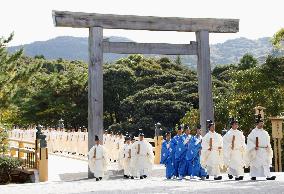
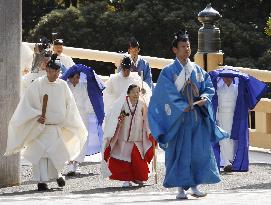
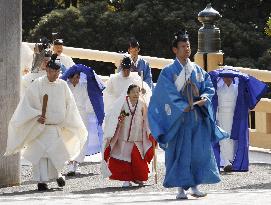
ISE, Japan - People wearing traditional Japanese outfits cross the Uji Bridge at Ise Shrine that was renewed for the first time in 20 years during a ceremonial walk event in Ise, Mie Prefecture, on Nov. 3, 2009.

  •  
Bridge crossing ceremony at Japan shrine

Bridge crossing ceremony at Japan shrine

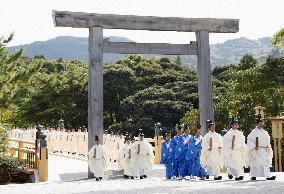
ISE, Japan - People wearing traditional Japanese outfits cross the Uji Bridge at Ise Shrine that was renewed for the first time in 20 years during a ceremonial walk event in Ise, Mie Prefecture, on Nov. 3, 2009.

  •  
New attire for Kyoto ''Aoi Matsuri'' unveiled

New attire for Kyoto ''Aoi Matsuri'' unveiled

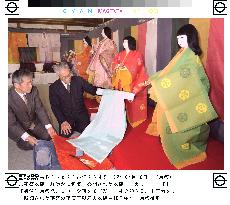
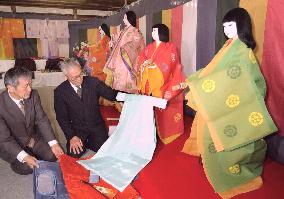
KYOTO, Japan - New attire to be worn by participants in Kyoto's annual ''Aoi Matsuri (festival)'' in May are on display at the Kyoto Imperial Palace on April 19. On May 15, some 500 participants, dressed like nobles in the Heian period (794-1185), take part in a procession that makes its way across the city's Aoi Bridge to Shimo-Gamo Shrine and then to Kami-Gamo Shrine.

  •  
New attire for Kyoto ''Aoi Matsuri'' unveiled

New attire for Kyoto ''Aoi Matsuri'' unveiled

KYOTO, Japan - New attire to be worn by participants in Kyoto's annual ''Aoi Matsuri (festival)'' in May are on display at the Kyoto Imperial Palace on April 19. On May 15, some 500 participants, dressed like nobles in the Heian period (794-1185), take part in a procession that makes its way across the city's Aoi Bridge to Shimo-Gamo Shrine and then to Kami-Gamo Shrine.

  •  
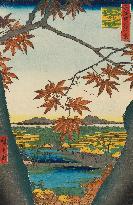
Maple Trees at Mama, Tetona shrine and Linked bridge

Maple Trees at Mama, Tetona shrine and Linked bridge

Utagawa Hiroshige print of Mama no moniji tekona no yashiro tsugihashi - Maple Trees at Mama, Tetona shrine and Linked bridge from the 'One Hundred Famous Views of Edo' series.

  •  
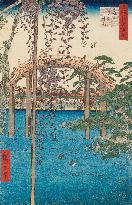
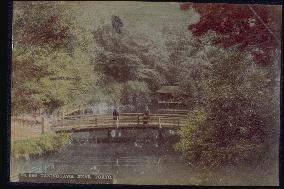
Drum bridge at Kameido Tenjin Shrine

Drum bridge at Kameido Tenjin Shrine

Utagawa Hiroshige print of Drum bridge at Kameido Tenjin Shrine. Inside Kameido Tenjin Shrine. Part of the 'One Hundred Famous Views of Edo' series.

  •  
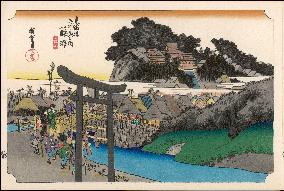
Hiroshige - 53 Stations of the Tokaido - Print 7

Hiroshige - 53 Stations of the Tokaido - Print 7

7 Fujisawa - The village by the edge of a stream, and a bridge leading to it, over which people are passing. In background, overlooking the village on a wooded hill, above the mists, stands the temple Yugi-o-ji; in the foreground a torii, and close to it four blind men following each other by the bank of the stream. This station was crowded with pilgrims visiting the famous temple at this station, and the neighbouring shrine. The imposing buildings of Yugyoji Temple (established in 1325) stand on a hillside in the background. The torii (archway) leads to the Enoshima Benten Shrine which is dedicated to the Goddess of Music. Utagawa Hiroshige (1797 - 1858). The Fifty-Three Stations of the Tokaido - Hoeido edition (1831-4) Date: 1831 - 1834

  •  
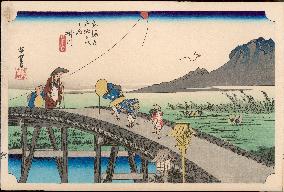
Hiroshige - 53 Stations of the Tokaido - Print 27

Hiroshige - 53 Stations of the Tokaido - Print 27

27 Kakegawa - Travellers crossing a high trestle-bridge over the Kake River, two of them peering into the water below, and behind a small boy watching a kite up in the air, while beyond another, with broken string, flutters to earth. Peasants transplanting rice in the flooded fields, and in the distance Mount Akiba rising above the mists. A shrine standing on the top of a mountain near this station attracted worshippers from all over Japan who came to pray for protection against the calamity of fire. An old couple of travellers are struggling against a strong wind as they toil to cross the arched bridge. A naughty boy is following them with a mocking gesture. Utagawa Hiroshige (1797 - 1858). The Fifty-Three Stations of the Tokaido - Hoeido edition (1831-4) Date: 1831 - 1834

  •  
Security in Ise-Shima area tightens ahead of G-7 summit

Security in Ise-Shima area tightens ahead of G-7 summit

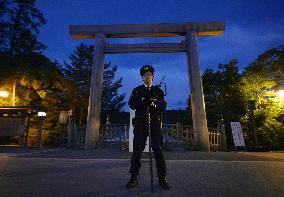
A police officer stands guard in front of the "torii" gate at the entrance of the Uji Bridge in the Ise Jingu shrine in Ise, Mie Prefecture, central Japan, on May 11, 2016. Ahead of the Ise-Shima summit of the Group of Seven industrialized nations taking place on May 26 and 27, officials have enforced around-the-clock security around the shrine, a site the leaders will visit during their stay. (Kyodo) ==Kyodo

  •  
Arched bridge lit up

Arched bridge lit up

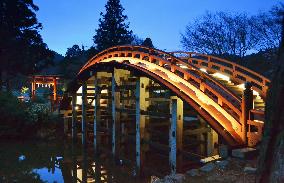
An arched bridge in the world heritage-listed Niutsuhime Shrine in the western Japan town of Katsuragi is lit up on a trial basis on April 4, 2016, ahead of Japan's Golden Week holidays from late April to early May. (Kyodo) ==Kyodo

  •  
Ise Grand Shrine a place of "appreciation" at Ise-Shima summit

Ise Grand Shrine a place of "appreciation" at Ise-Shima summit

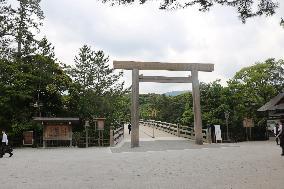
Photo taken May 25, 2016, shows the torii gate entrance at Kotaijingu, the inner shrine, leading across Uji Bridge at Ise Grand Shrine in Ise, Mie Prefecture. The most venerable shrine in Japan, it is dedicated to Amaterasu Omikami, the mythical ancestral sun goddess of the Imperial family. (Kyodo) ==Kyodo

  •  
Ise Grand Shrine a place of "appreciation" at Ise-Shima summit

Ise Grand Shrine a place of "appreciation" at Ise-Shima summit

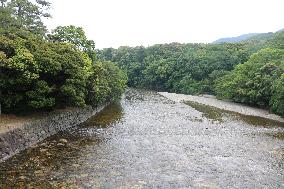
Photo taken May 25, 2016, shows a picturesque scene of the Isuzugawa river taken from Uji Bridge in the inner shrine at Ise Grand Shrine in Ise, Mie Prefecture. The most venerable shrine in Japan, it is dedicated to Amaterasu Omikami, the mythical ancestral sun goddess of the Imperial family. (Kyodo) ==Kyodo

  •  
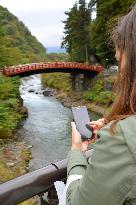
Spanish visitor uses smartphone to get info on Nikko tourist spots

Spanish visitor uses smartphone to get info on Nikko tourist spots

Noelia Dominguez, a 34-year-old Spanish banker touring Japan with her husband, operates a smartphone on Oct. 5, 2015, to get information on Shinkyo (the Sacred Bridge) at Nikko Futarasan Shrine in Nikko, north of Tokyo, where more than 100 radio beacons are installed to brief visitors on tourist spots in English, Chinese and Korean as well as Japanese. To receive information, smartphone users need to install a free app provided by NTT Resonant Inc. The company is experimenting with the smartphone-based Nikko guide system through the end of this year ahead of putting it into full operation next year. (Kyodo) ==Kyodo

  •  
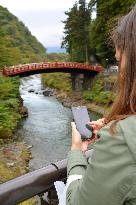
Spanish visitor uses smartphone to get info on Nikko tourist spots

Spanish visitor uses smartphone to get info on Nikko tourist spots

Noelia Dominguez, a 34-year-old Spanish banker touring Japan with her husband, operates a smartphone on Oct. 5, 2015, to get information on Shinkyo (the Sacred Bridge) at Nikko Futaarasan Shrine in Nikko, north of Tokyo, where more than 100 radio beacons are installed to brief visitors on tourist spots in English, Chinese and Korean as well as Japanese. To receive information, smartphone users need to install a free app provided by NTT Resonant Inc. The company is experimenting with the smartphone-based Nikko guide system through the end of this year ahead of putting it into full operation next year. (Kyodo) ==Kyodo

  •  
Bridge crossing ceremony at Japan shrine

Bridge crossing ceremony at Japan shrine

ISE, Japan - People wearing traditional Japanese outfits cross the Uji Bridge at Ise Shrine that was renewed for the first time in 20 years during a ceremonial walk event in Ise, Mie Prefecture, on Nov. 3, 2009. (Kyodo)

  •  
Bridge crossing ceremony at Japan shrine

Bridge crossing ceremony at Japan shrine

ISE, Japan - People wearing traditional Japanese outfits cross the Uji Bridge at Ise Shrine that was renewed for the first time in 20 years during a ceremonial walk event in Ise, Mie Prefecture, on Nov. 3, 2009. (Kyodo)

  •  
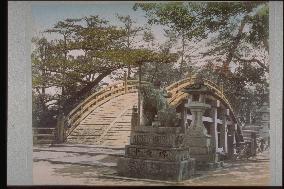
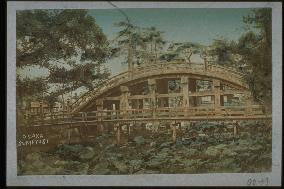
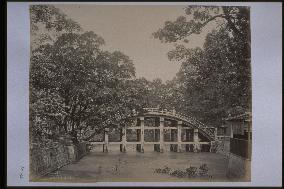
Soribashi bridge at Sumiyoshi Shrine

Soribashi bridge at Sumiyoshi Shrine

The arched bridge of Sumiyoshi Taisha is said to have been donated by Yodogimi (the photo has a caption reading Taikohashi ) and is a famous site at the Taisha.==Date:unknown, Place:Osaka, Photo:Ogawa Kazumasa, (Credit:Nagasaki University Library/Kyodo News Images) [Cabinet Number10‐24‐0]

  •  
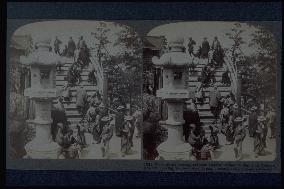
Taiko-bashi (drum) Bridge at Kameido Shrine

Taiko-bashi (drum) Bridge at Kameido Shrine

Stereograph published in 1904. Although the bridge is the same as in photographs #5001and #2215, the stone lantern in the foreground is larger. Gentlemen wearing Western-style suits and hats are visible among the worshippers, a sign of the times. Frequently a notice was posted on the parapets urging the elderly, ladies and children not to cross the bridge because of the danger (from Saishin Tokyo Hanjoki published in 1903).==Date:1904, Place:Tokyo, Photo:Underwood, (Credit:Nagasaki University Library/Kyodo News Images) [Cabinet Number97‐66‐0]

  •  
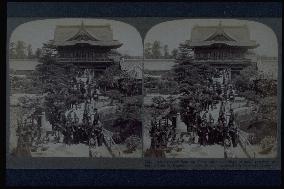
Kameido Shrine

Kameido Shrine

View of the Romon Gate from Taiko-bashi (Drum Bridge) located just through the torii gate at the entrance of the shrine. The five girls in hakama trousers are perhaps praying to pass a school examination. Three bridges span Shinji Pond: Taiko-bashi, Hira-bashi, and Taiko-bashi. They are said to represent the past, present, and future. This stereograph was published in 1904 by Underwood & Underwood Co.==Date:1904, Place:Tokyo, Photo:Underwood, (Credit:Nagasaki University Library/Kyodo News Images) [Cabinet Number97‐65‐0]

  •  
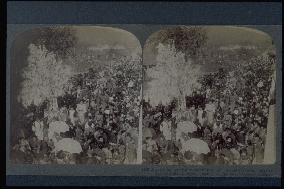
A procession of Shinto carrying the sacrement

A procession of Shinto carrying the sacrement

Stereograph depicting the annual festival at Fushimi Inari Shrine. A procession carrying a sacred image is crossing Kamogawa River at Shichijo Ohashi Bridge. The bridge is busy with people coming and going. The Kyoto Imperial Museum, built in 1895, is visible on the east side of Kamogawa River, but streetcar tracks laid on the bridge in 1913 are not visible. Taken in 1904.==Date:1904, Place:Kyoto, Photo:Underwood, (Credit:Nagasaki University Library/Kyodo News Images) [Cabinet Number97‐34‐0]

  •  
Soribashi bridge at Sumiyoshi Shrine

Soribashi bridge at Sumiyoshi Shrine

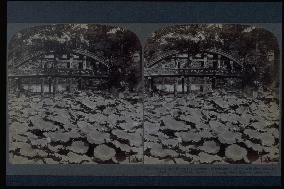
This stereograph depicts Soribashi Bridge and the lotus pond. The parapets of Yorubehashi seem different from those depicted in photograph #4595, indicating that this photograph was taken sometime later. Latter half of the Meiji Period.==Date:1904, Place:Osaka, Photo:Underwood, (Credit:Nagasaki University Library/Kyodo News Images) [Cabinet Number97‐11‐0]

  •  
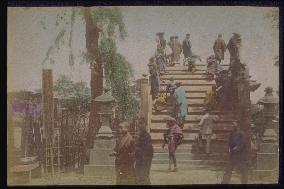
Taiko-bashi (Drum) Bridge at Kameido Shrine

Taiko-bashi (Drum) Bridge at Kameido Shrine

This is the sharply arched Taiko-bashi (also called Sori-bashi, or Warped Bridge ), which was apparently built after 1892. The present-day concrete Taiko-bashi was unveiled in August 1952 to commemorate the 1050th Sugawara Michizane anniversary and has a gentler slope with steps. The building visible behind the bridge is the Romon (Sakura Gate).==Date:about 1877, Place:Tokyo, Photo:unknown, (Credit:Nagasaki University Library/Kyodo News Images) [Cabinet Number96‐7‐0]

  •  
A lotus pond at Tsurugaoka Hachimangu Shrine

A lotus pond at Tsurugaoka Hachimangu Shrine

The photograph is labeled A B6 LOTUS POND AT KAMAKURA. Date unknown. View of the stone bridge from the east. The Sanno-torii (Third Gate) is visible behind the building on the left. This bridge is mentioned in books from the Edo Period. It was referred to as Akahashi (Red Bridge). There is a wooden bridge behind it. The stone bridge was destroyed by the Great Kanto Earthquake of 1923.==Date:unknown, Place:Kamakura, Photo:unknown, (Credit:Nagasaki University Library/Kyodo News Images) [Cabinet Number93‐40‐0]

  •  
Five main halls (temples) of Matsushima

Five main halls (temples) of Matsushima

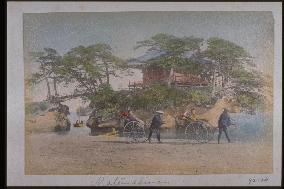
It is extremely rare to find rickshaws in a photo with Matsushima Beach in the background, implying that these women must be very upper class. At the time of construction, Godaido Shrine was vermillion, but, only a small part of the shrine building still bears its original color. It is odd that the bridge to the island is not vermillion.==Date:unknown, Place:Sendai, Photo:unknown, (Credit:Nagasaki University Library/Kyodo News Images) [Cabinet Number92‐26‐0]

  •  
Soribashi bridge at Sumiyoshi Shrine

Soribashi bridge at Sumiyoshi Shrine

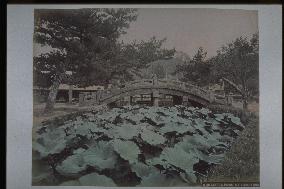
A lotus pond is below Soribashi Bridge. The bridge in front of it is Yorubehashi built in 1873. The photograph is dated around 1888.==Date:unknown, Place:Osaka, Photo:unknown, (Credit:Nagasaki University Library/Kyodo News Images) [Cabinet Number90‐37‐0]

  •  
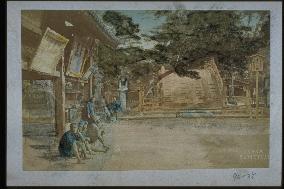
Soribashi bridge at Sumiyoshi Shrine

Soribashi bridge at Sumiyoshi Shrine

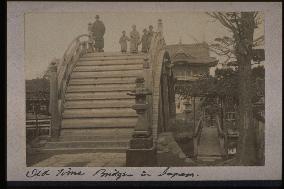
Ema-do is visible on the left. People donated ema (votive tablets) and stone lanterns as prayers for safe voyages at sea and success in business. Early Meiji Period.==Date:unknown, Place:Osaka, Photo:unknown, (Credit:Nagasaki University Library/Kyodo News Images) [Cabinet Number90‐35‐0]

  •  
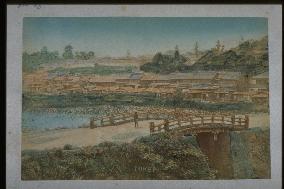
A scenery in the suburbs of Tokyo

A scenery in the suburbs of Tokyo

This is the earthen bridge leading to Ichigaya Gomon (gate), which was located to the left. The main residence of the Tokugawa family of Owari was located on the hill to the left. It was destroyed in 1868, and the Military Academy was built there in 1878. Ichigaya Hachiman Shrine is on the right side of the hill, and the town of Ichigaya Hachiman is visible at the foot of the hill. This photograph was carried in an 1872 issue of The Far East and later tinted.==Date:unknown, Place:Tokyo, Photo:unknown, (Credit:Nagasaki University Library/Kyodo News Images) [Cabinet Number90‐24‐0]

  •  
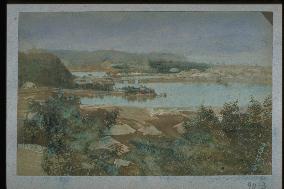
Kanazawa Hakkei

Kanazawa Hakkei

Hiragata Bay as seen from Kyurantei. Biwajima Benten is visible in the centre, with Seto Shinto Shrine at the tip of the peninsula. The teahouses on the right of the shrine are (from the left) Chiyomoto-ro and Ogiya, and Azumaya is in the rear. Suzaki Village is on the other side of Seto Bridge from Ogiya.==Date:unknown, Place:Yokohama, Photo:unknown, (Credit:Nagasaki University Library/Kyodo News Images) [Cabinet Number90‐3‐0]

  •  
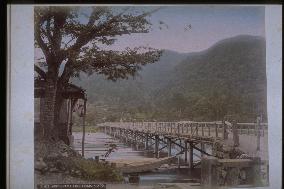
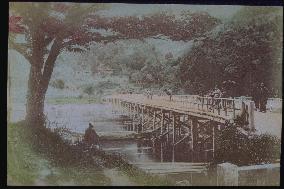
The Togetsukyo Bridge,Arashiyama

The Togetsukyo Bridge,Arashiyama

Togetsu Bridge at Arashiyama is viewed from the northern end, facing south. Horinji Temple is visible on the hillside. A sign at the northern end of the bridge informs people that cows and horses are not allowed to cross the bridge. A teahouse with hanging lanterns stands under a cherry tree. A maruko boat is docked nearby. The bridge was destroyed by a flood in 1892. The stone bridge to the right, Kinmonkyo, was later moved to Kurumazaki Shrine. Taken by Tamamura Kozaburo.==Date:unknown, Place:Kyoto, Photo:unknown, (Credit:Nagasaki University Library/Kyodo News Images) [Cabinet Number88‐6‐0]

  •  
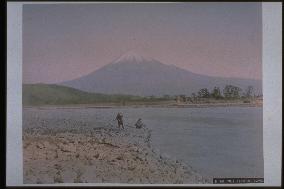
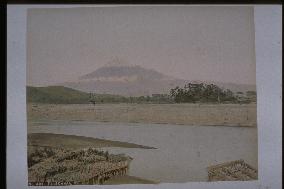
Mt. Fuji seen from the Fuji River

Mt. Fuji seen from the Fuji River

Northeastern view of the snow-capped peak of Mt. Fuji, taken from the bank of Fuji River in Iwabuchi, Fujikawa-machi. The mountain on the left is Mt. Iwamoto, and the tree line reaches to the forest of Matsuoka Sui Shinto Shrine (Fuji City) on the left. Two men are at the riverside, and Fujigawa Bridge, which crosses from the south of the shrine to Iwabuchi, is visible. This bridge was washed away many times from the beginning of the Meiji Period. It is difficult to determine exactly when this photograph was taken.==Date:unknown, Place:Shizuoka, Photo:unknown, (Credit:Nagasaki University Library/Kyodo News Images) [Cabinet Number86‐5‐0]

  •  
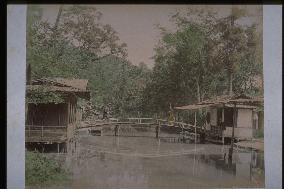
A teahouse,Shimogamo,Kyoto

A teahouse,Shimogamo,Kyoto

View of the Mitarashi River at Shimogamo Shinto Shrine. A woman riding a rickshaw and a woman with a parasol are passing each other on a bridge. There are summer pavilions on both sides of the river. The source of Mitarashi River is a spring at Mitarashi Shrine within the Shimogamo Shinto Shrine precincts. In the Meiji Period, bonfires were lit along the river and summer pavilions were built from which to observe them. In the back is Tadashi Forest.==Date:unknown, Place:Kyoto, Photo:unknown, (Credit:Nagasaki University Library/Kyodo News Images) [Cabinet Number85‐26‐0]

  •  
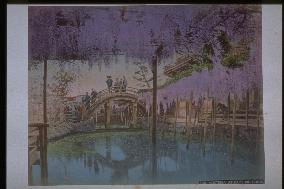
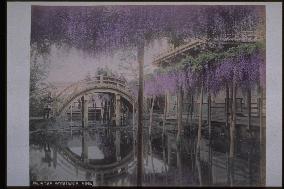
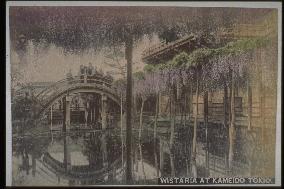
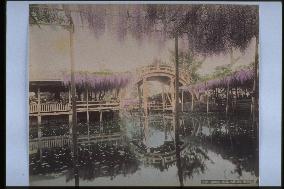
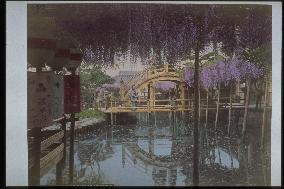
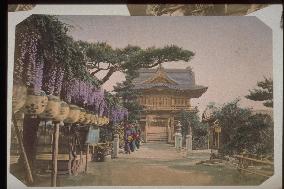
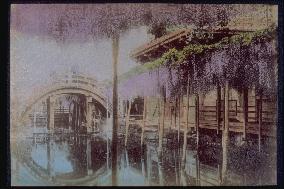
A wisteria trellis at Kameido Shrine

A wisteria trellis at Kameido Shrine

This is the smaller Taiko-bashi (Sori-bashi) located in front of the Romon (Sakura Gate) on the right. The Wisteria Festival of Kameido Tenjin Shrine held from mid-April to mid-May every year is a harbinger of summer. There are many other events held at the shrine. The parents of young children release carp into Shinji Pond during the Shichi-Go-San Festival on November 15 to pray for the healthy growth of their children. Masaoka shiki wrote the haiku poem: Sori-bashi, the wisteria are purple and carp red.==Date:unknown, Place:Tokyo, Photo:A. Farsari, (Credit:Nagasaki University Library/Kyodo News Images) [Cabinet Number81‐15‐0]

  •  
A wisteria trellis at Kameido Shrine

A wisteria trellis at Kameido Shrine

This is the smaller Taiko-bashi (Sori-bashi) located in front of the Romon (Sakura Gate) on the right. The Wisteria Festival of Kameido Tenjin Shrine held from mid-April to mid-May every year is a harbinger of summer. There are many other events held at the shrine. The parents of young children release carp into Shinji Pond during the Shichi-Go-San Festival on November 15 to pray for the healthy growth of their children. Masaoka shiki wrote the haiku poem: Sori-bashi, the wisteria are purple and carp red.==Date:unknown, Place:Tokyo, Photo:Tamamura Kozaburo, (Credit:Nagasaki University Library/Kyodo News Images) [Cabinet Number80‐25‐0]

  •  
Mt. Fuji seen from the Fuji River

Mt. Fuji seen from the Fuji River

Northeastern view of Mt. Fuji from the bank of Fuji River at Iwabuchi in Fujigawa-machi. The ferry port of Iwabuchi is in the foreground, and Matsuoka Sui Shinto Shrine of Fuji City is visible in the forest on the other side. The bridge between the shrine and Iwabuchi is not visible in this photograph, perhaps because it had been recently washed away, which often happened due to the rapid flow of Fuji River. The mountain on the left is Mt. Iwamoto, and pine trees line the other side of the river.==Date:unknown, Place:Shizuoka, Photo:Tamamura Kozaburo, (Credit:Nagasaki University Library/Kyodo News Images) [Cabinet Number79‐16‐0]

  •  
Soribashi bridge at Sumiyoshi Shrine

Soribashi bridge at Sumiyoshi Shrine

Soribashi Bridge at Sumiyoshi Shinto Shrine was also called the Drum Bridge (Taikobashi). This bridge was originally built for the symbolic crossing of Shinto deities, but eventually people were allowed to use it. Mikoshi, a portable shrine, is carried across the bridge during a summer festival. Mid-Meiji Period.==Date:unknown, Place:Osaka, Photo:R. Stillfried, (Credit:Nagasaki University Library/Kyodo News Images) [Cabinet Number78‐42‐0]

  •  
Suwa Park

Suwa Park

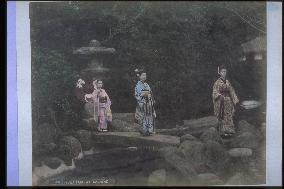
Suwa Park was established next to Suwa Shinto Shrine in 1874 for the people of Nagasaki and foreign visitors. The park included a pond and fountain. Geiko in kimono pose on the stone bridge over the pond around 1887.==Date:unknown, Place:Nagasaki, Photo:unknown, (Credit:Nagasaki University Library/Kyodo News Images) [Cabinet Number75‐11‐0]

  •  
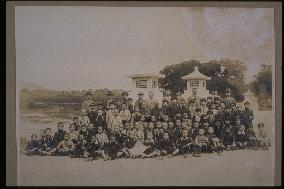
Pupils on a school trip

Pupils on a school trip

A group portrait taken in front of Jingubashi (bridge) during school trip. Harajuku Station was originally built in October 1906, a little closer (north) to Yoyogi than its present location. Meiji Jingu was completed in November, 1919. Jingubashi was built in September 1920 across the Yamanote Line from the Omote Sando (front approach) to the shrine. Kabashima Masayoshi, who founded the first bridge design engineering company in Japan, participated in the construction project. The grove on the far right is part of Meiji Jingu. The left edge of this photograph is now Yoyogi Park. Probably taken between 1921 and 1923.==Date:unknown, Place:Tokyo, Photo:unknown, (Credit:Nagasaki University Library/Kyodo News Images) [Cabinet Number72‐37‐0]

  •  
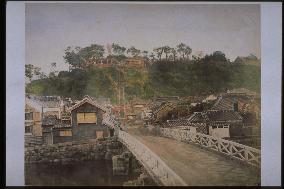
The hundred steps of Motomachi and Maeda-bashi Bridge,Yokohama

The hundred steps of Motomachi and Maeda-bashi Bridge,Yokohama

The stone steps visible in the centre are the Motomachi Hyakudan ( one hundred steps ). Sengen Shinto Shrine stands at the top of the stairs, with the border of Motomachi 2-chome and 3-chome at the bottom. The bridge in the foreground is Maedabashi, built when Horikawa Waterway was dug in 1860. Since it was replaced with an iron bridge in 1890, this photograph must have been taken prior to that date.==Date:unknown, Place:Yokohama, Photo:unknown, (Credit:Nagasaki University Library/Kyodo News Images) [Cabinet Number64‐40‐0]

  •  
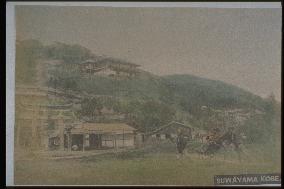
An entrance to Mt. Suwa

An entrance to Mt. Suwa

The torii gates of Suwa Shinto Shrine are on the left. The restaurant Tokiwaro, frequented by men-of-letters and politicians, is on the hillside. The observation deck above the restaurant commands a panoramic view of the city and harbour as well as Kii Peninsula and Awaji Island in the distance. The photographs taken from this spot appear in photograph albums, postcards, and guidebooks. The present-day Venus Bridge connects the original observation deck with a new one built above it.==Date:unknown, Place:Kobe, Photo:unknown, (Credit:Nagasaki University Library/Kyodo News Images) [Cabinet Number56‐33‐0]

  •  
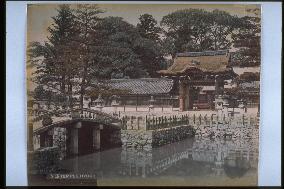
Rokuharamitsuji Temple

Rokuharamitsuji Temple

The Karamon Gate of Rokuson-o Shinto Shrine is seen facing east from the northeastern side of the Shinryu Pond. This shrine was rebuilt by Nankokushonin of Henjoshinin with the help of the Tokugawa Shogunate in 1702 and completed in 1707. It enshrines Rokuson-o (Minamoto Tsunemoto, a descendent of the Genji clan. The shape of the stone fence surrounding the pond indicates that this photograph was taken before 1911.==Date:unknown, Place:Kyoto, Photo:unknown, (Credit:Nagasaki University Library/Kyodo News Images) [Cabinet Number56‐20‐0]

  •  
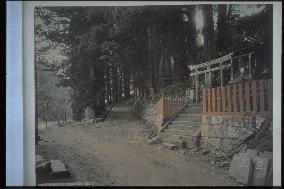
The approach to Toshogu Shrine,Nikko

The approach to Toshogu Shrine,Nikko

This is the entrance to the Sannai area encompassing Nikko Toshogu Shrine and Sanrinoji Temple. Shinkyo Bridge and Nikko Bridge are located to the left. Daiya River is visible in the background to the left. Nagasaka Slope is in the centre. The shrine on the right is Jinjaodo. Stones cut for construction are visible on the left.==Date:unknown, Place:Nikko, Photo:unknown, (Credit:Nagasaki University Library/Kyodo News Images) [Cabinet Number54‐6‐0]

  •  
A wisteria trellis at Kameido Shrine

A wisteria trellis at Kameido Shrine

This is the smaller Taiko-bashi (Sori-bashi) located in front of the Romon (Sakura Gate) on the right. The Wisteria Festival of Kameido Tenjin Shrine held from mid-April to mid-May every year is a harbinger of summer. There are many other events held at the shrine. The parents of young children release carp into Shinji Pond during the Shichi-Go-San Festival on November 15 to pray for the healthy growth of their children. Masaoka shiki wrote the haiku poem: Sori-bashi, the wisteria are purple and carp red.==Date:unknown, Place:Tokyo, Photo:unknown, (Credit:Nagasaki University Library/Kyodo News Images) [Cabinet Number53‐38‐0]

  •  
A wisteria trellis at Kameido Shrine

A wisteria trellis at Kameido Shrine

Taiko-bashi (Sori-bashi) and wisteria blossoms around 1897. View from the west side of Shinji Pond located to the left of the front entrance of the shrine. This is the bridge in photograph #4832, only viewed from the left. The bridge was designed to form a circle when viewed along with its reflection in the pond.==Date:unknown, Place:Tokyo, Photo:unknown, (Credit:Nagasaki University Library/Kyodo News Images) [Cabinet Number53‐17‐0]

  •  
A wisteria trellis at Kameido Shrine

A wisteria trellis at Kameido Shrine

Many festivals are celebrated throughout the year at Kameido Tenjin Shrine. While the Wisteria Festival is well-known, Usokae Shinji is also popular. This event is based on the belief that the mythical uso bird returns from the previous year and brings good luck with it. The conversation staged between the shrine priest and an oni (devil) at the Setsubun Tsuinasai Festival in February is also interesting. Since the oni has four eyes, the roof of the shrine office is embellished with ceramic tiles showing a devil with four eyes.==Date:unknown, Place:Tokyo, Photo:unknown, (Credit:Nagasaki University Library/Kyodo News Images) [Cabinet Number53‐4‐0]

  •  
Kameido Shrine

Kameido Shrine

Kameido Tenmangu Shrine (present-day Kameido Tenjinsha) is one of the three main shrines dedicated to Sugawara Michizane. The other two are Dazaifu Tenmangu Shrine in Fukuoka and Kitano Tenmangu Shrine in Kyoto. The shrine is said to go back to the year 1661when the Shinto priest of Dazaifu, Sugawara Otorii Nobusuke, carved a holy image from the wood of the tobiume (plum tree) and enshrined it in the eastern part of Honjo. In 1662, the fourth Shogun Ietsuna donated the land to the shrine, and shrine buildings including the Romon Gate, Shinji Pond, and Taiko Bridge were later built in imitation of the Dazaifu Tenmangu Shrine.==Date:unknown, Place:Tokyo, Photo:unknown, (Credit:Nagasaki University Library/Kyodo News Images) [Cabinet Number51‐39‐0]

  •  
The Togetsukyo Bridge,Arashiyama

The Togetsukyo Bridge,Arashiyama

Togetsu Bridge at Arashiyama is viewed from the northern end, facing south. Horinji Temple is visible on the hillside. Kimono-clad women look toward the camera from the bridge. A man is fishing under the cherry tree. The bridge was destroyed by a flood in 1892. The stone bridge in the foreground is Kinmonkyo, which was later moved to Kurumazaki Shrine. Taken by Tamamura Kozaburo.==Date:unknown, Place:Kyoto, Photo:Tamamura Kozaburo, (Credit:Nagasaki University Library/Kyodo News Images) [Cabinet Number48‐113‐0]

  •  
Taiko-bashi (Drum) Bridge at Kameido Shrine

Taiko-bashi (Drum) Bridge at Kameido Shrine

The steep inclination of Taiko Bridge made it hard to cross, but these people seem to be enjoying themselves. The inclination of the bridge shown in a photograph from the early Meiji Period is gentler. There is also a photograph of the bridge taken in 1890-92 when it was in such a bad state that people were not allowed to cross it. The bridge shown here was apparently built soon after that time, which means that this photograph was taken after 1892.==Date:unknown, Place:Tokyo, Photo:Tamamura Kozaburo, (Credit:Nagasaki University Library/Kyodo News Images) [Cabinet Number48‐67‐0]

  •  
Autumn tints of Takinogawa, Oji

Autumn tints of Takinogawa, Oji

Oji Station is built over Shakujii River. In this area the river is called Otonashi River. The reason for this name is as follows. Toyoshima Gonnokami Kiyomitsu, a medieval feudal lord, hailed from Kishu (present-day Wakayama Prefecture) and thus established a shrine to Jakuichi Ouji Gongen (Kumano Gongen) that later became Oji Gongen. Consequently, this area was called Oji, and the river was named after the Otonashi River of Kishu. Upstream on the Otonashi River, Takinogawa Village gained fame for its autumn colours. Taken in the mid-Meiji Period.==Date:unknown, Place:Tokyo, Photo:Tamamura Kozaburo, (Credit:Nagasaki University Library/Kyodo News Images) [Cabinet Number48‐59‐0]

  •  
A wisteria trellis at Kameido Shrine

A wisteria trellis at Kameido Shrine

This is the smaller Taiko-bashi (Sori-bashi) located in front of the Romon (Sakura Gate) on the right. The Wisteria Festival of Kameido Tenjin Shrine held from mid-April to mid-May every year is a harbinger of summer. There are many other events held at the shrine. The parents of young children release carp into Shinji Pond during the Shichi-Go-San Festival on November 15 to pray for the healthy growth of their children. Masaoka shiki wrote the haiku poem: Sori-bashi, the wisteria are purple and carp red.==Date:unknown, Place:Tokyo, Photo:Tamamura Kozaburo, (Credit:Nagasaki University Library/Kyodo News Images) [Cabinet Number48‐56‐0]

  •  
Shinobazu Pond

Shinobazu Pond

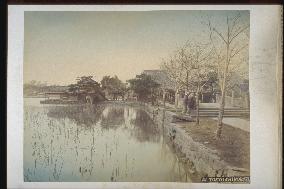
Benten-do on Nakanoshima and the path to it are seen at Shinobazu Pond. The Buddhist priest Tenkai modeled the pond after Lake Biwa and built the shrine to worship the deity Benzaiten of Chikubushima. The stone bridge was built between 1789 and 1801. Numerous dead lotus stems remain in the water, indicating that the season is winter.==Date:unknown, Place:Tokyo, Photo:unknown, (Credit:Nagasaki University Library/Kyodo News Images) [Cabinet Number47‐1‐0]

  • Main
  • Top
  • Editorial
  • Creative
  • About Us
  • About ILG
  • Terms of use
  • Company
  • BEHIND
  • Price List
  • Single Plan
  • Monthly Plan
  • Services
  • Shooting
  • Rights Clearance
  • Support
  • FAQ
  • How To Buy
  • Contact Us
  • Become a Partner

© KYODO NEWS IMAGES INC

All Rights Reserved.

  • Editorial
  • Olympics
  • News
  • Sports
  • Japan
  • Tech
  • Royal
  • Disaster
  • NorthKorea
  • Old Japan
  • SNS
  • Creative
  • Food
  • Japan
  • Landscape
  • Animal
  • Popular
  • #Ukraine
  • #Thailand
  • #coronavirus
  • #N. Korea
  • #Russia
  • #China
  • #Ukraine
  • #Thailand
  • #coronavirus
  • #N. Korea
  • #Russia
  • #China
  • Food
  • Japan
  • Landscape
  • Animal
  • Olympics
  • News
  • Sports
  • Japan
  • Tech
  • Royal
  • Disaster
  • NorthKorea
  • Old Japan
  • SNS