•  
Odesa region comes under Russian drone attack on November 29

Odesa region comes under Russian drone attack on November 29

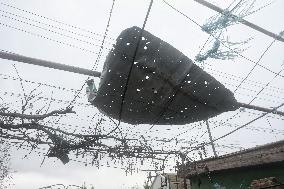
ODESA REGION, UKRAINE - NOVEMBER 29, 2024 - A piece of the fence dotted with shrapnel holes rests on the trellis for grapevines outside a house destroyed by a massive Russian drone strike in Odesa region, southern Ukraine. Seven people were injured in the Russian attack on Friday night, November 29. Homes, as well as port and transportation infrastructure, were damaged.

  •  
The World's Important Agricultural Cultural Heritage Grape Trellis In Zhangjiakou

The World's Important Agricultural Cultural Heritage Grape Trellis In Zhangjiakou

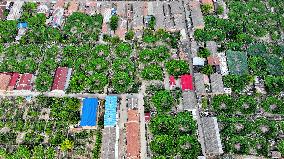
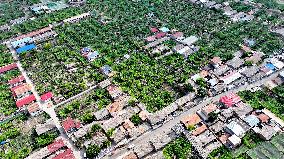
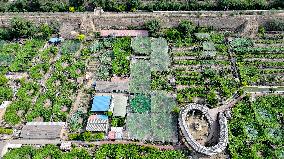
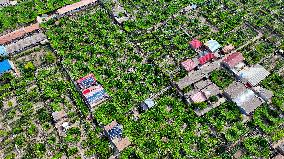
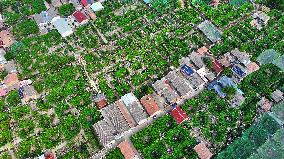
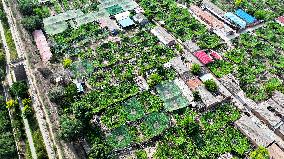
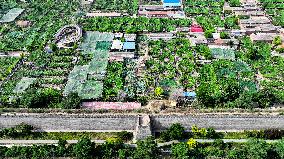
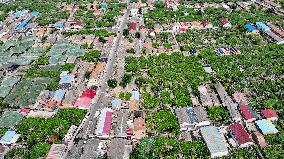
Photo taken on June 24, 2023 shows grape tresses and hidden farmhouses in Guanhou village, Zhangjiakou city, North China's Hebei province. Xuanhua has a history of growing grapes for more than 1,300 years. The "Xuanhua Urban Traditional Vineyard" with Guanhou village as the main planting area has the oldest existing vines for more than 600 years. In June 2013, it was characterized by its unique "traditional grape planting system featuring funnel rack in the courtyard and multi-plant hole planting and cultivation". Identified by the Food and Agriculture Organization of the United Nations as the world's important agricultural cultural heritage protection pilot, the courtyard economy based on sightseeing, catering, picking experience has become a characteristic pillar industry for farmers to increase income and rural revitalization.

  •  
The World's Important Agricultural Cultural Heritage Grape Trellis In Zhangjiakou

The World's Important Agricultural Cultural Heritage Grape Trellis In Zhangjiakou

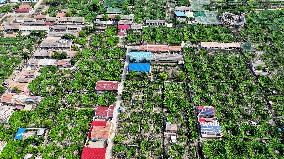
Photo taken on June 24, 2023 shows grape tresses and hidden farmhouses in Guanhou village, Zhangjiakou city, North China's Hebei province. Xuanhua has a history of growing grapes for more than 1,300 years. The "Xuanhua Urban Traditional Vineyard" with Guanhou village as the main planting area has the oldest existing vines for more than 600 years. In June 2013, it was characterized by its unique "traditional grape planting system featuring funnel rack in the courtyard and multi-plant hole planting and cultivation". Identified by the Food and Agriculture Organization of the United Nations as the world's important agricultural cultural heritage protection pilot, the courtyard economy based on sightseeing, catering, picking experience has become a characteristic pillar industry for farmers to increase income and rural revitalization.

  •  
The World's Important Agricultural Cultural Heritage Grape Trellis In Zhangjiakou

The World's Important Agricultural Cultural Heritage Grape Trellis In Zhangjiakou

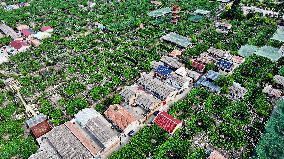
Photo taken on June 24, 2023 shows grape tresses and hidden farmhouses in Guanhou village, Zhangjiakou city, North China's Hebei province. Xuanhua has a history of growing grapes for more than 1,300 years. The "Xuanhua Urban Traditional Vineyard" with Guanhou village as the main planting area has the oldest existing vines for more than 600 years. In June 2013, it was characterized by its unique "traditional grape planting system featuring funnel rack in the courtyard and multi-plant hole planting and cultivation". Identified by the Food and Agriculture Organization of the United Nations as the world's important agricultural cultural heritage protection pilot, the courtyard economy based on sightseeing, catering, picking experience has become a characteristic pillar industry for farmers to increase income and rural revitalization.

  •  
The World's Important Agricultural Cultural Heritage Grape Trellis In Zhangjiakou

The World's Important Agricultural Cultural Heritage Grape Trellis In Zhangjiakou

Photo taken on June 24, 2023 shows grape tresses and hidden farmhouses in Guanhou village, Zhangjiakou city, North China's Hebei province. Xuanhua has a history of growing grapes for more than 1,300 years. The "Xuanhua Urban Traditional Vineyard" with Guanhou village as the main planting area has the oldest existing vines for more than 600 years. In June 2013, it was characterized by its unique "traditional grape planting system featuring funnel rack in the courtyard and multi-plant hole planting and cultivation". Identified by the Food and Agriculture Organization of the United Nations as the world's important agricultural cultural heritage protection pilot, the courtyard economy based on sightseeing, catering, picking experience has become a characteristic pillar industry for farmers to increase income and rural revitalization.

  •  
The World's Important Agricultural Cultural Heritage Grape Trellis In Zhangjiakou

The World's Important Agricultural Cultural Heritage Grape Trellis In Zhangjiakou

Photo taken on June 24, 2023 shows grape tresses and hidden farmhouses in Guanhou village, Zhangjiakou city, North China's Hebei province. Xuanhua has a history of growing grapes for more than 1,300 years. The "Xuanhua Urban Traditional Vineyard" with Guanhou village as the main planting area has the oldest existing vines for more than 600 years. In June 2013, it was characterized by its unique "traditional grape planting system featuring funnel rack in the courtyard and multi-plant hole planting and cultivation". Identified by the Food and Agriculture Organization of the United Nations as the world's important agricultural cultural heritage protection pilot, the courtyard economy based on sightseeing, catering, picking experience has become a characteristic pillar industry for farmers to increase income and rural revitalization.

  •  
The World's Important Agricultural Cultural Heritage Grape Trellis In Zhangjiakou

The World's Important Agricultural Cultural Heritage Grape Trellis In Zhangjiakou

Photo taken on June 24, 2023 shows grape tresses and hidden farmhouses in Guanhou village, Zhangjiakou city, North China's Hebei province. Xuanhua has a history of growing grapes for more than 1,300 years. The "Xuanhua Urban Traditional Vineyard" with Guanhou village as the main planting area has the oldest existing vines for more than 600 years. In June 2013, it was characterized by its unique "traditional grape planting system featuring funnel rack in the courtyard and multi-plant hole planting and cultivation". Identified by the Food and Agriculture Organization of the United Nations as the world's important agricultural cultural heritage protection pilot, the courtyard economy based on sightseeing, catering, picking experience has become a characteristic pillar industry for farmers to increase income and rural revitalization.

  •  
The World's Important Agricultural Cultural Heritage Grape Trellis In Zhangjiakou

The World's Important Agricultural Cultural Heritage Grape Trellis In Zhangjiakou

Photo taken on June 24, 2023 shows grape tresses and hidden farmhouses in Guanhou village, Zhangjiakou city, North China's Hebei province. Xuanhua has a history of growing grapes for more than 1,300 years. The "Xuanhua Urban Traditional Vineyard" with Guanhou village as the main planting area has the oldest existing vines for more than 600 years. In June 2013, it was characterized by its unique "traditional grape planting system featuring funnel rack in the courtyard and multi-plant hole planting and cultivation". Identified by the Food and Agriculture Organization of the United Nations as the world's important agricultural cultural heritage protection pilot, the courtyard economy based on sightseeing, catering, picking experience has become a characteristic pillar industry for farmers to increase income and rural revitalization.

  •  
The World's Important Agricultural Cultural Heritage Grape Trellis In Zhangjiakou

The World's Important Agricultural Cultural Heritage Grape Trellis In Zhangjiakou

Photo taken on June 24, 2023 shows grape tresses and hidden farmhouses in Guanhou village, Zhangjiakou city, North China's Hebei province. Xuanhua has a history of growing grapes for more than 1,300 years. The "Xuanhua Urban Traditional Vineyard" with Guanhou village as the main planting area has the oldest existing vines for more than 600 years. In June 2013, it was characterized by its unique "traditional grape planting system featuring funnel rack in the courtyard and multi-plant hole planting and cultivation". Identified by the Food and Agriculture Organization of the United Nations as the world's important agricultural cultural heritage protection pilot, the courtyard economy based on sightseeing, catering, picking experience has become a characteristic pillar industry for farmers to increase income and rural revitalization.

  •  
The World's Important Agricultural Cultural Heritage Grape Trellis In Zhangjiakou

The World's Important Agricultural Cultural Heritage Grape Trellis In Zhangjiakou

Photo taken on June 24, 2023 shows grape tresses and hidden farmhouses in Guanhou village, Zhangjiakou city, North China's Hebei province. Xuanhua has a history of growing grapes for more than 1,300 years. The "Xuanhua Urban Traditional Vineyard" with Guanhou village as the main planting area has the oldest existing vines for more than 600 years. In June 2013, it was characterized by its unique "traditional grape planting system featuring funnel rack in the courtyard and multi-plant hole planting and cultivation". Identified by the Food and Agriculture Organization of the United Nations as the world's important agricultural cultural heritage protection pilot, the courtyard economy based on sightseeing, catering, picking experience has become a characteristic pillar industry for farmers to increase income and rural revitalization.

  •  
The World's Important Agricultural Cultural Heritage Grape Trellis In Zhangjiakou

The World's Important Agricultural Cultural Heritage Grape Trellis In Zhangjiakou

Photo taken on June 24, 2023 shows grape tresses and hidden farmhouses in Guanhou village, Zhangjiakou city, North China's Hebei province. Xuanhua has a history of growing grapes for more than 1,300 years. The "Xuanhua Urban Traditional Vineyard" with Guanhou village as the main planting area has the oldest existing vines for more than 600 years. In June 2013, it was characterized by its unique "traditional grape planting system featuring funnel rack in the courtyard and multi-plant hole planting and cultivation". Identified by the Food and Agriculture Organization of the United Nations as the world's important agricultural cultural heritage protection pilot, the courtyard economy based on sightseeing, catering, picking experience has become a characteristic pillar industry for farmers to increase income and rural revitalization.

  •  
CHINA-ZHEJIANG-JINHUA-RURAL DEVELOPMENT (CN)

CHINA-ZHEJIANG-JINHUA-RURAL DEVELOPMENT (CN)

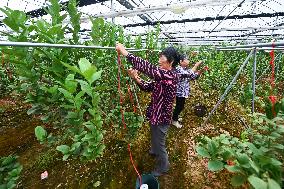
(230620) -- JINHUA, June 20, 2023 (Xinhua) -- Farmers tie fingered citron plants to trellis with strings at a plantation in Beishankou Village of Chisong Town in Jindong District of Jinhua City, east China's Zhejiang Province, June 20, 2023. Based on the integration of tourism and agriculture, Jindong District has fostered a rural industrial development belt among its administrative villages with local distinctive industries. (Xinhua/Xu Yu)

  •  
Illuminated wisteria trellis

Illuminated wisteria trellis

A wisteria trellis is illuminated with about 300,000 LED lamps at Ashikaga Flower Park in Ashikaga, Tochigi Prefecture, eastern Japan, on Dec. 10, 2022.

  •  
Illuminated wisteria trellis

Illuminated wisteria trellis

A wisteria trellis is illuminated with about 300,000 LED lamps at Ashikaga Flower Park in Ashikaga, Tochigi Prefecture, eastern Japan, on Dec. 10, 2022.

  •  
Illuminated wisteria trellis

Illuminated wisteria trellis

A wisteria trellis is illuminated with about 300,000 LED lamps at Ashikaga Flower Park in Ashikaga, Tochigi Prefecture, eastern Japan, on Dec. 10, 2022.

  •  
Illuminated wisteria trellis

Illuminated wisteria trellis

A wisteria trellis is illuminated with about 300,000 LED lamps at Ashikaga Flower Park in Ashikaga, Tochigi Prefecture, eastern Japan, on Dec. 10, 2022.

  •  
CHINA-NINGXIA-YINCHUAN-WINE-FEATURED TOWN (CN)

CHINA-NINGXIA-YINCHUAN-WINE-FEATURED TOWN (CN)

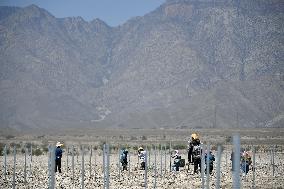
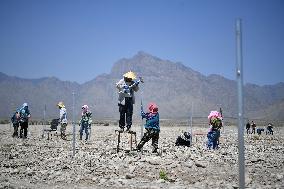
(220616) -- NINGXIA, June 16, 2022 (Xinhua) -- Workers put up grape trellis on the construction site of the Turandot Winery Town project in Yinchuan, northwest China's Ningxia Hui Autonomous Region, June 14, 2022. At the eastern foothills of the Helan Mountains in Yinchuan, Ningxia, Turandot Winery Town is a key construction project for the development of the grape and wine industry with a planned area of 3303 mu (about 220.2 hectares) and a total investment of 2.5 billion yuan (about 373.25 million U.S. dollars). The town boasts the integrated development of grape planting, wine brewing and wine culture-featured tourism. The eastern foothills of the Helan Mountains in Ningxia, located between the 37th and the 40th parallels of the Northern Hemisphere, are deemed the "golden zone" for growing wine grapes. (Xinhua/Wang Peng)

  •  
CHINA-NINGXIA-YINCHUAN-WINE-FEATURED TOWN (CN)

CHINA-NINGXIA-YINCHUAN-WINE-FEATURED TOWN (CN)

(220616) -- NINGXIA, June 16, 2022 (Xinhua) -- Workers put up grape trellis on the construction site of the Turandot Winery Town project in Yinchuan, northwest China's Ningxia Hui Autonomous Region, June 14, 2022. At the eastern foothills of the Helan Mountains in Yinchuan, Ningxia, Turandot Winery Town is a key construction project for the development of the grape and wine industry with a planned area of 3303 mu (about 220.2 hectares) and a total investment of 2.5 billion yuan (about 373.25 million U.S. dollars). The town boasts the integrated development of grape planting, wine brewing and wine culture-featured tourism. The eastern foothills of the Helan Mountains in Ningxia, located between the 37th and the 40th parallels of the Northern Hemisphere, are deemed the "golden zone" for growing wine grapes. (Xinhua/Wang Peng)

  •  
Wisteria trellis,Maebashi,the Nakasendo Road

Wisteria trellis,Maebashi,the Nakasendo Road

Maehashi lies in central Gunma Prefecture. The prefecture capital was established here, and the city prospered as a collection and distribution centre for silk products. The exact location of this wisteria trellis is unknown, but if it is indeed Maehashi city, then it is probably close to the bank of Tone River, north of the prefecture office, because aqueducts and ponds are visible.==Date:unknown, Place:Maebashi, Photo:unknown, (Credit:Nagasaki University Library/Kyodo News Images) [Cabinet Number98‐43‐0]

  •  
Wisteria trellis,Maebashi,the Nakasendo Road

Wisteria trellis,Maebashi,the Nakasendo Road

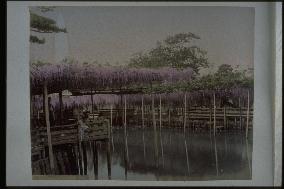
Maehashi lies in central Gunma Prefecture. The prefecture capital was established here, and the city prospered as a collection and distribution centre for silk products. The exact location of this wisteria trellis is unknown, but if it is indeed Maehashi city, then it is probably close to the bank of Tone River, north of the prefecture office, because aqueducts and ponds are visible.==Date:1904, Place:Maebashi, Photo:unknown, (Credit:Nagasaki University Library/Kyodo News Images) [Cabinet Number98‐14‐0]

  •  
A wisteria trellis at Kameido Shrine

A wisteria trellis at Kameido Shrine

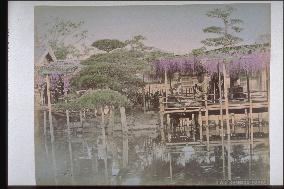
These wisteria terraces were all destroyed during World War II air raids. The wisteria trees of today were planted one by one from around 1950 by the local people. The wisteria blossoms at Kameido Tenjin Shrine are said to be the best in Tokyo, and they were chosen as one of the New Best One Hundred Scenes of Tokyo. This stereograph was published in 1904 in a book-shaped case.==Date:1904, Place:Tokyo, Photo:Underwood, (Credit:Nagasaki University Library/Kyodo News Images) [Cabinet Number97‐67‐0]

  •  
A teahouse in the precincts with a wisteria trellis

A teahouse in the precincts with a wisteria trellis

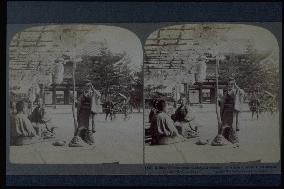
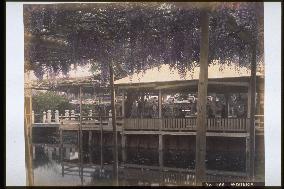
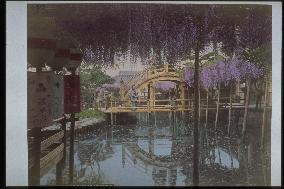
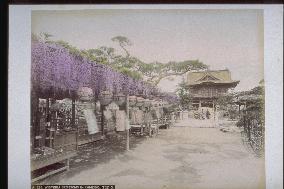
This is a teahouse in front of Otenmon Gate at Heian Shrine. Lanterns hang near the wisteria trellis. People are relaxing under the wisteria blossoms. A woman holding a parasol on a rickshaw is visible on the right, as well as Daigokuden Hall beyond the gate. The shrine was built in 1895. This may have been taken by the British photographer H. G. Ponting.==Date:unknown, Place:Kyoto, Photo:unknown, (Credit:Nagasaki University Library/Kyodo News Images) [Cabinet Number97‐43‐0]

  •  
A wisteria trellis at Hikone

A wisteria trellis at Hikone

A wisteria trellis at Hikone==Date:unknown, Place:Hikone, Photo:unknown, (Credit:Nagasaki University Library/Kyodo News Images)

  •  
A wisteria trellis at Kameido Shrine

A wisteria trellis at Kameido Shrine

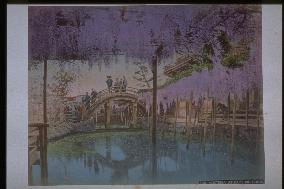
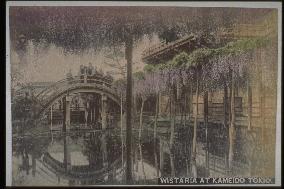
The smaller Taiko-bashi (Sori-bashi) as in photographs #2652, #4197 and #2203. There is a small bridge in front. The same bridge is also visible in photograph #2615. This bridge is visible in a picture postcard published around 1907, indicating that this photograph was taken a little later. Since wisteria blossoms are usually viewed from below, this view from the bridge was quite rare.==Date:unknown, Place:Tokyo, Photo:unknown, (Credit:Nagasaki University Library/Kyodo News Images) [Cabinet Number88‐26‐0]

  •  
Wisteria trellis at a teahouse,the Nakasendo Road

Wisteria trellis at a teahouse,the Nakasendo Road

Wisteria blossoms on Nakasendo probably refers to the wisteria at Ushijima (present-day Ushijima in Kasukabe City, Saitama Prefecture), but this is not certain. If so, however, this would be the Shingon Sect Rengein Temple grounds where wisterias, said to have been planted by Kobo Daishi (the founder of the Shingon Sect), still can be found today. The wisteria trees are 1,200 years old, and the plot is some 700 square meters in area. The trees were designated a National Natural Monument in 1928. A private company called Tokaen currently manages the garden.==Date:unknown, Place:Tokyo, Photo:unknown, (Credit:Nagasaki University Library/Kyodo News Images) [Cabinet Number88‐34‐0]

  •  
A wisteria trellis at Kameido Shrine

A wisteria trellis at Kameido Shrine

People relaxing with tea under the wisteria blossoms near Shinji Pond. Dazaifu and Kameido shrines are both dedicated to Sugawara Michizane, although Dazaifu Tenmangu in Fukuoka is famous for plum blossoms while Kameido Tenmangu in Tokyo is famous for wisteria blossoms. Sugawara Michizane is revered as a deity of learning, and during the examination season the shrine is filled with ema cards upon which students write their wishes.==Date:unknown, Place:Tokyo, Photo:unknown, (Credit:Nagasaki University Library/Kyodo News Images) [Cabinet Number88‐27‐0]

  •  
A wisteria trellis at Kameido Shrine

A wisteria trellis at Kameido Shrine

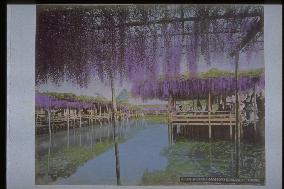
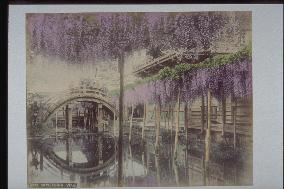
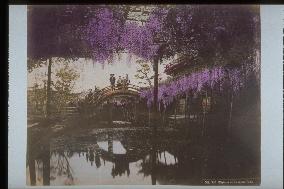
The reflection of the wisteria on Shinji Pond is beautiful. These wisteria blossoms, called Goshaku-fuji, were held in high regard during the entire Edo Period, and they appear in ukiyoe prints by Ando Hiroshige and Utagawa Kuniyoshi. This is still a popular place to appreciate the wisteria blossoms. Taken around 1897.==Date:unknown, Place:Tokyo, Photo:unknown, (Credit:Nagasaki University Library/Kyodo News Images) [Cabinet Number87‐11‐0]

  •  
A teahouse with a wisteria trellis

A teahouse with a wisteria trellis

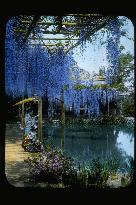
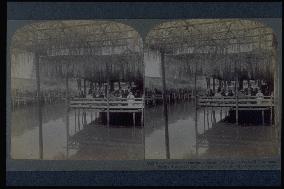
A teahouse with a wisteria trellis==Date:unknown, Place:unknown, Photo:unknown, (Credit:Nagasaki University Library/Kyodo News Images)

  •  
A wisteria trellis at Kameido Shrine

A wisteria trellis at Kameido Shrine

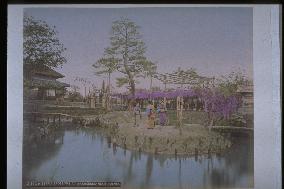
This area was formerly an island shaped like a turtle. It was later connected to the mainland and Kame-mura (Turtle Village) was established. The well dug there was called Kamenoi (Turtle Well). Sometime later, Kame-mura became confused with Kamenoi and the village came to be called Kameido-mura. It is said that during the Edo Period, it was called Kamedo-mura without the i sound. Due to its name, many people brought turtles here. Today, there are still many turtles in the pond, but most are imported species.==Date:unknown, Place:Tokyo, Photo:A. Farsari, (Credit:Nagasaki University Library/Kyodo News Images) [Cabinet Number82‐29‐0]

  •  
A wisteria trellis at Kameido Shrine

A wisteria trellis at Kameido Shrine

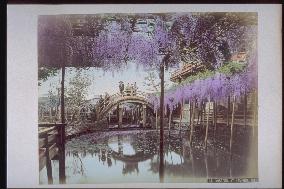
This is the smaller Taiko-bashi (Sori-bashi) located in front of the Romon (Sakura Gate) on the right. The Wisteria Festival of Kameido Tenjin Shrine held from mid-April to mid-May every year is a harbinger of summer. There are many other events held at the shrine. The parents of young children release carp into Shinji Pond during the Shichi-Go-San Festival on November 15 to pray for the healthy growth of their children. Masaoka shiki wrote the haiku poem: Sori-bashi, the wisteria are purple and carp red.==Date:unknown, Place:Tokyo, Photo:A. Farsari, (Credit:Nagasaki University Library/Kyodo News Images) [Cabinet Number81‐15‐0]

  •  
A wisteria trellis at Kameido Shrine

A wisteria trellis at Kameido Shrine

This is the smaller Taiko-bashi (Sori-bashi) located in front of the Romon (Sakura Gate) on the right. The Wisteria Festival of Kameido Tenjin Shrine held from mid-April to mid-May every year is a harbinger of summer. There are many other events held at the shrine. The parents of young children release carp into Shinji Pond during the Shichi-Go-San Festival on November 15 to pray for the healthy growth of their children. Masaoka shiki wrote the haiku poem: Sori-bashi, the wisteria are purple and carp red.==Date:unknown, Place:Tokyo, Photo:Tamamura Kozaburo, (Credit:Nagasaki University Library/Kyodo News Images) [Cabinet Number80‐25‐0]

  •  
A teahouse with a wisteria trellis

A teahouse with a wisteria trellis

A teahouse with a wisteria trellis==Date:unknown, Place:unknown, Photo:Tamamura Kozaburo, (Credit:Nagasaki University Library/Kyodo News Images)

  •  
A wisteria trellis and women

A wisteria trellis and women

A wisteria trellis and women==Date:unknown, Place:unknown, Photo:unknown, (Credit:Nagasaki University Library/Kyodo News Images)

  •  
A wisteria trellis at Kameido Shrine

A wisteria trellis at Kameido Shrine

This is the smaller Taiko-bashi (Sori-bashi) located in front of the Romon (Sakura Gate) on the right. The Wisteria Festival of Kameido Tenjin Shrine held from mid-April to mid-May every year is a harbinger of summer. There are many other events held at the shrine. The parents of young children release carp into Shinji Pond during the Shichi-Go-San Festival on November 15 to pray for the healthy growth of their children. Masaoka shiki wrote the haiku poem: Sori-bashi, the wisteria are purple and carp red.==Date:unknown, Place:Tokyo, Photo:unknown, (Credit:Nagasaki University Library/Kyodo News Images) [Cabinet Number53‐38‐0]

  •  
A teahouse with a wisteria trellis

A teahouse with a wisteria trellis

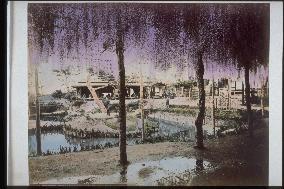
Kameido Tenjin Shrine was the most famous wisteria-blossom viewing place in Tokyo. This is probably Kameido Tenjin Shrine, because the stone lantern is very similar to that portrayed in photograph #4511, and because there seems to be a pond in the background. However, there is no definite proof. Probably taken in the mid-Meiji Period.==Date:unknown, Place:Tokyo, Photo:unknown, (Credit:Nagasaki University Library/Kyodo News Images) [Cabinet Number53‐34‐0]

  •  
A wisteria trellis at Kameido Shrine

A wisteria trellis at Kameido Shrine

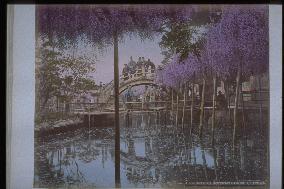
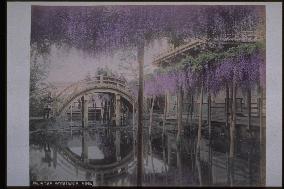
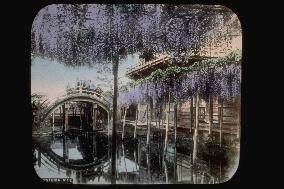
Taiko-bashi (Sori-bashi) and wisteria blossoms around 1897. View from the west side of Shinji Pond located to the left of the front entrance of the shrine. This is the bridge in photograph #4832, only viewed from the left. The bridge was designed to form a circle when viewed along with its reflection in the pond.==Date:unknown, Place:Tokyo, Photo:unknown, (Credit:Nagasaki University Library/Kyodo News Images) [Cabinet Number53‐17‐0]

  •  
A wisteria trellis at Kameido Shrine

A wisteria trellis at Kameido Shrine

Many festivals are celebrated throughout the year at Kameido Tenjin Shrine. While the Wisteria Festival is well-known, Usokae Shinji is also popular. This event is based on the belief that the mythical uso bird returns from the previous year and brings good luck with it. The conversation staged between the shrine priest and an oni (devil) at the Setsubun Tsuinasai Festival in February is also interesting. Since the oni has four eyes, the roof of the shrine office is embellished with ceramic tiles showing a devil with four eyes.==Date:unknown, Place:Tokyo, Photo:unknown, (Credit:Nagasaki University Library/Kyodo News Images) [Cabinet Number53‐4‐0]

  •  
A wisteria trellis at Kameido Shrine

A wisteria trellis at Kameido Shrine

This is the smaller Taiko-bashi (Sori-bashi) located in front of the Romon (Sakura Gate) on the right. The Wisteria Festival of Kameido Tenjin Shrine held from mid-April to mid-May every year is a harbinger of summer. There are many other events held at the shrine. The parents of young children release carp into Shinji Pond during the Shichi-Go-San Festival on November 15 to pray for the healthy growth of their children. Masaoka shiki wrote the haiku poem: Sori-bashi, the wisteria are purple and carp red.==Date:unknown, Place:Tokyo, Photo:Tamamura Kozaburo, (Credit:Nagasaki University Library/Kyodo News Images) [Cabinet Number48‐56‐0]

  •  
A wisteria trellis at Kameido Shrine

A wisteria trellis at Kameido Shrine

The identical structure as the photos numbered 2-30 and 16-27. The wisteria shelf and arched bridge in the back have been destroyed during the war, and the present one has been rebuilt after the war.==Date:unknown, Place:Tokyo, Photo:Kusakabe Kinbei, (Credit:Nagasaki University Library/Kyodo News Images) [Cabinet Number40‐5‐0]

  •  
A wisteria trellis at Kameido Shrine

A wisteria trellis at Kameido Shrine

Kameido Tenjin was famous for its wisteria blossoms. The wooden arched bridge in the front of the photo was famous, but it has been rebuilt. The fourth Shogun Ietsuna built the foundation for the present buildings by donating the main building and others.==Date:unknown, Place:Tokyo, Photo:unknown, (Credit:Nagasaki University Library/Kyodo News Images) [Cabinet Number31‐45‐0]

  •  
Wisteria trellis

Wisteria trellis

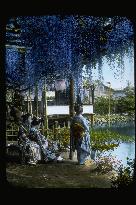
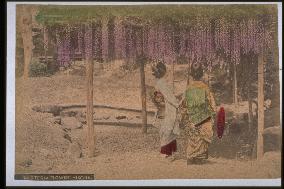
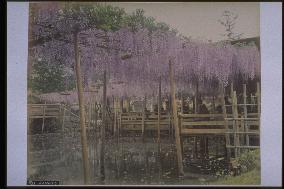
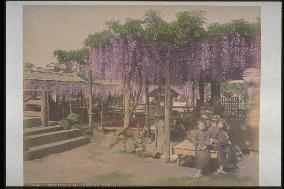
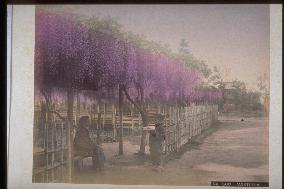
A woman sits under a huge wisteria trellis surrounded by a bamboo fence, watching a small girl facing her holding a tray with a tea pot and cups.==Date:unknown, Place:unknown, Photo:Tamamura Kozaburo, (Credit:Nagasaki University Library/Kyodo News Images) [Cabinet Number29‐2‐0]

  •  
Wisteria trellis at a teahouse,the Nakasendo Road

Wisteria trellis at a teahouse,the Nakasendo Road

A resting spot for people walking along the Nakasendo. The wisteria trellises seen from the teahouse were famous, and many came to see them. There is an English caption by the compiler of the album, but it should be spelled Blossoms. A typical Japanese spelling error.==Date:unknown, Place:Tokyo, Photo:Ogawa Kazumasa, (Credit:Nagasaki University Library/Kyodo News Images) [Cabinet Number25‐73‐0]

  •  
Satake Garden,Mukojima

Satake Garden,Mukojima

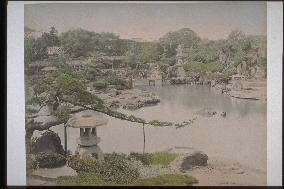
A landscape garden in the go-round style. A pine branch reaches over the pond, and people can be seen on the bridge built over the pond. Many lanterns can be seen here and there. To the left rear is a wisteria trellis.==Date:unknown, Place:Tokyo, Photo:Ogawa Kazumasa, (Credit:Nagasaki University Library/Kyodo News Images) [Cabinet Number25‐74‐0]

  •  
Wisteria trellis at YOKOHAMA tobemachi

Wisteria trellis at YOKOHAMA tobemachi

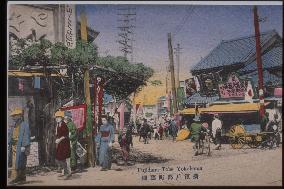
A post card from the end of the Taisho era depicts the wisteria vines in Tobe, Yokohama.==Date:unknown, Place:Yokohama, Photo:unknown, (Credit:Nagasaki University Library/Kyodo News Images) [Cabinet Number20‐32‐0]

  •  
A wisteria trellis at Kameido Shrine

A wisteria trellis at Kameido Shrine

Probably the same negative was used for this as for the photo numbered 2-30. The people on the arched bridge are the same. The colouring of this photo is slightly less clear.==Date:unknown, Place:Tokyo, Photo:unknown, (Credit:Nagasaki University Library/Kyodo News Images) [Cabinet Number16‐27‐0]

  •  
A wisteria trellis at Kameido Shrine

A wisteria trellis at Kameido Shrine

The English caption reads Wisteria vine . The wisteria vine of Kameido Tenjin in Tokyo was a famous site, and many photos of it remain.==Date:unknown, Place:Tokyo, Photo:Tamamura Kozaburo, (Credit:Nagasaki University Library/Kyodo News Images) [Cabinet Number11‐3‐0]

  •  
Wisteria trellis and girls in a jinrikisha,a man-pulled cart

Wisteria trellis and girls in a jinrikisha,a man-pulled cart

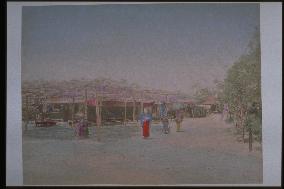
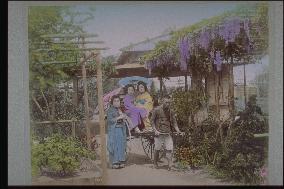
On the path between wisteria trestles, two women hold an umbrella on a rickshaw pulled by a cart man. Another woman stands next to them, holding an umbrella.==Date:unknown, Place:unknown, Photo:Ogawa Kazumasa, (Credit:Nagasaki University Library/Kyodo News Images) [Cabinet Number10‐36‐0]

  •  
A wisteria trellis at Kameido Shrine

A wisteria trellis at Kameido Shrine

As the name Tenjin suggests, the deity enshrined in the temple is Sugawara Michizane, and the structure of the shrine is an imitation of the Tenmangu in Dazaifu. Two women relax watching flowers.==Date:unknown, Place:Tokyo, Photo:Ogawa Kazumasa, (Credit:Nagasaki University Library/Kyodo News Images) [Cabinet Number8‐13‐0]

  •  
Gate and wisteria trellis at kameido tenjin shrine

Gate and wisteria trellis at kameido tenjin shrine

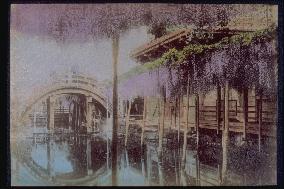
The tea house to the left protrudes over Shinji Pond, and flowers could be enjoyed there. An arch bridge stands ahead of the approach to the main hall of worship.==Date:unknown, Place:Tokyo, Photo:Ogawa Kazumasa, (Credit:Nagasaki University Library/Kyodo News Images) [Cabinet Number6‐17‐0]

  •  
A wisteria trellis at Kameido Shrine

A wisteria trellis at Kameido Shrine

The wisteria trellis at Kameido Tenjin was famous from the Edo era and has been portrayed in ukiyoe (wood block prints) and nishikie (coloured prints). The wisteria trellis in the photo was destroyed during World WarⅡ, and the present trellis was restored after the war. The arched bridge in the background has been replaced with a concrete bridge without bridge girders.==Date:unknown, Place:Tokyo, Photo:Kusakabe Kinbei, (Credit:Nagasaki University Library/Kyodo News Images) [Cabinet Number2‐30‐0]

  • Main
  • Top
  • Editorial
  • Creative
  • About Us
  • About ILG
  • Terms of use
  • Company
  • BEHIND
  • Price List
  • Single Plan
  • Monthly Plan
  • Services
  • Shooting
  • Rights Clearance
  • Support
  • FAQ
  • How To Buy
  • Contact Us
  • Become a Partner

© KYODO NEWS IMAGES INC

All Rights Reserved.

  • Editorial
  • Olympics
  • News
  • Sports
  • Japan
  • Tech
  • Royal
  • Disaster
  • NorthKorea
  • Old Japan
  • SNS
  • Creative
  • Food
  • Japan
  • Landscape
  • Animal
  • Popular
  • #Ukraine
  • #China
  • #coronavirus
  • #N. Korea
  • #Thailand
  • #Russia
  • #Ukraine
  • #China
  • #coronavirus
  • #N. Korea
  • #Thailand
  • #Russia
  • Food
  • Japan
  • Landscape
  • Animal
  • Olympics
  • News
  • Sports
  • Japan
  • Tech
  • Royal
  • Disaster
  • NorthKorea
  • Old Japan
  • SNS