•  
Emperor recalls years as student at Gakushuin

Emperor recalls years as student at Gakushuin

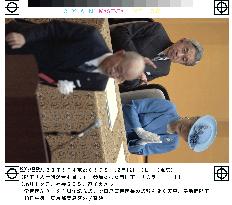
TOKYO, Japan - Emperor Akihito (L at back) and Empress Michiko attend a ceremony commemorating the 125th anniversary of Gakushuin in Mejiro in Tokyo's Toshima Ward on Dec. 13. In his speech, the emperor recalled being an elementary student at Gakushuin in 1940. Gakushuin was founded in 1877 as a peer school for the imperial family and related nobility. It became a private school after World War II.

  •  
Hirafuku folding screen returns to Japan after 70 years

Hirafuku folding screen returns to Japan after 70 years

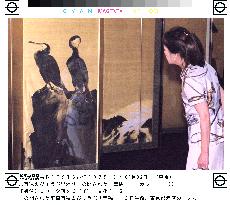
TOKYO, Japan - A visitor watches a folding screen presented to Italian fascist leader Benito Mussolini by the late Japanese industrialist Kishichiro Okura before World War II which was shown to the media Aug. 3 at a Tokyo hotel after almost 70 years abroad. The screen, called ''Araiso'' (Rocky Beach) and painted by Japanese artist Hyakusui Hirafuku (1877-1933), was presented to Mussolini after being displayed at an exhibition in Rome of Japanese art organized by Okura in 1930. It depicts a bird on a bare rock against a gold background.

  •  
Statue of General Saigo - Ueno Park, Tokyo, Japan

Statue of General Saigo - Ueno Park, Tokyo, Japan

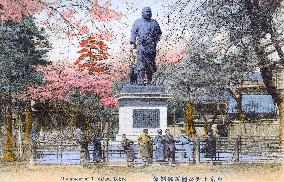
Statue of General Saigo Takamori (Takanaga) (1828-1877). Saigo was one of the most influential samurai in Japanese history, living during the late Edo Period and early Meiji Era. He has been dubbed the 'last true samurai'. The famous bronze statue shown here (of Saigo in hunting attire with his dog) stands in Ueno Park, Tokyo, Japan. Made by Takamura Koun, it was unveiled on 18 December 1898. Date: circa 1910s

  •  
Emperor recalls years as student at Gakushuin

Emperor recalls years as student at Gakushuin

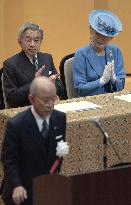
TOKYO, Japan - Emperor Akihito (L at back) and Empress Michiko attend a ceremony commemorating the 125th anniversary of Gakushuin in Mejiro in Tokyo's Toshima Ward on Dec. 13. In his speech, the emperor recalled being an elementary student at Gakushuin in 1940. Gakushuin was founded in 1877 as a peer school for the imperial family and related nobility. It became a private school after World War II. (Kyodo)

  •  
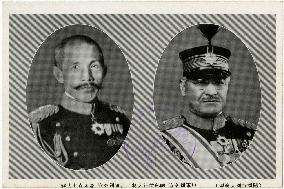
Japan - General Sadao Araki and General Nobuyuki Abe

Japan - General Sadao Araki and General Nobuyuki Abe

(left) General Sadao Araki (1877-1966) - general in the Imperial Japanese Army before and during World War II. Leader of the Kodo-ha (Imperial Way) faction, an ultra-nationalistic group active in the 1930s. He strongly advocated the importance of character building through rigid mental and physical discipline. (right) General Nobuyuki Abe (1875-1953) - general in the Imperial Japanese Army, Governor-General of Korea, and 36th Prime Minister of Japan from 30th August 1939 to 16th January 1940. Date: circa 1940

  •  
York, Minster, choir east c1877

York, Minster, choir east c1877

York, Minster, choir east c1877

  •  
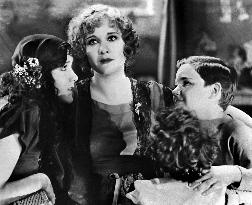
Peter Pan  film (1924)

Peter Pan film (1924)

Mary Brian, Esther Ralston & Jack Murphy Characters: Wendy Moira Angela Darling,Mrs. Darling & John Napoleon Darling Film: Peter Pan (1877) 01 May 1924 Date: 01-May-1924

  •  
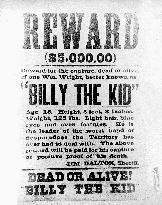
Billy The Kid  film (1877)

Billy The Kid film (1877)

Billy The Kid Reward Poster Film: Billy The Kid (1924) 01 May 1877 Date: 1877-05-01

  •  
MAURICE COSTELLO (b.1877)

MAURICE COSTELLO (b.1877)

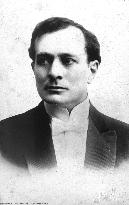
MAURICE COSTELLO Date: 1877

  •  
Suizenji Park

Suizenji Park

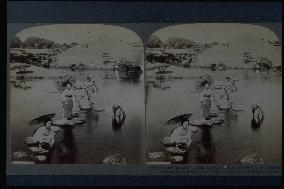
This is the well known Suizenji Jojuen Park in Kumamoto. The photograph was taken from the site of the former Suigetsu-tei. Suigetsu-tei was destroyed by fire in 1877 during the Seinan War, and the site is occupied today by Kokondenju-no-ma. Women with parasols stand on the stepping stones. This is probably a staged photograph sold as a souvenir.==Date:1904, Place:Kumamoto, Photo:Underwood, (Credit:Nagasaki University Library/Kyodo News Images) [Cabinet Number97‐4‐0]

  •  
The Kegon Falls

The Kegon Falls

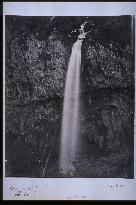
Kegon Falls is one of the three major waterfalls of Japan, along with Nachi Falls (Wakayama Prefecture) and Fukuroda Falls (Ibaragi Prefecture). It is roughly 97m high. Local resident Hoshino Gorobei built the road along the basin of the falls in 1900 and opened a teahouse. The elevator currently in service started operation in in 1930. Fujimura Misao committed suicide here in 1903.==Date:about 1877, Place:Nikko, Photo:F. Beato/R. Stillfried, (Credit:Nagasaki University Library/Kyodo News Images) [Cabinet Number96‐76‐0]

  •  
Suizenji Park?

Suizenji Park?

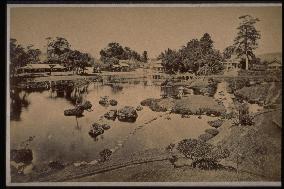
This photograph captures the entire view of Suizenji Jojuen Park seen from the southeast. Izumi Shinto Shrine, completed in October 1871, is visible to the far right. The two stone bridges to the left of the shrine were built as the shrine approach. Tomishige Rihei took this photograph, and the original plate is kept today at Tomishige Photography Studio. Taken between 1877 and 1887.==Date:unknown, Place:Kumamoto, Photo:, (Credit:Nagasaki University Library/Kyodo News Images) [Cabinet Number96‐26‐0]

  •  
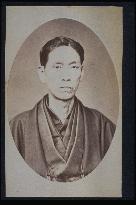
Portrait of (Goto)

Portrait of (Goto)

Portrait of (Goto)==Date:about 1877, Place:Osaka, Photo:unknown, (Credit:Nagasaki University Library/Kyodo News Images)

  •  
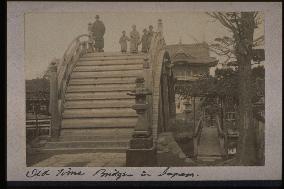
Taiko-bashi (Drum) Bridge at Kameido Shrine

Taiko-bashi (Drum) Bridge at Kameido Shrine

This is the sharply arched Taiko-bashi (also called Sori-bashi, or Warped Bridge ), which was apparently built after 1892. The present-day concrete Taiko-bashi was unveiled in August 1952 to commemorate the 1050th Sugawara Michizane anniversary and has a gentler slope with steps. The building visible behind the bridge is the Romon (Sakura Gate).==Date:about 1877, Place:Tokyo, Photo:unknown, (Credit:Nagasaki University Library/Kyodo News Images) [Cabinet Number96‐7‐0]

  •  
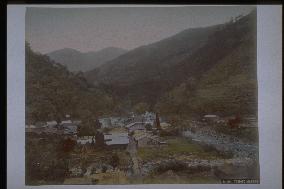
Yumoto Spa

Yumoto Spa

This is the spa town of Yumoto. The white building in the centre is Fukuzumi Inn, Kinzenro Inn built in 1877, and Bansuiro Inn completed in 1878 are visible. The old Asahi Bridge is over Hayakawa River on the right, which will be replaced by the new wooden truss bridge in September, 1885. Hence, this photo was taken between 1878 and 1885. The river in the foreground is Sukumo, and the mountain on the left is Yusaka.==Date:unknown, Place:Hakone, Photo:A. Farsari, (Credit:Nagasaki University Library/Kyodo News Images) [Cabinet Number81‐21‐0]

  •  
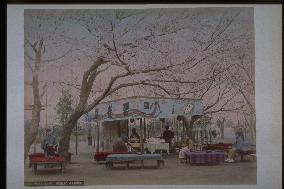
A teahouse in Yokohama Park

A teahouse in Yokohama Park

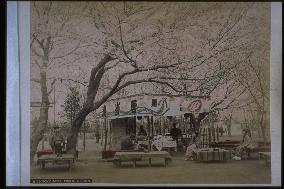
Yokohama Park was opened in 1877 as a Western-style park for the use of both Japanese and foreigners. In 1909, after the abolition of the foreign settlement, the entire park came under the management of Yokohama City. A fountain and flower beds were added, and the cherry blossoms attracted many visitors.==Date:unknown, Place:Yokohama, Photo:A. Farsari, (Credit:Nagasaki University Library/Kyodo News Images) [Cabinet Number81‐7‐0]

  •  
A lighthouse in Bizen

A lighthouse in Bizen

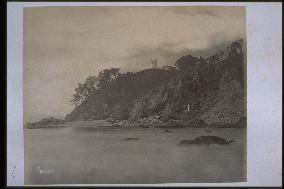
Although the photograph is entitled BIZEN on the lower left, this is Sugashima Lighthouse located at the northeastern tip of Sugashima (present-day Toba City, Mie Prefecture) at the entrance to Ise Bay. Designed by British engineer R. H. Brunton and first lit on July 1, 1873, the lighthouse is still in operation today. The attached residence was relocated to Meiji Mura Museum and designated an Important Cultural Asset by the Japanese government. This is an early photograph taken before 1877.==Date:unknown, Place:Okayama, Photo:R. Stillfried, (Credit:Nagasaki University Library/Kyodo News Images) [Cabinet Number78‐49‐0]

  •  
A teahouse at Oji

A teahouse at Oji

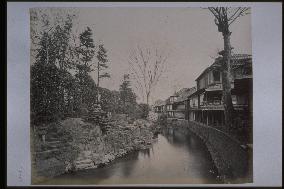
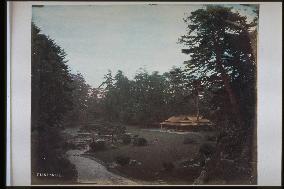
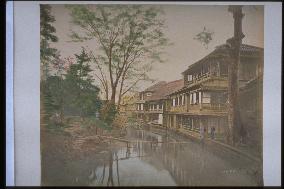
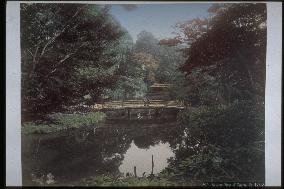
The garden of Ogiya Restaurant is on the left. The water is flowing through grooves in the rocks apparently made by long exposure. Felice Beato took a similar photograph of the garden at the beginning of the Meiji Period and added the caption: Stream with a rushing waterfall. Also, a similar photograph was published in an 1872 issue of The Far East entitled, Waterfall at O-jee from the Tea-House Garden. Taken between 1877 and 1887 (second decade of the Meiji Period).==Date:unknown, Place:Tokyo, Photo:R. Stillfried, (Credit:Nagasaki University Library/Kyodo News Images) [Cabinet Number78‐34‐0]

  •  
A five-story pagoda,Asakusa

A five-story pagoda,Asakusa

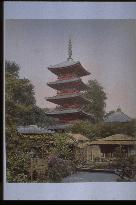
The five-story pagoda viewed from Benten Pond. The original is said to have been built by Awanokami Taira-no-Kinmasa in 942. The pagoda in this photograph was rebuilt in 1648 and designated a National Treasure in 1911, but it burned to the ground during 1945 air raids (together with the sutra depository). The present day five-story pagoda was erected in 1973. This photograph was taken in the second decade of the Meiji Period (1877-1887), probably by Stillfried.==Date:unknown, Place:Tokyo, Photo:R. Stillfried, (Credit:Nagasaki University Library/Kyodo News Images) [Cabinet Number77‐25‐0]

  •  
Fukiage Park,the Imperial Palace

Fukiage Park,the Imperial Palace

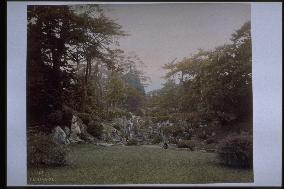
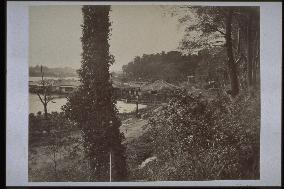
The residences of feudal lords were formerly located here as protection on the west side of Edo Castle. However, the area was converted to a garden after the great fire of the Meireki Period in 1657. The garden was designed in exact detail, right down to the location of each stone and tree. There were apparently two waterfalls in the garden, one at the southern edge of Oike (Great Pond) in the centre of the garden and the other near Takimi Teahouse. Since there is foliage, this photograph probably depicts the waterfall near the teahouse. Probably taken between 1877 and 1887 (second decade of Meiji Period).==Date:unknown, Place:Tokyo, Photo:R. Stillfried, (Credit:Nagasaki University Library/Kyodo News Images) [Cabinet Number77‐12‐0]

  •  
Fukiage Park,the Imperial Palace

Fukiage Park,the Imperial Palace

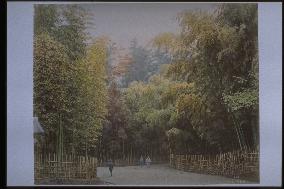
The 8th Shogun Tokugawa Yoshimune is said to have planted bamboo trees in Fukiage Garden located north of Hanzo-mon around 1725, a time when the shogunate was in dire financial straits. Bamboo was chosen because it is practical and abundant. The bamboo trees can still be seen today inside Hanzo-mon. Emperor Showa (1926-1989) used to enjoy digging up bamboo shoots here. Taken between 1877 and 1887 (second decade of the Meiji Period).==Date:unknown, Place:Tokyo, Photo:R. Stillfried, (Credit:Nagasaki University Library/Kyodo News Images) [Cabinet Number77‐6‐0]

  •  
Nagasaki Harbour and townscape seen from Tateyama

Nagasaki Harbour and townscape seen from Tateyama

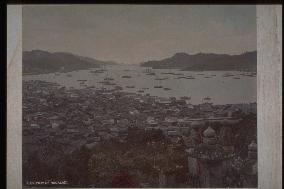
Nagasaki Harbour and townscape seen from Tateyama==Date:1877-1886, Place:Nagasaki, Photo:unknown, (Credit:Nagasaki University Library/Kyodo News Images)

  •  
A picture of Kumamoto Castle

A picture of Kumamoto Castle

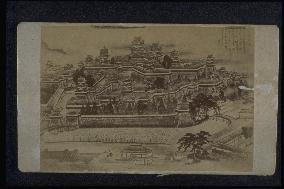
This is a bird's eye view of the honmaru (principal compound) of Kumamoto Castle, entitled Real View of Kumamoto Castle. A description is written in the upper right-hand corner. The castle burned down in 1877, just before the Seinan War, and many illustrations of this sort were made in memory of the old castle. The picture depicts the big and small donjons in the centre, the compounds to the right and left and on the lower levels, and the guard towers. The original plate is kept at Tomishige Photograph Studio, which has been in business since the early Meiji Period.==Date:unknown, Place:Kumamoto, Photo:unknown, (Credit:Nagasaki University Library/Kyodo News Images) [Cabinet Number71‐51‐0]

  •  
Kozu-sha,Osaka

Kozu-sha,Osaka

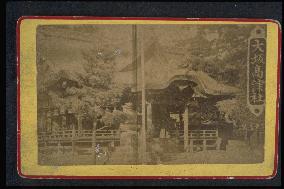
Legend has it that Emperor Nintoku, now enshrined at Takatsu Shinto Shrine, canceled all taxation for a period of three years after noting from the top of this hill that no smoke was coming out of the chimneys of houses below. The shrine is located on the cliff at Ue-machi and commands a panoramic view of the city of Osaka. Probably taken in the second decade of the Meiji Period (1877-1887).==Date:unknown, Place:Osaka, Photo:unknown, (Credit:Nagasaki University Library/Kyodo News Images) [Cabinet Number71‐12‐0]

  •  
Kita Mido (North Hall)

Kita Mido (North Hall)

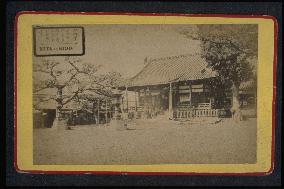
Kitanomido is also known as Nishihonganji Tsumura Betsuin (subtemple). Designated a subtemple in 1876, it served as a rest place for Emperor Meiji at the time of the Meiji Restoration. The Osaka Prefecture Office and Osaka Hospital were also located here at different times. Probably taken in the second decade of the Meiji Period (1877-1887).==Date:unknown, Place:Osaka, Photo:unknown, (Credit:Nagasaki University Library/Kyodo News Images) [Cabinet Number71‐9‐0]

  •  
Oura Catholic Church and Nagasaki Harbour

Oura Catholic Church and Nagasaki Harbour

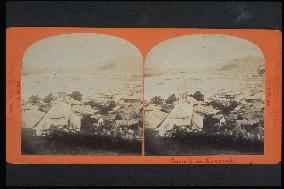
This is Nagasaki Port and Dejima viewed from behind Oura Church. The photograph is part of a stereo-photo series by Wilhelm Burger taken around 1868. The exterior wall of the back of the nave (the alter area) was semicircular at the time of the establishiment, and the pinnacles on the sides of the front of the church were already gone at the time of this photo. The big roof on the right is Myogyoji Temple. The building at Oura No. 11 is visible by the mouth of Oura River.==Date:about 1877, Place:Nagasaki, Photo:Wilhelm Burger, (Credit:Nagasaki University Library/Kyodo News Images)

  •  
Oura Catholic Church seen from Higashiyamate

Oura Catholic Church seen from Higashiyamate

Oura Catholic Church seen from Higashiyamate==Date:about 1877, Place:Nagasaki, Photo:Wilhelm Burger, (Credit:Nagasaki University Library/Kyodo News Images)

  •  
Daibutsu (the Great Buddha) of Kamakura

Daibutsu (the Great Buddha) of Kamakura

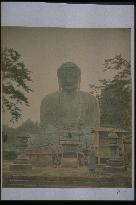
Like photographs #2748 and #3132, this is thought to have been taken between 1877 and 1887 when the reconstruction of the building was underway. However, no donors' signboards are visible. Also, there is a temporary shack on the lower right of the statue, but it is empty. This photograph may have been taken by Usui Shuzaburo (a 19th-century photographer in Yokohama). The Great Buddha is an object of worship and climbing upon it is prohibited today.==Date:unknown, Place:Kamakura, Photo:Usui Shuzaburo?, (Credit:Nagasaki University Library/Kyodo News Images) [Cabinet Number65‐6‐0]

  •  
Fukiage Park,the Imperial Palace

Fukiage Park,the Imperial Palace

Four teahouses appear in Fukiage Gyoen Jissokuzu (Actual Measurements of Fukiage Garden) issued by the Ministry of Internal Affairs in 1878. These are Suwa, Momiji, Takimi, and Namiki. This photograph depicts Takimi-Ochaya located right inside Onari Gate near Nishihane Bridge in the northeast corner of Fukiage Garden. This teahouse was built in 1711. Probably taken between 1877 and 1887 (second decade of the Meiji Period).==Date:unknown, Place:Tokyo, Photo:unknown, (Credit:Nagasaki University Library/Kyodo News Images) [Cabinet Number59‐55‐0]

  •  
The lotus moat of the Imperial Palace

The lotus moat of the Imperial Palace

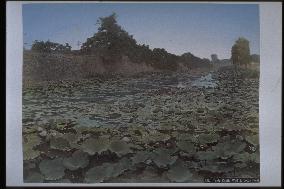
Hasuike (Lotus Pond) Moat between Honmaru and Koyozan. The height of the stone wall on the left indicates that the Honmaru Palace is on that side and therefore that this is a view of Hasuike-mon looking southeast from Shita-mon at Koyozan. Taken by Kusakabe Kinbei, probably between 1877 and 1887 (second decade of the Meiji Period).==Date:unknown, Place:Tokyo, Photo:unknown, (Credit:Nagasaki University Library/Kyodo News Images) [Cabinet Number59‐14‐0]

  •  
Dotonbori Lane

Dotonbori Lane

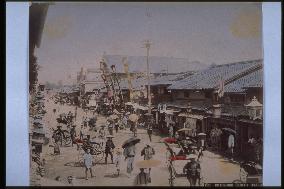
The large building in the centre is Benten-za, a theatre renovated in 1876 and again in 1894. This photograph depicts the building after renovations in 1876 and is therefore thought to have been taken in the second decade of the Meiji Period (1877-1887).==Date:unknown, Place:Osaka, Photo:unknown, (Credit:Nagasaki University Library/Kyodo News Images) [Cabinet Number57‐17‐0]

  •  
Yokohama Park

Yokohama Park

Yokohama Park was opened in 1877 as a Western-style park for the use of both Japanese and foreigners. In 1909, after the abolition of the foreign settlement, the entire park came under the management of Yokohama City. A fountain and flower beds were added, and the cherry blossoms attracted many visitors.==Date:unknown, Place:Yokohama, Photo:unknown, (Credit:Nagasaki University Library/Kyodo News Images) [Cabinet Number55‐41‐0]

  •  
The approach to Benzaiten,Shinobazu Pond

The approach to Benzaiten,Shinobazu Pond

Deai-jaya (teahouses for dating) lined the approach to Nakanoshima until 1877. The circumference of Shinobazu Pond was filled in in 1868. The fact that this work is yet to be completed in this photograph indicates that it was taken before that year. The torii gate of Toshogu Shrine is visible in the centre back.==Date:unknown, Place:Tokyo, Photo:unknown, (Credit:Nagasaki University Library/Kyodo News Images) [Cabinet Number55‐24‐0]

  •  
Yokohama Park

Yokohama Park

Yokohama Park was opened in 1877 as a Western-style park for the use of both Japanese and foreigners. In 1909, after the abolition of the foreign settlement, the entire park came under the management of Yokohama City. A fountain and flower beds were added, and the cherry blossoms attracted many visitors.==Date:unknown, Place:Yokohama, Photo:unknown, (Credit:Nagasaki University Library/Kyodo News Images) [Cabinet Number55‐12‐0]

  •  
A monument of a soldier at Mt. Ise

A monument of a soldier at Mt. Ise

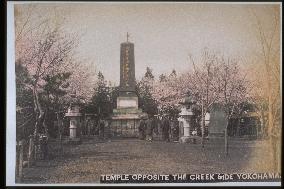
Monument erected to commemorate the victims of the 1877 Seinan War (Satsuma Rebellion). It was built at Iseyama Kodaijingu the year following the war. Iseyama Kodaijingu (Shinto shrine) was built after the relocation of a small shrine from Tobe-machi to Nogeyama in 1870. Nogeyama was renamed Iseyama after the construction of the new shrine.==Date:unknown, Place:Yokohama, Photo:unknown, (Credit:Nagasaki University Library/Kyodo News Images) [Cabinet Number55‐3‐0]

  •  
Autumn tints of Takinogawa, Oji

Autumn tints of Takinogawa, Oji

The photographs of Takinogawa taken during the Meiji Period capture the beauty of the autumn colours. However, after World War II, the development of the residential areas changed the area upstream. The river banks were covered with concrete and the river started to smell due to waste water from houses. The local people launched a movement to protect the river, and finally the government built the Otonashi River Shinsui (Water Friendly) Park in 1985. Spring water is mixed with the natural flow and filtered. Thus, clean water is circulated in certain areas. Depicting the area under present-day Otonashi Bridge, this photograph was taken by Kusakabe Kinbei between 1877 and 1887 (second decade of the Meiji Period).==Date:unknown, Place:Tokyo, Photo:Kusakabe Kinbei, (Credit:Nagasaki University Library/Kyodo News Images) [Cabinet Number53‐32‐0]

  •  
A teahouse at Oji

A teahouse at Oji

The cooks and waitresses are intentionally posing for this photograph believed to have been taken by Usui Shuzaburo, an apprentice to Shimooka Renjo. Ogiya Restaurant was also known for its expertise in cooking. Take-out Kamayaki Tamago (Pan Baked Egg Omelet) gained special popularity. This dish is famous to this day. Taken between 1877 and 1887 (second decade of the Meiji Period).==Date:unknown, Place:Tokyo, Photo:unknown, (Credit:Nagasaki University Library/Kyodo News Images) [Cabinet Number53‐33‐0]

  •  
The 1st National Industrial Exhibition (Ueno Park)

The 1st National Industrial Exhibition (Ueno Park)

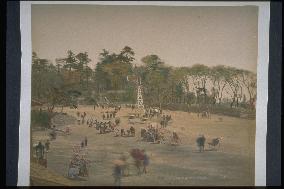
The stairs to Ueno Park seen from Ueno Hirokoji Square, taken during the First National Industrial Exhibition held from August 21 to November 30, 1877. A Western-style windmill with a blade length of 15m used for pumping water was placed at the bottom of the stairs and became a popular attraction. The panel to the left of the stairs possibly carried information about the exhibition. Some vendors have set up shop.==Date:1877, Place:Tokyo, Photo:unknown, (Credit:Nagasaki University Library/Kyodo News Images) [Cabinet Number53‐13‐0]

  •  
Yasukuni Shrine,Kudan

Yasukuni Shrine,Kudan

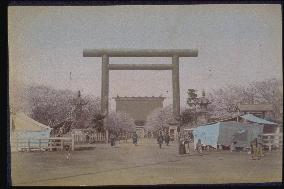
Shokonsha Shrine (Shrine to Invite Spirits) was built in 1869 as a dedication to the spirits of the samurai who died in the Boshin War. The soldiers who died in the Saga Rebellion and Taiwan Expedition of 1874 and the Seinan War of 1877 were also enshrined here. In 1879 the shrine was renamed Bekkaku Kanpeisha Yasukuni Shinto Shrine. The words bekkaku kanpeisha mean that the men enshrined here made special contributions to their country. Taken between 1887 and 1897.==Date:unknown, Place:Tokyo, Photo:Tamamura Kozaburo, (Credit:Nagasaki University Library/Kyodo News Images) [Cabinet Number48‐73‐0]

  •  
The theatre district in Isezaki-cho

The theatre district in Isezaki-cho

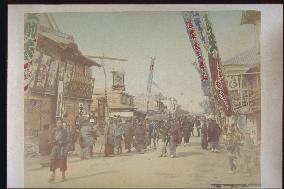
The theater town in Isezakicho. Theater huts stood along from around 1877, and it developed into an amusement district.==Date:1887-1896, Place:Yokohama, Photo:Kusakabe Kinbei, (Credit:Nagasaki University Library/Kyodo News Images) [Cabinet Number40‐1‐0]

  •  
Miyanoshita village

Miyanoshita village

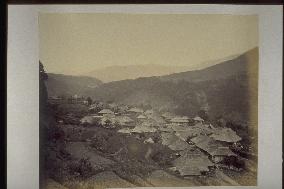
The Naraya Hotel can be seen, but not the Fujiya Hotel, so this photo was taken before 1877. Miyanoshita was a spa from the old days, with inns such as Fujiya, Naraya and Yamadaya and was famous for the stone bath of the Taiko in Sokokura. Baelz and Chamberlain also enjoyed the scenery.==Date:unknown, Place:Hakone, Photo:F. Beato, (Credit:Nagasaki University Library/Kyodo News Images) [Cabinet Number36‐6‐0]

  •  
Isaba-sen and benzai-sen,transport ships,in oura NAGASAKI

Isaba-sen and benzai-sen,transport ships,in oura NAGASAKI

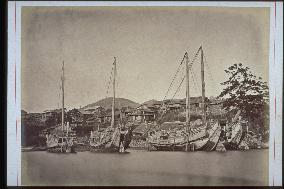
Large and middle-sized Benzai boats and Isaba boats at Oura, Nagasaki. The two at the right are relatively large Benzai boats built in the Kansai style of about 1000 koku , and the one in the center is a middle size of about 500 koku. The one to the left, which is small and has a different form, is probably the Isaba boat that was popular in the Kansai area for travel over short distances.==Date:1877, Place:Nagasaki, Photo:unknown, (Credit:Nagasaki University Library/Kyodo News Images) [Cabinet Number21‐18‐0]

  •  
The former Chumon Gate,Suwa Shrine

The former Chumon Gate,Suwa Shrine

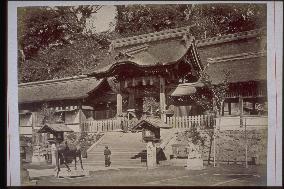
Entitled Entrance of temple in English, but this is the old middle gate of Suwa Shinto Shrine in Nagasaki. It is a photo from the album of Ueno Hikoma. It was taken between 1877 and 1887, as the Imari porcelain lantern is still not installed by the gate.==Date:unknown, Place:Nagasaki, Photo:unknown, (Credit:Nagasaki University Library/Kyodo News Images) [Cabinet Number21‐15‐0]

  •  
Cherry-viewing

Cherry-viewing

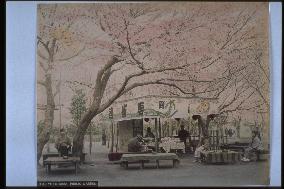
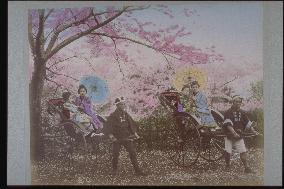
The rickshaw was invented in 1868, and developed rapidly as a vehicle in the era of civilization . In 1877 in Tokyo, there were 14,000 rickshaws for two passengers, and 10,000 for a single passenger. Women dressed in contempory style sit under the cherry blossoms.==Date:Middle Meiji, Place:unknown, Photo:Ogawa Kazumasa, (Credit:Nagasaki University Library/Kyodo News Images) [Cabinet Number10‐42‐0]

  •  
Viewing Shin-Ohashi from Umegasaki Bridge

Viewing Shin-Ohashi from Umegasaki Bridge

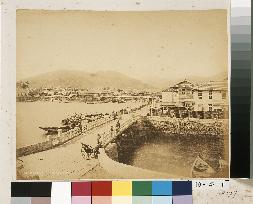
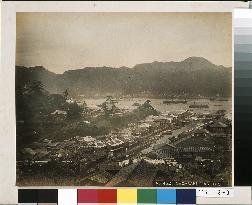
This is a view of Shinchi and Dejima from Umegasaki Bridge looking along the waterfront toward Dejima and Shinchi. Umegasaki Bridge is the wooden structure built in 1869. The date is between 1877 and 1887.==Date:unknown, Place:Nagasaki, Photo:unknown, (Credit:Nagasaki University Library/Kyodo News Images) [Cabinet Number110‐47‐0]

  •  
A distant view of Nagasaki Harbour from Tateyama

A distant view of Nagasaki Harbour from Tateyama

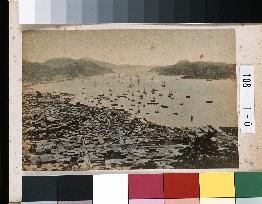
This photograph taken from Tateyama depicts the northern part of Nagasaki and the waterfront from Daikoku-machi to Dejima around 1877. A cannon installed by the former Saga Clan is visible on the lower right. The area from Daikoku-machi, Uragoto-machi and Ohato to Dejima is shown. The waterfront was extended around 1887 to make way for the newly constructed Togitsu Road.==Date:unknown, Place:Nagasaki, Photo:unknown, (Credit:Nagasaki University Library/Kyodo News Images) [Cabinet Number108‐1‐0]

  •  
The city of Nagasaki seen from Fukusaiji Temple

The city of Nagasaki seen from Fukusaiji Temple

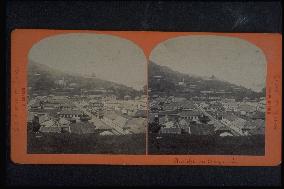
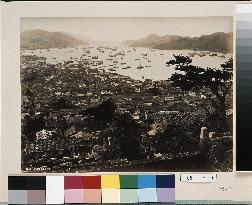
This is a view from the cemetery at Fukusaiji Temple looking over central Nagasaki and the waterfront area from Daikoku-machi to Dejima. The re-routing of Nakashima River had not been completed at this time, so the date is between 1877 and 1887. Also, the construction of the new Urakami Road along the waterfront from Dejima to Goto-machi has not been completed yet. A cannon platform is visible near the edge of the pine tree. The open land in the centre is the site of the former Omura Clan residence.==Date:unknown, Place:Nagasaki, Photo:unknown, (Credit:Nagasaki University Library/Kyodo News Images) [Cabinet Number109‐4‐0]

  •  
Along Oura River

Along Oura River

Along Oura River==Date:1877-1886?, Place:Nagasaki, Photo:Tamamura Kozaburo, (Credit:Nagasaki University Library/Kyodo News Images)

  •  
Kanazawa Castle in central Japan

Kanazawa Castle in central Japan

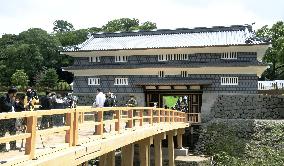
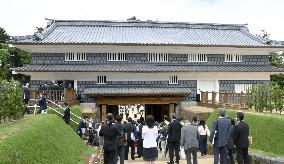
Photo taken July 18, 2020, shows the just restored Nezumitamon bridge and Nezumitamon gate at Kanazawa Castle in central Japan. A ceremony was held the same day celebrating the restoration of the gate, which burned down in a fire in 1884, and the bridge, which was dismantled in 1877 as it became too old.

  •  
Kanazawa Castle in central Japan

Kanazawa Castle in central Japan

Photo taken July 18, 2020, shows the just restored Nezumitamon bridge and Nezumitamon gate at Kanazawa Castle in central Japan. A ceremony was held the same day celebrating the restoration of the gate, which burned down in a fire in 1884, and the bridge, which was dismantled in 1877 as it became too old.

  • Main
  • Top
  • Editorial
  • Creative
  • About Us
  • About ILG
  • Terms of use
  • Company
  • BEHIND
  • Price List
  • Single Plan
  • Monthly Plan
  • Services
  • Shooting
  • Rights Clearance
  • Support
  • FAQ
  • How To Buy
  • Contact Us
  • Become a Partner

© KYODO NEWS IMAGES INC

All Rights Reserved.

  • Editorial
  • Olympics
  • News
  • Sports
  • Japan
  • Tech
  • Royal
  • Disaster
  • NorthKorea
  • Old Japan
  • SNS
  • Creative
  • Food
  • Japan
  • Landscape
  • Animal
  • Popular
  • #Ukraine
  • #Russia
  • #coronavirus
  • #N. Korea
  • #Thailand
  • #China
  • #Ukraine
  • #Russia
  • #coronavirus
  • #N. Korea
  • #Thailand
  • #China
  • Food
  • Japan
  • Landscape
  • Animal
  • Olympics
  • News
  • Sports
  • Japan
  • Tech
  • Royal
  • Disaster
  • NorthKorea
  • Old Japan
  • SNS