•  
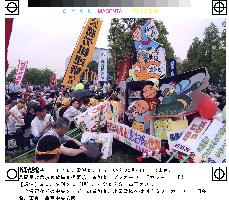
(2)May Day rallies held across Japan

(2)May Day rallies held across Japan

TOKYO, Japan - Banners and placards critical of Prime Minister Junichiro Koizumi's policies are prominent in this year's May Day rallies organized by the National Confederation of Trade Unions (Zenroren) and some affiliates of the Japanese Trade Union Confederation (Rengo) on May 1. Zenroren held its main gathering in Tokyo's Kameido Park, drawing an estimated 80,000 people.

  •  
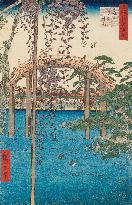
Drum bridge at Kameido Tenjin Shrine

Drum bridge at Kameido Tenjin Shrine

Utagawa Hiroshige print of Drum bridge at Kameido Tenjin Shrine. Inside Kameido Tenjin Shrine. Part of the 'One Hundred Famous Views of Edo' series.

  •  
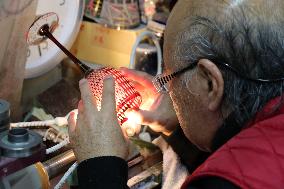
Japan's cut glass master carries on tradition, answering modern needs

Japan's cut glass master carries on tradition, answering modern needs

Ryuichi Kumakura, a 70-year-old artisan of Edo Kiriko traditional Japanese cut glass, engraves his original "Kometsunagi" (chain of rice grains) design on a wine glass at his studio in Tokyo's Kameido on Dec. 12, 2017. (Kyodo) ==Kyodo

  •  
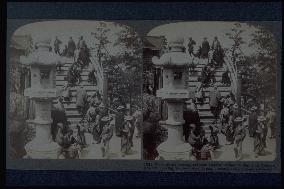
Taiko-bashi (drum) Bridge at Kameido Shrine

Taiko-bashi (drum) Bridge at Kameido Shrine

Stereograph published in 1904. Although the bridge is the same as in photographs #5001and #2215, the stone lantern in the foreground is larger. Gentlemen wearing Western-style suits and hats are visible among the worshippers, a sign of the times. Frequently a notice was posted on the parapets urging the elderly, ladies and children not to cross the bridge because of the danger (from Saishin Tokyo Hanjoki published in 1903).==Date:1904, Place:Tokyo, Photo:Underwood, (Credit:Nagasaki University Library/Kyodo News Images) [Cabinet Number97‐66‐0]

  •  
A wisteria trellis at Kameido Shrine

A wisteria trellis at Kameido Shrine

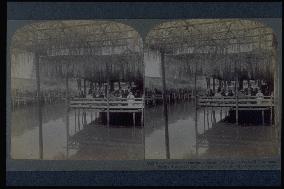
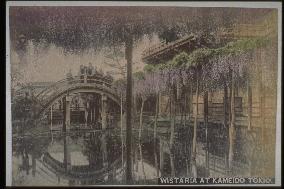
These wisteria terraces were all destroyed during World War II air raids. The wisteria trees of today were planted one by one from around 1950 by the local people. The wisteria blossoms at Kameido Tenjin Shrine are said to be the best in Tokyo, and they were chosen as one of the New Best One Hundred Scenes of Tokyo. This stereograph was published in 1904 in a book-shaped case.==Date:1904, Place:Tokyo, Photo:Underwood, (Credit:Nagasaki University Library/Kyodo News Images) [Cabinet Number97‐67‐0]

  •  
Kameido Shrine

Kameido Shrine

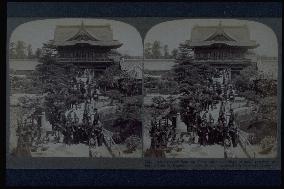
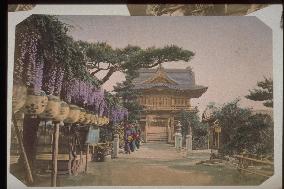
View of the Romon Gate from Taiko-bashi (Drum Bridge) located just through the torii gate at the entrance of the shrine. The five girls in hakama trousers are perhaps praying to pass a school examination. Three bridges span Shinji Pond: Taiko-bashi, Hira-bashi, and Taiko-bashi. They are said to represent the past, present, and future. This stereograph was published in 1904 by Underwood & Underwood Co.==Date:1904, Place:Tokyo, Photo:Underwood, (Credit:Nagasaki University Library/Kyodo News Images) [Cabinet Number97‐65‐0]

  •  
Taiko-bashi (Drum) Bridge at Kameido Shrine

Taiko-bashi (Drum) Bridge at Kameido Shrine

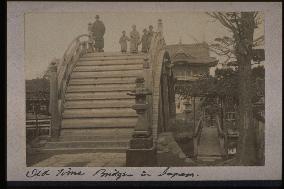
This is the sharply arched Taiko-bashi (also called Sori-bashi, or Warped Bridge ), which was apparently built after 1892. The present-day concrete Taiko-bashi was unveiled in August 1952 to commemorate the 1050th Sugawara Michizane anniversary and has a gentler slope with steps. The building visible behind the bridge is the Romon (Sakura Gate).==Date:about 1877, Place:Tokyo, Photo:unknown, (Credit:Nagasaki University Library/Kyodo News Images) [Cabinet Number96‐7‐0]

  •  
Kameido Shrine

Kameido Shrine

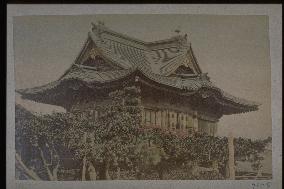
Originally called Kameido Tenmangu, the shrine was renamed Kameido Jinja in 1873 Kameido Tenjinsha in 1936. The original shrine was built soon after the Great Fire of Meireki (1657) when the Shogunate planned to develop the Honjo area and the government provided the land for the shrine. This is the Romon Gate. This gate and the main shrine building were destroyed by air raids in 1945.==Date:unknown, Place:Tokyo, Photo:unknown, (Credit:Nagasaki University Library/Kyodo News Images) [Cabinet Number91‐5‐0]

  •  
A wisteria trellis at Kameido Shrine

A wisteria trellis at Kameido Shrine

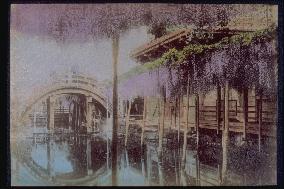
The smaller Taiko-bashi (Sori-bashi) as in photographs #2652, #4197 and #2203. There is a small bridge in front. The same bridge is also visible in photograph #2615. This bridge is visible in a picture postcard published around 1907, indicating that this photograph was taken a little later. Since wisteria blossoms are usually viewed from below, this view from the bridge was quite rare.==Date:unknown, Place:Tokyo, Photo:unknown, (Credit:Nagasaki University Library/Kyodo News Images) [Cabinet Number88‐26‐0]

  •  
A wisteria trellis at Kameido Shrine

A wisteria trellis at Kameido Shrine

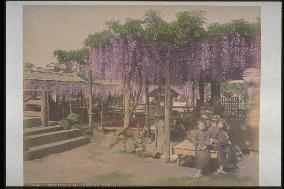
People relaxing with tea under the wisteria blossoms near Shinji Pond. Dazaifu and Kameido shrines are both dedicated to Sugawara Michizane, although Dazaifu Tenmangu in Fukuoka is famous for plum blossoms while Kameido Tenmangu in Tokyo is famous for wisteria blossoms. Sugawara Michizane is revered as a deity of learning, and during the examination season the shrine is filled with ema cards upon which students write their wishes.==Date:unknown, Place:Tokyo, Photo:unknown, (Credit:Nagasaki University Library/Kyodo News Images) [Cabinet Number88‐27‐0]

  •  
A wisteria trellis at Kameido Shrine

A wisteria trellis at Kameido Shrine

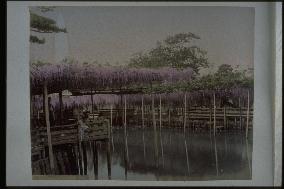
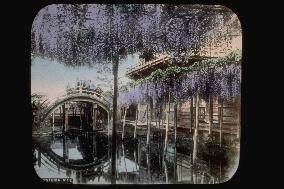
The reflection of the wisteria on Shinji Pond is beautiful. These wisteria blossoms, called Goshaku-fuji, were held in high regard during the entire Edo Period, and they appear in ukiyoe prints by Ando Hiroshige and Utagawa Kuniyoshi. This is still a popular place to appreciate the wisteria blossoms. Taken around 1897.==Date:unknown, Place:Tokyo, Photo:unknown, (Credit:Nagasaki University Library/Kyodo News Images) [Cabinet Number87‐11‐0]

  •  
A wisteria trellis at Kameido Shrine

A wisteria trellis at Kameido Shrine

This area was formerly an island shaped like a turtle. It was later connected to the mainland and Kame-mura (Turtle Village) was established. The well dug there was called Kamenoi (Turtle Well). Sometime later, Kame-mura became confused with Kamenoi and the village came to be called Kameido-mura. It is said that during the Edo Period, it was called Kamedo-mura without the i sound. Due to its name, many people brought turtles here. Today, there are still many turtles in the pond, but most are imported species.==Date:unknown, Place:Tokyo, Photo:A. Farsari, (Credit:Nagasaki University Library/Kyodo News Images) [Cabinet Number82‐29‐0]

  •  
A wisteria trellis at Kameido Shrine

A wisteria trellis at Kameido Shrine

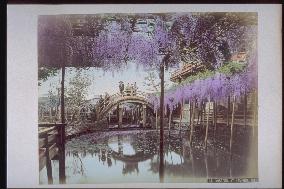
This is the smaller Taiko-bashi (Sori-bashi) located in front of the Romon (Sakura Gate) on the right. The Wisteria Festival of Kameido Tenjin Shrine held from mid-April to mid-May every year is a harbinger of summer. There are many other events held at the shrine. The parents of young children release carp into Shinji Pond during the Shichi-Go-San Festival on November 15 to pray for the healthy growth of their children. Masaoka shiki wrote the haiku poem: Sori-bashi, the wisteria are purple and carp red.==Date:unknown, Place:Tokyo, Photo:A. Farsari, (Credit:Nagasaki University Library/Kyodo News Images) [Cabinet Number81‐15‐0]

  •  
A wisteria trellis at Kameido Shrine

A wisteria trellis at Kameido Shrine

This is the smaller Taiko-bashi (Sori-bashi) located in front of the Romon (Sakura Gate) on the right. The Wisteria Festival of Kameido Tenjin Shrine held from mid-April to mid-May every year is a harbinger of summer. There are many other events held at the shrine. The parents of young children release carp into Shinji Pond during the Shichi-Go-San Festival on November 15 to pray for the healthy growth of their children. Masaoka shiki wrote the haiku poem: Sori-bashi, the wisteria are purple and carp red.==Date:unknown, Place:Tokyo, Photo:Tamamura Kozaburo, (Credit:Nagasaki University Library/Kyodo News Images) [Cabinet Number80‐25‐0]

  •  
A wisteria trellis at Kameido Shrine

A wisteria trellis at Kameido Shrine

This is the smaller Taiko-bashi (Sori-bashi) located in front of the Romon (Sakura Gate) on the right. The Wisteria Festival of Kameido Tenjin Shrine held from mid-April to mid-May every year is a harbinger of summer. There are many other events held at the shrine. The parents of young children release carp into Shinji Pond during the Shichi-Go-San Festival on November 15 to pray for the healthy growth of their children. Masaoka shiki wrote the haiku poem: Sori-bashi, the wisteria are purple and carp red.==Date:unknown, Place:Tokyo, Photo:unknown, (Credit:Nagasaki University Library/Kyodo News Images) [Cabinet Number53‐38‐0]

  •  
A teahouse with a wisteria trellis

A teahouse with a wisteria trellis

Kameido Tenjin Shrine was the most famous wisteria-blossom viewing place in Tokyo. This is probably Kameido Tenjin Shrine, because the stone lantern is very similar to that portrayed in photograph #4511, and because there seems to be a pond in the background. However, there is no definite proof. Probably taken in the mid-Meiji Period.==Date:unknown, Place:Tokyo, Photo:unknown, (Credit:Nagasaki University Library/Kyodo News Images) [Cabinet Number53‐34‐0]

  •  
A wisteria trellis at Kameido Shrine

A wisteria trellis at Kameido Shrine

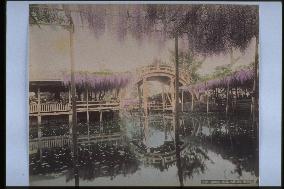
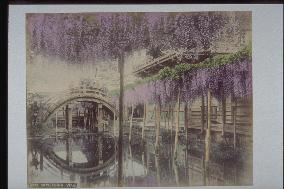
Taiko-bashi (Sori-bashi) and wisteria blossoms around 1897. View from the west side of Shinji Pond located to the left of the front entrance of the shrine. This is the bridge in photograph #4832, only viewed from the left. The bridge was designed to form a circle when viewed along with its reflection in the pond.==Date:unknown, Place:Tokyo, Photo:unknown, (Credit:Nagasaki University Library/Kyodo News Images) [Cabinet Number53‐17‐0]

  •  
A wisteria trellis at Kameido Shrine

A wisteria trellis at Kameido Shrine

Many festivals are celebrated throughout the year at Kameido Tenjin Shrine. While the Wisteria Festival is well-known, Usokae Shinji is also popular. This event is based on the belief that the mythical uso bird returns from the previous year and brings good luck with it. The conversation staged between the shrine priest and an oni (devil) at the Setsubun Tsuinasai Festival in February is also interesting. Since the oni has four eyes, the roof of the shrine office is embellished with ceramic tiles showing a devil with four eyes.==Date:unknown, Place:Tokyo, Photo:unknown, (Credit:Nagasaki University Library/Kyodo News Images) [Cabinet Number53‐4‐0]

  •  
Kameido Shrine

Kameido Shrine

Kameido Tenmangu Shrine (present-day Kameido Tenjinsha) is one of the three main shrines dedicated to Sugawara Michizane. The other two are Dazaifu Tenmangu Shrine in Fukuoka and Kitano Tenmangu Shrine in Kyoto. The shrine is said to go back to the year 1661when the Shinto priest of Dazaifu, Sugawara Otorii Nobusuke, carved a holy image from the wood of the tobiume (plum tree) and enshrined it in the eastern part of Honjo. In 1662, the fourth Shogun Ietsuna donated the land to the shrine, and shrine buildings including the Romon Gate, Shinji Pond, and Taiko Bridge were later built in imitation of the Dazaifu Tenmangu Shrine.==Date:unknown, Place:Tokyo, Photo:unknown, (Credit:Nagasaki University Library/Kyodo News Images) [Cabinet Number51‐39‐0]

  •  
Taiko-bashi (Drum) Bridge at Kameido Shrine

Taiko-bashi (Drum) Bridge at Kameido Shrine

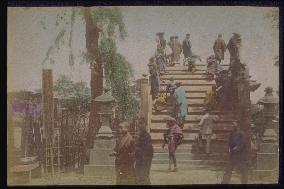
The steep inclination of Taiko Bridge made it hard to cross, but these people seem to be enjoying themselves. The inclination of the bridge shown in a photograph from the early Meiji Period is gentler. There is also a photograph of the bridge taken in 1890-92 when it was in such a bad state that people were not allowed to cross it. The bridge shown here was apparently built soon after that time, which means that this photograph was taken after 1892.==Date:unknown, Place:Tokyo, Photo:Tamamura Kozaburo, (Credit:Nagasaki University Library/Kyodo News Images) [Cabinet Number48‐67‐0]

  •  
A wisteria trellis at Kameido Shrine

A wisteria trellis at Kameido Shrine

This is the smaller Taiko-bashi (Sori-bashi) located in front of the Romon (Sakura Gate) on the right. The Wisteria Festival of Kameido Tenjin Shrine held from mid-April to mid-May every year is a harbinger of summer. There are many other events held at the shrine. The parents of young children release carp into Shinji Pond during the Shichi-Go-San Festival on November 15 to pray for the healthy growth of their children. Masaoka shiki wrote the haiku poem: Sori-bashi, the wisteria are purple and carp red.==Date:unknown, Place:Tokyo, Photo:Tamamura Kozaburo, (Credit:Nagasaki University Library/Kyodo News Images) [Cabinet Number48‐56‐0]

  •  
A wisteria trellis at Kameido Shrine

A wisteria trellis at Kameido Shrine

The identical structure as the photos numbered 2-30 and 16-27. The wisteria shelf and arched bridge in the back have been destroyed during the war, and the present one has been rebuilt after the war.==Date:unknown, Place:Tokyo, Photo:Kusakabe Kinbei, (Credit:Nagasaki University Library/Kyodo News Images) [Cabinet Number40‐5‐0]

  •  
A wisteria trellis at Kameido Shrine

A wisteria trellis at Kameido Shrine

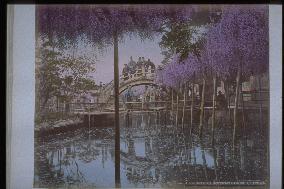
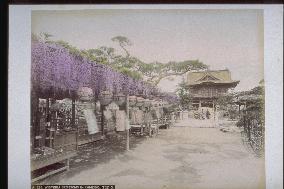
Kameido Tenjin was famous for its wisteria blossoms. The wooden arched bridge in the front of the photo was famous, but it has been rebuilt. The fourth Shogun Ietsuna built the foundation for the present buildings by donating the main building and others.==Date:unknown, Place:Tokyo, Photo:unknown, (Credit:Nagasaki University Library/Kyodo News Images) [Cabinet Number31‐45‐0]

  •  
A wisteria trellis at Kameido Shrine

A wisteria trellis at Kameido Shrine

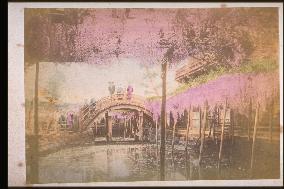
Probably the same negative was used for this as for the photo numbered 2-30. The people on the arched bridge are the same. The colouring of this photo is slightly less clear.==Date:unknown, Place:Tokyo, Photo:unknown, (Credit:Nagasaki University Library/Kyodo News Images) [Cabinet Number16‐27‐0]

  •  
A wisteria trellis at Kameido Shrine

A wisteria trellis at Kameido Shrine

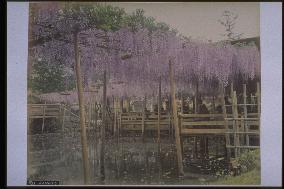
The English caption reads Wisteria vine . The wisteria vine of Kameido Tenjin in Tokyo was a famous site, and many photos of it remain.==Date:unknown, Place:Tokyo, Photo:Tamamura Kozaburo, (Credit:Nagasaki University Library/Kyodo News Images) [Cabinet Number11‐3‐0]

  •  
Wisteria and girls

Wisteria and girls

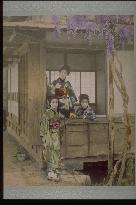
This collection includes the Wisteria of Kameido, Tokyo (53-4). This photo was probably taken at the same location. The photographer's attention is focused on the style of the three women. The atmosphere of Edo remains in the Hori River and the building, which looks like a teahouse.==Date:unknown, Place:Tokyo, Photo:Ogawa Kazumasa, (Credit:Nagasaki University Library/Kyodo News Images) [Cabinet Number10‐50‐0]

  •  
A wisteria trellis at Kameido Shrine

A wisteria trellis at Kameido Shrine

As the name Tenjin suggests, the deity enshrined in the temple is Sugawara Michizane, and the structure of the shrine is an imitation of the Tenmangu in Dazaifu. Two women relax watching flowers.==Date:unknown, Place:Tokyo, Photo:Ogawa Kazumasa, (Credit:Nagasaki University Library/Kyodo News Images) [Cabinet Number8‐13‐0]

  •  
Gate and wisteria trellis at kameido tenjin shrine

Gate and wisteria trellis at kameido tenjin shrine

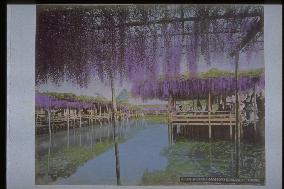
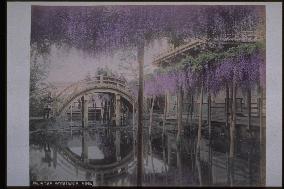
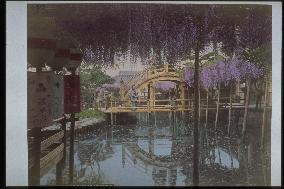
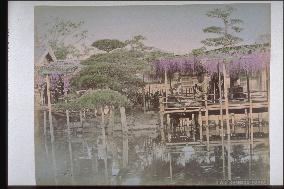
The tea house to the left protrudes over Shinji Pond, and flowers could be enjoyed there. An arch bridge stands ahead of the approach to the main hall of worship.==Date:unknown, Place:Tokyo, Photo:Ogawa Kazumasa, (Credit:Nagasaki University Library/Kyodo News Images) [Cabinet Number6‐17‐0]

  •  
Iris flowers in horikiri

Iris flowers in horikiri

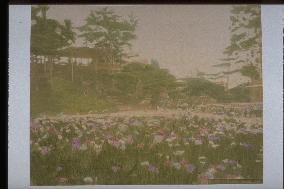
The irises of Horikiri were famous together with the wisteria of Kameido and have been a popular motif in ukiyoe, nishikie and travelogues.==Date:unknown, Place:Tokyo, Photo:Kusakabe Kinbei, (Credit:Nagasaki University Library/Kyodo News Images) [Cabinet Number2‐31‐0]

  •  
A wisteria trellis at Kameido Shrine

A wisteria trellis at Kameido Shrine

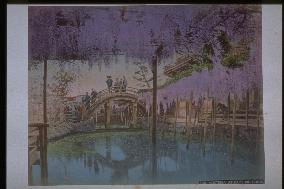
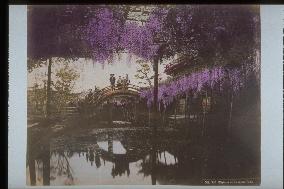
The wisteria trellis at Kameido Tenjin was famous from the Edo era and has been portrayed in ukiyoe (wood block prints) and nishikie (coloured prints). The wisteria trellis in the photo was destroyed during World WarⅡ, and the present trellis was restored after the war. The arched bridge in the background has been replaced with a concrete bridge without bridge girders.==Date:unknown, Place:Tokyo, Photo:Kusakabe Kinbei, (Credit:Nagasaki University Library/Kyodo News Images) [Cabinet Number2‐30‐0]

  •  
Kameido Tenjin Honsha

Kameido Tenjin Honsha

Kameido Tenjin Honsha==Date:Early Meiji, Place:Tokyo, Photo:unknown, (Credit:Nagasaki University Library/Kyodo News Images)

  •  
Kameido Tenjin

Kameido Tenjin

Kameido Tenjin==Date:Early Meiji, Place:Tokyo, Photo:unknown, (Credit:Nagasaki University Library/Kyodo News Images)

  •  
Kameido

Kameido

Kameido==Date:Early Meiji, Place:Tokyo, Photo:unknown, (Credit:Nagasaki University Library/Kyodo News Images)

  •  
A wisteria trellis at Kameido Shrine

A wisteria trellis at Kameido Shrine

A wisteria trellis at Kameido Shrine ==Date:unknown, Place:Tokyo, Photo:unknown, (Credit:Nagasaki University Library/Kyodo News Images)

  •  
A wisteria trellis at Kameido Shrine

A wisteria trellis at Kameido Shrine

A wisteria trellis at Kameido Shrine ==Date:unknown, Place:Tokyo, Photo:unknown, (Credit:Nagasaki University Library/Kyodo News Images)

  •  
(2)May Day rallies held across Japan

(2)May Day rallies held across Japan

TOKYO, Japan - Banners and placards critical of Prime Minister Junichiro Koizumi's policies are prominent in this year's May Day rallies organized by the National Confederation of Trade Unions (Zenroren) and some affiliates of the Japanese Trade Union Confederation (Rengo) on May 1. Zenroren held its main gathering in Tokyo's Kameido Park, drawing an estimated 80,000 people.

  •  
Kameido Tenjin shrine in Tokyo

Kameido Tenjin shrine in Tokyo

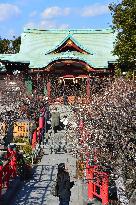
File photo taken on Feb. 5, 2018, shows the precincts of Kameido Tenjin shrine in eastern Tokyo. The Shinto shrine, dedicated to Tenjin, the posthumous, deified name of Sugawara no Michizane, poet, scholar and politician of the Heian Period, is a popular place for students to pray for exam success. (Kyodo) ==Kyodo

  • Main
  • Top
  • Editorial
  • Creative
  • About Us
  • About ILG
  • Terms of use
  • Company
  • BEHIND
  • Price List
  • Single Plan
  • Monthly Plan
  • Services
  • Shooting
  • Rights Clearance
  • Support
  • FAQ
  • How To Buy
  • Contact Us
  • Become a Partner

© KYODO NEWS IMAGES INC

All Rights Reserved.

  • Editorial
  • Olympics
  • News
  • Sports
  • Japan
  • Tech
  • Royal
  • Disaster
  • NorthKorea
  • Old Japan
  • SNS
  • Creative
  • Food
  • Japan
  • Landscape
  • Animal
  • Popular
  • #Ukraine
  • #Russia
  • #coronavirus
  • #N. Korea
  • #Thailand
  • #China
  • #Ukraine
  • #Russia
  • #coronavirus
  • #N. Korea
  • #Thailand
  • #China
  • Food
  • Japan
  • Landscape
  • Animal
  • Olympics
  • News
  • Sports
  • Japan
  • Tech
  • Royal
  • Disaster
  • NorthKorea
  • Old Japan
  • SNS