•  
Kameido Shrine

Kameido Shrine

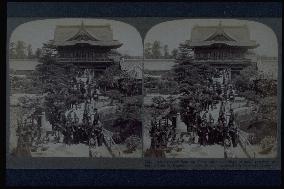
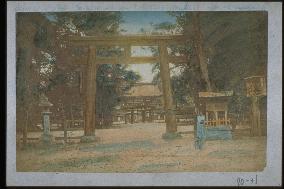
View of the Romon Gate from Taiko-bashi (Drum Bridge) located just through the torii gate at the entrance of the shrine. The five girls in hakama trousers are perhaps praying to pass a school examination. Three bridges span Shinji Pond: Taiko-bashi, Hira-bashi, and Taiko-bashi. They are said to represent the past, present, and future. This stereograph was published in 1904 by Underwood & Underwood Co.==Date:1904, Place:Tokyo, Photo:Underwood, (Credit:Nagasaki University Library/Kyodo News Images) [Cabinet Number97‐65‐0]

  •  
Taiko-bashi (Drum) Bridge at Kameido Shrine

Taiko-bashi (Drum) Bridge at Kameido Shrine

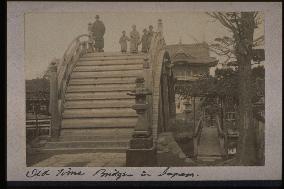
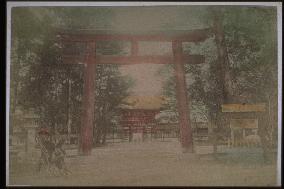
This is the sharply arched Taiko-bashi (also called Sori-bashi, or Warped Bridge ), which was apparently built after 1892. The present-day concrete Taiko-bashi was unveiled in August 1952 to commemorate the 1050th Sugawara Michizane anniversary and has a gentler slope with steps. The building visible behind the bridge is the Romon (Sakura Gate).==Date:about 1877, Place:Tokyo, Photo:unknown, (Credit:Nagasaki University Library/Kyodo News Images) [Cabinet Number96‐7‐0]

  •  
Tsurugaoka Hachimangu Shrine

Tsurugaoka Hachimangu Shrine

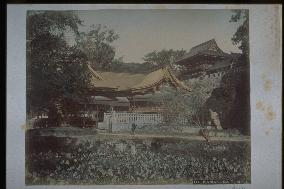
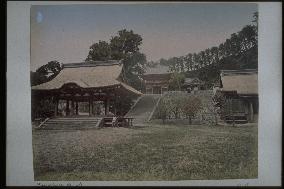
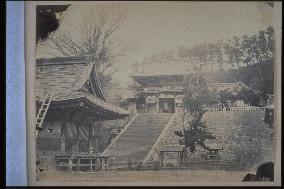
View of Wakamiya Shrine from the east. The Jogu Romon (upper shrine gate) and cloister are visible above. The roof thatched with bark shingles was rebuilt in 1624. The upper shrine, constructed in the early Edo Period, was destroyed by fire in 1821 and reconstructed with a bronze roof in 1828. Wakamiya Shrine and Jogu Romon are both Important Cultural Assets. The date of the photograph is unknown.==Date:unknown, Place:Kamakura, Photo:unknown, (Credit:Nagasaki University Library/Kyodo News Images) [Cabinet Number93‐36‐0]

  •  
Kameido Shrine

Kameido Shrine

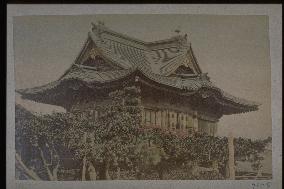
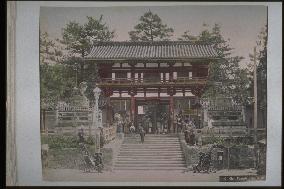
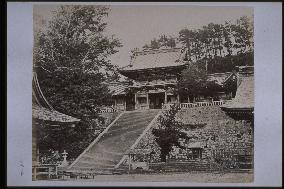
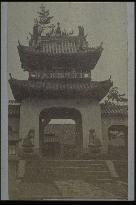
Originally called Kameido Tenmangu, the shrine was renamed Kameido Jinja in 1873 Kameido Tenjinsha in 1936. The original shrine was built soon after the Great Fire of Meireki (1657) when the Shogunate planned to develop the Honjo area and the government provided the land for the shrine. This is the Romon Gate. This gate and the main shrine building were destroyed by air raids in 1945.==Date:unknown, Place:Tokyo, Photo:unknown, (Credit:Nagasaki University Library/Kyodo News Images) [Cabinet Number91‐5‐0]

  •  
Shimogamo Shirine

Shimogamo Shirine

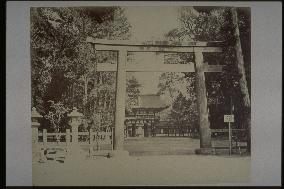
View of the second torii gate and two-story romon gate of Shimogamo Shinto Shrine from the shrine approach, facing north. On the left and right is a stone lantern and a wooden seisatsu sign with a kirizuma roof on the left. The words Take Heed are written on the sign in Japanese. A man wearing a yukata (summer kimono) is standing with his arms crossed on the west side of the seisatsu. The seisatsu prohibited entry to carriages, hunting, fishing and the cutting of trees and plants by order of the Department of Internal Affairs and Kyoto Prefecture. A coniferous forest with huge trees surrounds the area.==Date:unknown, Place:Kyoto, Photo:unknown, (Credit:Nagasaki University Library/Kyodo News Images) [Cabinet Number90‐31‐0]

  •  
Shimogamo Shirine

Shimogamo Shirine

View of the second torii gate and two-story romon gate of Shimogamo Shinto Shrine from the shrine approach, facing north. A young man is looking at the camera, sitting on a rickshaw in front of the stone lantern to the left. There is a wooden seisatsu sign with a kirizuma roof on the left. The seisatsu carried a message prohibiting entry to carriages, hunting, fishing and the cutting of trees and plants by order of the Department of Internal Affairs and Kyoto Prefecture. A coniferous forest with huge trees surrounds the area.==Date:unknown, Place:Kyoto, Photo:unknown, (Credit:Nagasaki University Library/Kyodo News Images) [Cabinet Number89‐12‐0]

  •  
The Sanmon Gate of Yasaka Shrine,Gion,Kyoto

The Sanmon Gate of Yasaka Shrine,Gion,Kyoto

View of the western romon gate of Yasaka Shinto Shrine. Statues of komainu (guardian dogs) stand on both sides of the gate. Rickshaw drivers are relaxing while women and children stand in front of the stone walls and gate. A gaslight and electric pole are visible near the stone walls. The gate roof was covered with hinoki tree bark in 1497 and re-covered with roof tiles during the Eiroku Period (1558-1570). The gate in the picture is painted red, with a kirizuma style roof and roof tiles. There are statues of two ministers within the shrine grounds.==Date:unknown, Place:Kyoto, Photo:unknown, (Credit:Nagasaki University Library/Kyodo News Images) [Cabinet Number87‐37‐0]

  •  
Tsurugaoka Hachimangu Shrine

Tsurugaoka Hachimangu Shrine

No tablet is visible on the Jogu Romon (upper shrine gate). Although the stone stairs remain in front of the Kaguraden on the left, the shitomi (storm door) on the side and mune (junction at the top of the roof) have been removed, indicating that this photograph was taken soon after the demolition of the buildings.==Date:unknown, Place:Kamakura, Photo:unknown, (Credit:Nagasaki University Library/Kyodo News Images) [Cabinet Number87‐29‐0]

  •  
Tsurugaoka Hachimangu Shrine

Tsurugaoka Hachimangu Shrine

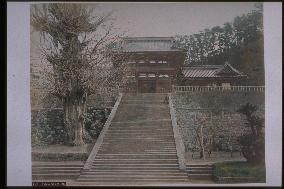
Labeled L17 HACHIMAN(B), the photograph depicts the Jogu Romon (upper shrine gate). The tablet on the gate reads Hachiman-gu. Since the view from the bottom of the stairs is similar to that in a photograph taken in 1893 and no artillery monument can be seen, this photograph is thought to have been taken between 1887 and 1892.==Date:unknown, Place:Kamakura, Photo:A. Farsari, (Credit:Nagasaki University Library/Kyodo News Images) [Cabinet Number82‐17‐0]

  •  
A wisteria trellis at Kameido Shrine

A wisteria trellis at Kameido Shrine

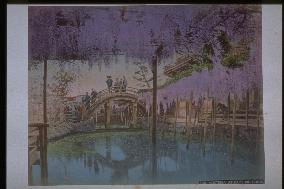
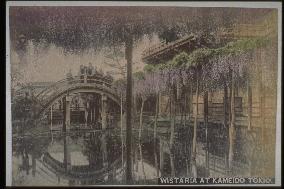
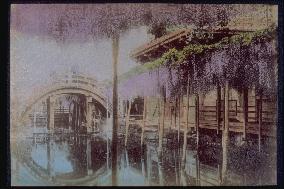
This is the smaller Taiko-bashi (Sori-bashi) located in front of the Romon (Sakura Gate) on the right. The Wisteria Festival of Kameido Tenjin Shrine held from mid-April to mid-May every year is a harbinger of summer. There are many other events held at the shrine. The parents of young children release carp into Shinji Pond during the Shichi-Go-San Festival on November 15 to pray for the healthy growth of their children. Masaoka shiki wrote the haiku poem: Sori-bashi, the wisteria are purple and carp red.==Date:unknown, Place:Tokyo, Photo:A. Farsari, (Credit:Nagasaki University Library/Kyodo News Images) [Cabinet Number81‐15‐0]

  •  
A wisteria trellis at Kameido Shrine

A wisteria trellis at Kameido Shrine

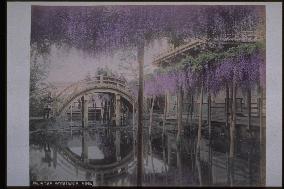
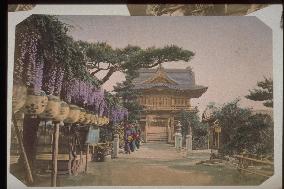
This is the smaller Taiko-bashi (Sori-bashi) located in front of the Romon (Sakura Gate) on the right. The Wisteria Festival of Kameido Tenjin Shrine held from mid-April to mid-May every year is a harbinger of summer. There are many other events held at the shrine. The parents of young children release carp into Shinji Pond during the Shichi-Go-San Festival on November 15 to pray for the healthy growth of their children. Masaoka shiki wrote the haiku poem: Sori-bashi, the wisteria are purple and carp red.==Date:unknown, Place:Tokyo, Photo:Tamamura Kozaburo, (Credit:Nagasaki University Library/Kyodo News Images) [Cabinet Number80‐25‐0]

  •  
Tsurugaoka Hachimangu Shrine

Tsurugaoka Hachimangu Shrine

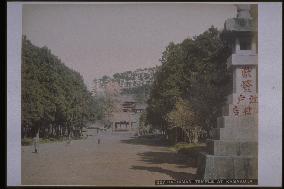
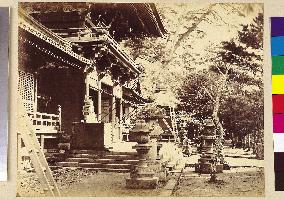
The stone lantern in the foreground was donated by the sugar wholesalers of Edo in 1862, and it still stands at present. A wooden torii gate stands in the centre, and behind it are the Kaguraden and the Jogu Romon (upper shrine gate). An illustration in the February 11, 1865 issue of The Illustrated London News and the art of Renjo Shimooka indicate that the Niomon gate at the torii existed until the end of the Edo Period. This photograph may have been taken around the beginning of the Meiji Period.==Date:unknown, Place:Kamakura, Photo:unknown, (Credit:Nagasaki University Library/Kyodo News Images) [Cabinet Number80‐19‐0]

  •  
Tsurugaoka Hachimangu Shrine

Tsurugaoka Hachimangu Shrine

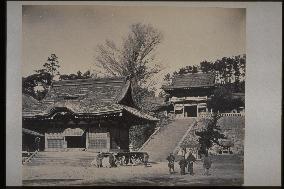
A pattern similar to that in photograph #4749 is visible under the eave of the Jogu Romon (upper shrine gate). The cleansing basin is located on the right side, at the foot of the stone stairs. Kora-Myojin Shrine is behind it. Neither were in existence after the first years of the Meiji Period. The absence of a tablet on the Romon gate of the upper shrine and the time-worn appearance of the Kaguraden roof indicate that this was taken around the same time as photograph #3073.==Date:unknown, Place:Kamakura, Photo:R. Stillfried, (Credit:Nagasaki University Library/Kyodo News Images) [Cabinet Number78‐12‐0]

  •  
The Sanmon Gate,Sofukuji Temple

The Sanmon Gate,Sofukuji Temple

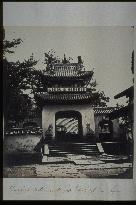
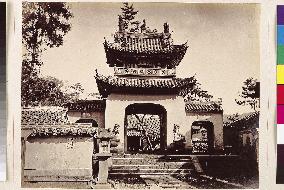
The Sanmon (Romon) Gate at Sofukuji Temple. Date unknown. The gate was rebuilt in dragon palace gate style in 1849. A famous tourist attraction in Nagasaki, it remains to this day as a nationally designated Important Cultural Asset.==Date:about 1865, Place:Nagasaki, Photo:F. Beato, (Credit:Nagasaki University Library/Kyodo News Images) [Cabinet Number66‐28‐0]

  •  
The Kaguraden and honden (inner sanctuary),Tsurugaoka Hachimangu Shrine

The Kaguraden and honden (inner sanctuary),Tsurugaoka Hachimangu Shrine

The building on the left seems to the Rinzo (sutra repository), which was later demolished. Since there is no tablet visible on the Romon gate and the square foundation stones are placed next to the Kaguraden, this photograph is thought to have been taken around 1870 when the temple buildings were demolished. Taken by Felix Beato.==Date:unknown, Place:Kamakura, Photo:F. Beato, (Credit:Nagasaki University Library/Kyodo News Images) [Cabinet Number62‐32‐0]

  •  
Shimogamo Shirine

Shimogamo Shirine

View of the second torii gate and two-story romon gate of Shimogamo Shinto Shrine from the shrine approach, facing north. There is a stone lantern on the left and a wooden notice board on the right. The board probably carries a message prohibiting entry to carriages, hunting, fishing and the cutting of trees and plants. A coniferous forest with huge trees surrounds the area. This photo was taken by Felix Beato.==Date:unknown, Place:Kyoto, Photo:F. Beato, (Credit:Nagasaki University Library/Kyodo News Images) [Cabinet Number62‐20‐0]

  •  
The Sanmon Gate,Sofukuji Temple

The Sanmon Gate,Sofukuji Temple

The Sanmon (Romon) Gate at Sofukuji Temple. Date unknown. The gate was rebuilt in dragon palace gate style in 1849. A famous tourist attraction in Nagasaki, it remains to this day as a nationally designated Important Cultural Asset.==Date:unknown, Place:Nagasaki, Photo:unknown, (Credit:Nagasaki University Library/Kyodo News Images) [Cabinet Number58‐28‐4]

  •  
Tsurugaoka Hachimangu Shrine

Tsurugaoka Hachimangu Shrine

The words Hachimangu-ji (Hachiman Shrine Temple) are inscribed on the tablet at the Jogu Romon (upper shrine gate). Tsurugaoka-Hachiman Shrine was a combination Shinto shrine and Buddhist temple until the end of the Edo period in 1868, when the temple was abolished in response to a government edict. This photograph was probably taken just before the temple buildings were removed.==Date:unknown, Place:Kamakura, Photo:unknown, (Credit:Nagasaki University Library/Kyodo News Images) [Cabinet Number55‐19‐0]

  •  
A wisteria trellis at Kameido Shrine

A wisteria trellis at Kameido Shrine

This is the smaller Taiko-bashi (Sori-bashi) located in front of the Romon (Sakura Gate) on the right. The Wisteria Festival of Kameido Tenjin Shrine held from mid-April to mid-May every year is a harbinger of summer. There are many other events held at the shrine. The parents of young children release carp into Shinji Pond during the Shichi-Go-San Festival on November 15 to pray for the healthy growth of their children. Masaoka shiki wrote the haiku poem: Sori-bashi, the wisteria are purple and carp red.==Date:unknown, Place:Tokyo, Photo:unknown, (Credit:Nagasaki University Library/Kyodo News Images) [Cabinet Number53‐38‐0]

  •  
Kameido Shrine

Kameido Shrine

Kameido Tenmangu Shrine (present-day Kameido Tenjinsha) is one of the three main shrines dedicated to Sugawara Michizane. The other two are Dazaifu Tenmangu Shrine in Fukuoka and Kitano Tenmangu Shrine in Kyoto. The shrine is said to go back to the year 1661when the Shinto priest of Dazaifu, Sugawara Otorii Nobusuke, carved a holy image from the wood of the tobiume (plum tree) and enshrined it in the eastern part of Honjo. In 1662, the fourth Shogun Ietsuna donated the land to the shrine, and shrine buildings including the Romon Gate, Shinji Pond, and Taiko Bridge were later built in imitation of the Dazaifu Tenmangu Shrine.==Date:unknown, Place:Tokyo, Photo:unknown, (Credit:Nagasaki University Library/Kyodo News Images) [Cabinet Number51‐39‐0]

  •  
A wisteria trellis at Kameido Shrine

A wisteria trellis at Kameido Shrine

This is the smaller Taiko-bashi (Sori-bashi) located in front of the Romon (Sakura Gate) on the right. The Wisteria Festival of Kameido Tenjin Shrine held from mid-April to mid-May every year is a harbinger of summer. There are many other events held at the shrine. The parents of young children release carp into Shinji Pond during the Shichi-Go-San Festival on November 15 to pray for the healthy growth of their children. Masaoka shiki wrote the haiku poem: Sori-bashi, the wisteria are purple and carp red.==Date:unknown, Place:Tokyo, Photo:Tamamura Kozaburo, (Credit:Nagasaki University Library/Kyodo News Images) [Cabinet Number48‐56‐0]

  •  
The honden (inner sanctuary),Tsurugaoka Hachimangu Shrine

The honden (inner sanctuary),Tsurugaoka Hachimangu Shrine

Rokkaku-do (Hexagonal Building) is visible beyond the Romon (Cherry Gate). The bronze and stone lanterns visible in front of the gate were removed along with Rokkaku-do at the beginning of the Meiji Period. The same photograph, credited to F. Beato, is preserved at the Yokohama Archives of History. Beato visited Kamakura in 1864. This photograph is thought to have been taken around that time.==Date:unknown, Place:Kamakura, Photo:F. Beato, (Credit:Nagasaki University Library/Kyodo News Images) [Cabinet Number104‐11‐0]

  •  
The Romon of Sofukuji Temple

The Romon of Sofukuji Temple

This is a photograph of the Sanmon (Romon) gate of Sofukuji Temple taken between 1860 and 1870. The gate was reconstructed in dragon palace gate style. This is the outermost gate of the temple and consists of a central gate with two side doors. This type of gate is called sanmon (three gates).==Date:unknown, Place:Nagasaki, Photo:Ueno Hikoma, (Credit:Nagasaki University Library/Kyodo News Images) [Cabinet Number102‐14‐0]

  • Main
  • Top
  • Editorial
  • Creative
  • About Us
  • About ILG
  • Terms of use
  • Company
  • BEHIND
  • Price List
  • Single Plan
  • Monthly Plan
  • Services
  • Shooting
  • Rights Clearance
  • Support
  • FAQ
  • How To Buy
  • Contact Us
  • Become a Partner

© KYODO NEWS IMAGES INC

All Rights Reserved.

  • Editorial
  • Olympics
  • News
  • Sports
  • Japan
  • Tech
  • Royal
  • Disaster
  • NorthKorea
  • Old Japan
  • SNS
  • Creative
  • Food
  • Japan
  • Landscape
  • Animal
  • Popular
  • #Ukraine
  • #Russia
  • #coronavirus
  • #N. Korea
  • #Thailand
  • #China
  • #Ukraine
  • #Russia
  • #coronavirus
  • #N. Korea
  • #Thailand
  • #China
  • Food
  • Japan
  • Landscape
  • Animal
  • Olympics
  • News
  • Sports
  • Japan
  • Tech
  • Royal
  • Disaster
  • NorthKorea
  • Old Japan
  • SNS