•  
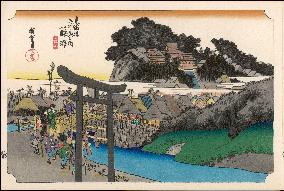
Hiroshige - 53 Stations of the Tokaido - Print 7

Hiroshige - 53 Stations of the Tokaido - Print 7

7 Fujisawa - The village by the edge of a stream, and a bridge leading to it, over which people are passing. In background, overlooking the village on a wooded hill, above the mists, stands the temple Yugi-o-ji; in the foreground a torii, and close to it four blind men following each other by the bank of the stream. This station was crowded with pilgrims visiting the famous temple at this station, and the neighbouring shrine. The imposing buildings of Yugyoji Temple (established in 1325) stand on a hillside in the background. The torii (archway) leads to the Enoshima Benten Shrine which is dedicated to the Goddess of Music. Utagawa Hiroshige (1797 - 1858). The Fifty-Three Stations of the Tokaido - Hoeido edition (1831-4) Date: 1831 - 1834

  •  

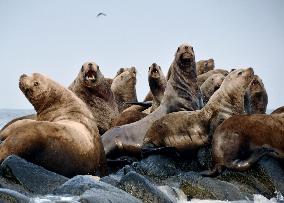
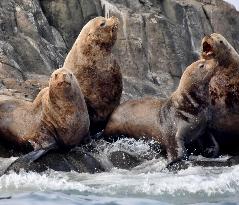
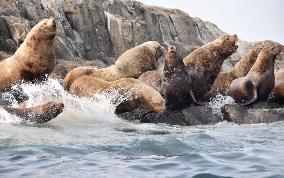
Sea lions on Hokkaido uninhabited isle

WAKKANAI, Japan Kyodo - Photo shows sea lions on Benten Island off Soya Cape in Hokkaido, northern Japan, on Dec. 24, 2020. The marine mammals have appeared around the uninhabited isle from November to June in recent years from near Sakhalin, with thousands of them seen at peak times in spring in search of food.

  •  
Dance for 2011 quake-tsunami victims in Japan

Dance for 2011 quake-tsunami victims in Japan

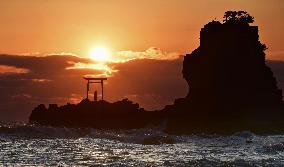
Dancer Mariko Odawara performs in front of a sacred arch on Benten Island belonging to the Fukushima Prefecture city of Iwaki, northeastern Japan, on March 7, 2021, for those killed in the earthquake-tsunami disaster of March 11, 2011.

  •  
Dance for 2011 quake-tsunami victims in Japan

Dance for 2011 quake-tsunami victims in Japan

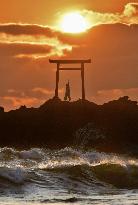
Dancer Mariko Odawara performs in front of a sacred arch on Benten Island belonging to the Fukushima Prefecture city of Iwaki, northeastern Japan, on March 7, 2021, for those killed in the earthquake-tsunami disaster of March 11, 2011.

  •  
Sea lions on Hokkaido uninhabited isle

Sea lions on Hokkaido uninhabited isle

Photo shows sea lions on Benten Island off Soya Cape in Hokkaido, northern Japan, on Dec. 24, 2020. The marine mammals have appeared around the uninhabited isle from November to June in recent years from near Sakhalin, with thousands of them seen at peak times in spring in search of food.

  •  
Sea lions on Hokkaido uninhabited isle

Sea lions on Hokkaido uninhabited isle

Photo shows sea lions on Benten Island off Soya Cape in Hokkaido, northern Japan, on Dec. 24, 2020. The marine mammals have appeared around the uninhabited isle from November to June in recent years from near Sakhalin, with thousands of them seen at peak times in spring in search of food.

  •  
Sea lions on Hokkaido uninhabited isle

Sea lions on Hokkaido uninhabited isle

Photo shows sea lions on Benten Island off Soya Cape in Hokkaido, northern Japan, on Dec. 24, 2020. The marine mammals have appeared around the uninhabited isle from November to June in recent years from near Sakhalin, with thousands of them seen at peak times in spring in search of food.

  •  
A distant view of Yokohama Station

A distant view of Yokohama Station

This is the original Yokohama Station designed by American architect R. P. Bridgens and built in 1871. The building is of stone and wood construction. This is the site of present-day Sakuragi-cho Station. Connecting to Honmachi Dori on the right is Benten Bridge, a triple-arch bridge built by the Train Works Division of the Ministry of Engineering in 1871.==Date:unknown, Place:Yokohama, Photo:unknown, (Credit:Nagasaki University Library/Kyodo News Images) [Cabinet Number93‐28‐0]

  •  
Ferry boat

Ferry boat

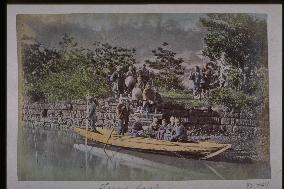
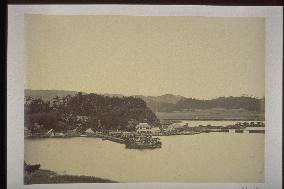
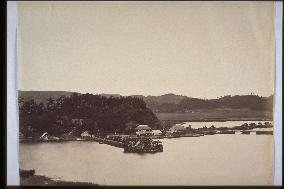
The embankment at Biwajima Benten was a landing spot for ferries crossing Hiragata Bay to Nojima. Most of the passengers are probably pilgrims from the Boso Peninsula traveling to Oyama. Today, Biwajima Benten is the last station on the Kanazawa Seaside Railroad Line. The byakushin trees (Juniperus chinensis) with white trunks in the photograph are still thriving today near Kanazawa Hakkei Station.==Date:unknown, Place:Yokohama, Photo:unknown, (Credit:Nagasaki University Library/Kyodo News Images) [Cabinet Number92‐44‐0]

  •  
Benten Pond,Zojoji Temple,Shiba

Benten Pond,Zojoji Temple,Shiba

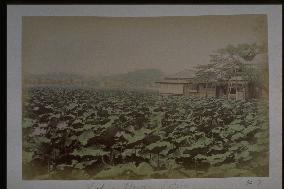
Shinobazu Pond at Ueno Park is viewed from the east. This location used to be a cove of Tokyo Bay. To the right is Nakajima where shrine to Benzaiten (deity of music and art) stands. This pond was famous for its lotus flowers, and it was a popular attraction for the people of Edo and later Tokyo.==Date:unknown, Place:Tokyo, Photo:unknown, (Credit:Nagasaki University Library/Kyodo News Images) [Cabinet Number92‐7‐0]

  •  
Benten Pond,Zojoji Temple,Shiba

Benten Pond,Zojoji Temple,Shiba

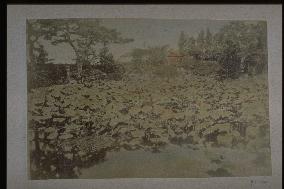
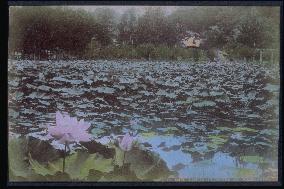
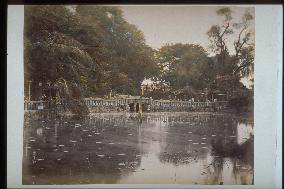
Large lotus leaves cover the surface of a pond. There is an elevated area with a simple hut called an azumaya built on top. Stone lanterns and a five-tier stone tower are placed around the pond. However, since this kind of landscaping cannot be seen at the Benten Pond of Zojoji Temple, it is probably some other pond.==Date:unknown, Place:Tokyo, Photo:unknown, (Credit:Nagasaki University Library/Kyodo News Images) [Cabinet Number91‐21‐0]

  •  
Kanazawa Hakkei

Kanazawa Hakkei

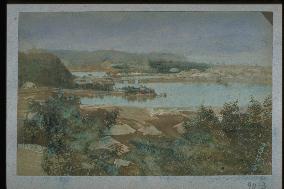
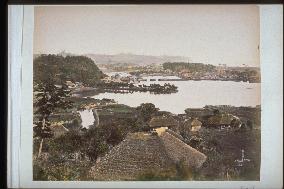
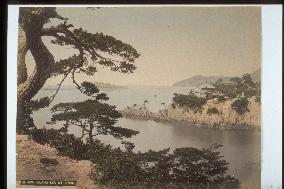
Hiragata Bay as seen from Kyurantei. Biwajima Benten is visible in the centre, with Seto Shinto Shrine at the tip of the peninsula. The teahouses on the right of the shrine are (from the left) Chiyomoto-ro and Ogiya, and Azumaya is in the rear. Suzaki Village is on the other side of Seto Bridge from Ogiya.==Date:unknown, Place:Yokohama, Photo:unknown, (Credit:Nagasaki University Library/Kyodo News Images) [Cabinet Number90‐3‐0]

  •  
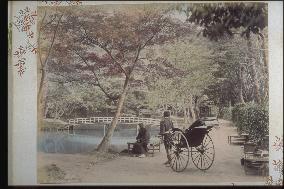
Benten Pond,Eikan-do Temple

Benten Pond,Eikan-do Temple

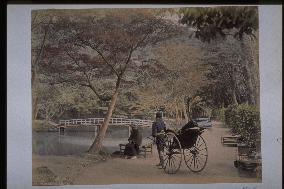
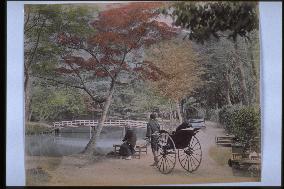
View of the Hojo Pond at Eikando Temple, looking south-southeast. A young rickshaw driver and an old woman sitting on a bench fill the centre of the picture. The gently curving wooden bridge connects to Benten Island on the left. The stone bridge leading to the main hall is visible in the rear. Japanese maple trees are growing along the pond. The goal of this photo is to show that Eikando was a well-known place for the enjoyment of autumn colours.==Date:unknown, Place:Kyoto, Photo:unknown, (Credit:Nagasaki University Library/Kyodo News Images) [Cabinet Number85‐25‐0]

  •  
Cherry trees by Shinobazu Pond

Cherry trees by Shinobazu Pond

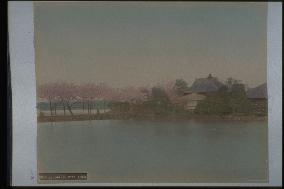
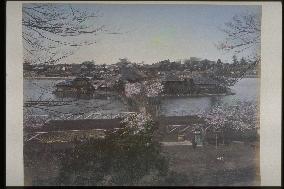
Nakanoshima is an artificial islands in Shinobazu Pond built by Mizutani Isenokami Katsutaka using a small existing island and enlarging it with soil from a hill in Ueno. The Buddhist priest Tenkai built Benten-do to worship Benzaiten of Chikubushima at Lake Biwa, and it was visited by many people over the years. The shrine was destroyed in a 1945 air raid on Tokyo.==Date:unknown, Place:Tokyo, Photo:unknown, (Credit:Nagasaki University Library/Kyodo News Images) [Cabinet Number83‐30‐0]

  •  
Enoshima coast

Enoshima coast

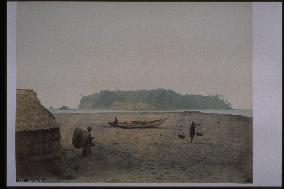
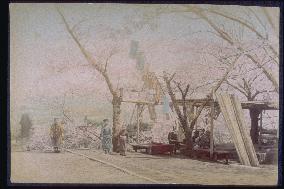
Photographer unknown. Entitled L25 Enoshima. The structure on the left could be a fisherman's shack. The name Enoshima appears in Azumakagami (chronicle of the Kamakura Shogunate) as follows: Mongaku built the Great Benzaiten at Enoshima on April 5th, 1182. Apparently Benten worship spread among commoners and samurai alike and many people visited the site.==Date:unknown, Place:Enoshima, Photo:A. Farsari, (Credit:Nagasaki University Library/Kyodo News Images) [Cabinet Number82‐20‐0]

  •  
A five-story pagoda,Asakusa

A five-story pagoda,Asakusa

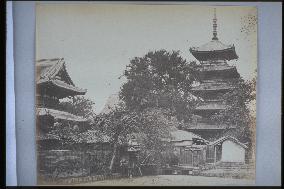
The five-story pagoda viewed from Benten Pond. The original is said to have been built by Awanokami Taira-no-Kinmasa in 942. The pagoda in this photograph was rebuilt in 1648 and designated a National Treasure in 1911, but it burned to the ground during 1945 air raids (together with the sutra depository). The present day five-story pagoda was erected in 1973. This photograph was taken in the second decade of the Meiji Period (1877-1887), probably by Stillfried.==Date:unknown, Place:Tokyo, Photo:R. Stillfried, (Credit:Nagasaki University Library/Kyodo News Images) [Cabinet Number77‐25‐0]

  •  
Ueno Park

Ueno Park

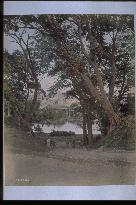
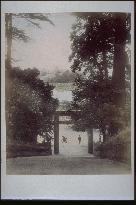
This is the slope leading from Kuromon Street in Ueno Park to the road next to the approach to Benten-do. The work on the park has not been completed, and it retains a very natural look. The size of the trees can be judged by the two people standing under them. Because the area around the pond has not yet been reclaimed, this photograph must have been taken in the first years of the Meiji Period.==Date:unknown, Place:Tokyo, Photo:R. Stillfried, (Credit:Nagasaki University Library/Kyodo News Images) [Cabinet Number77‐23‐0]

  •  
Minamiyamate and Nagasaki Harbour

Minamiyamate and Nagasaki Harbour

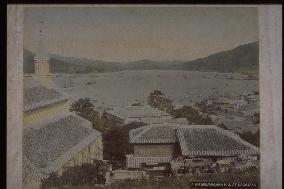
Oura Church was renovated in 1875 and the original three pinnacles became one. Since the Benten Bridge over Oura River is a wood and metal mix pony style double warren truss bridge, this photo must have been taken after 1889. The building in the center is the Belle Vue Hotel.==Date:Middle Meiji (1883-1897), Place:Nagasaki, Photo:unknown, (Credit:Nagasaki University Library/Kyodo News Images) [Cabinet Number73‐28‐0]

  •  
Along Oura River

Along Oura River

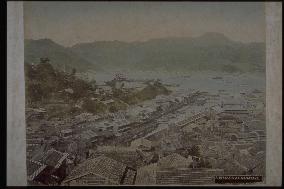
The Oura and Sagarimatsu neighbourhoods of the Nagasaki Foreign Settlement are seen on the right and left, respectively, from the hillside to the south of Higashiyamate. The houses stand in an organized pattern at Sagarimatsu. The photograph reveals the juxtaposition of the settlement and Japanese neighborhoods. Matsugae Bridge and Benten Bridge, both built in 1889, are visible. This is the same as photograph #3856.==Date:unknown, Place:Nagasaki, Photo:unknown, (Credit:Nagasaki University Library/Kyodo News Images) [Cabinet Number73‐1‐0]

  •  
Inokashira Benten

Inokashira Benten

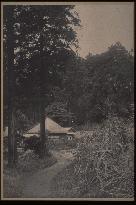
The back of the photograph carried the inscription, Taken at Benten, Inokashira, Tokyo in September 1913. This must be Inokashira, the origin of one of Edo's water supplies. Many trees were planted around Inokashira Pond to preserve the water resources. Inokashira Benzaiten (one of the seven deities of luck) is on a small island called Nakanoshima in the western part of the pond. A Taisho-Period postcard shows Benzaiten with a beautiful thatched roof by a pond. The lack of a pond in this photograph and the simple structure of the house suggest that this is not Benzaiten but a teahouse nearby.==Date:1913, Place:Tokyo, Photo:unknown, (Credit:Nagasaki University Library/Kyodo News Images) [Cabinet Number72‐23‐0]

  •  
Sailors playing cards on their ship

Sailors playing cards on their ship

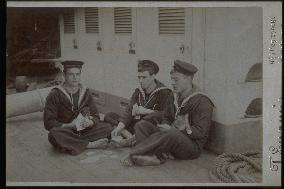
The sailors probably had this photograph taken to commemorate their visit to Yokohama. The mount is from the Enami Tamotsu Studio at No.9 Benten Dori 1-chome. Opened by Enami Nobukuni in 1892, the studio was located at this address until the Great Kanto Earthquake of 1923.==Date:unknown, Place:Yokohama, Photo:unknown, (Credit:Nagasaki University Library/Kyodo News Images) [Cabinet Number69‐24‐0]

  •  
Himeishi Daimyojin Shrine

Himeishi Daimyojin Shrine

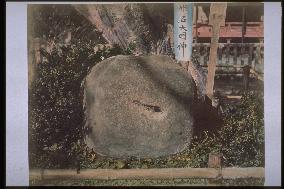
The photograph and mount bear the labels Himeishi Daimyojin and ..at the Temple of KAMAKURA respectively. An illustrated map from the year 1850 shows the Himeishi (Princess Stone) in the Tsurugaoka Hachimangu Shrine precincts. It also resembles, in terms of its shape and markings, the Masakoishi (Masako Stone) located today on Benten Island in the shrine pond, but the exact details are unclear. This photograph may be the work of Stillfried. The date is unknown.==Date:unknown, Place:Kamakura, Photo:unknown, (Credit:Nagasaki University Library/Kyodo News Images) [Cabinet Number64‐76‐0]

  •  
Sensoji Temple

Sensoji Temple

The five-story pagoda and Niomon (gate) seen from Benten Pond. Taken by Felix Beato, this is one of the oldest existing photographs of Sensoji Temple. Benten Shinto Shrine dedicated to the deity Benzaiten is simpler and looks slightly different from the one portrayed in photographs #2414 and 4440. The one in this photograph is older. Legend has it that the huge gingko tree in the centre grew from a pair of chopsticks left behind by Minamoto Yoritomo. The tree unfortunately perished in the air raids of 1945.==Date:unknown, Place:Tokyo, Photo:F. Beato, (Credit:Nagasaki University Library/Kyodo News Images) [Cabinet Number62‐34‐0]

  •  
Dotonbori Lane

Dotonbori Lane

The large building in the centre is Benten-za, a theatre renovated in 1876 and again in 1894. This photograph depicts the building after renovations in 1876 and is therefore thought to have been taken in the second decade of the Meiji Period (1877-1887).==Date:unknown, Place:Osaka, Photo:unknown, (Credit:Nagasaki University Library/Kyodo News Images) [Cabinet Number57‐17‐0]

  •  
Benten-dori Street

Benten-dori Street

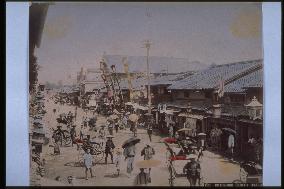
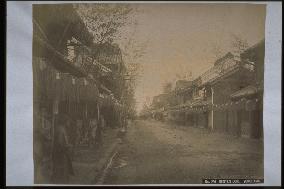
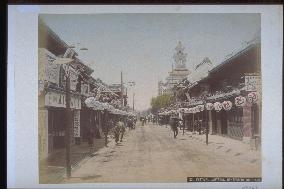
View of Benten Dori 3-chome from 2-chome. The main street of Kan'nai, Benten Dori runs two blocks south of Honmachi Dori. It was the centre of the trading business of Yokohama and the site of shops opened by prominent silk companies like Hara, Mogi, and Ono.==Date:unknown, Place:Yokohama, Photo:unknown, (Credit:Nagasaki University Library/Kyodo News Images) [Cabinet Number55‐46‐0]

  •  
Benten-dori Street

Benten-dori Street

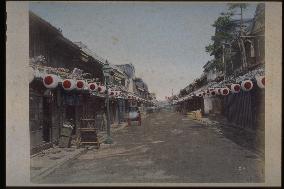
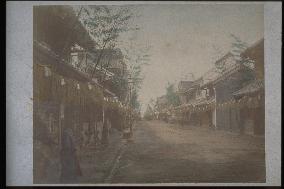
The main street of Kan'nai, Benten Dori runs two blocks south of Honmachi Dori. It was the centre of the trading business of Yokohama and the site of shops opened by prominent silk companies like Hara, Mogi, and Ono. The location of the gaslight suggests that this Benten Dori 1-chome.==Date:unknown, Place:Yokohama, Photo:unknown, (Credit:Nagasaki University Library/Kyodo News Images) [Cabinet Number55‐36‐0]

  •  
Benten-dori Street

Benten-dori Street

The main street of Kan'nai, Benten Dori runs two blocks south of Honmachi Dori. It was the centre of the trading business of Yokohama and the site of shops opened by prominent silk companies like Hara, Mogi, and Ono. The location of the gaslight suggests that this Benten Dori 1-chome.==Date:unknown, Place:Yokohama, Photo:unknown, (Credit:Nagasaki University Library/Kyodo News Images) [Cabinet Number55‐18‐0]

  •  
Shinobazu Pond

Shinobazu Pond

Shinobasu Pond and Nakanoshima, where Benten-do is located, are viewed from the top of the hill at Ueno. The area between the fences, which stretches right to left, is the racecourse. The overpass, which is the approach to Benten-do, was built between 1661 and 1673. Before that, people used boats to visit Benten-do.==Date:unknown, Place:Tokyo, Photo:unknown, (Credit:Nagasaki University Library/Kyodo News Images) [Cabinet Number53‐24‐0]

  •  
Benten Pond,Eikan-do Temple

Benten Pond,Eikan-do Temple

View of the Hojo Pond at Eikando Temple, looking south-southeast. A young rickshaw driver and an old woman sitting on a bench fill the centre of the picture. The gently curving wooden bridge connects to Benten Island on the left. The stone bridge leading to the main hall is visible in the rear. Japanese maple trees are growing along the pond. The goal of this photo is to show that Eikando was a well-known place for the enjoyment of autumn colours.==Date:unknown, Place:Kyoto, Photo:unknown, (Credit:Nagasaki University Library/Kyodo News Images) [Cabinet Number52‐11‐0]

  •  
The hour bell and the five-story pagoda,Sensoji Temple

The hour bell and the five-story pagoda,Sensoji Temple

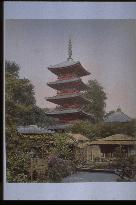
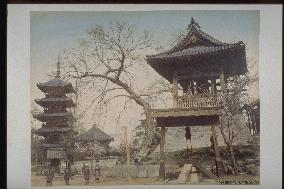
A simple shrine dedicated to Benten is shown in the foreground of the five-story pagoda. Behind it is a restaurant. The roof visible to the right of the pagoda is the sutra depository). It was called rindo (round hall) or rinzo (round storehouse) because worshippers rotated it while praying. The bell tower was destroyed in a 1945 air raid, but the bell was fortunately saved. A new bell tower using the same bell was completed on December 18, 1946. This photograph was taken before 1886, because Benten Pond is still visible.==Date:unknown, Place:Tokyo, Photo:unknown, (Credit:Nagasaki University Library/Kyodo News Images) [Cabinet Number51‐36‐0]

  •  
A lotus pond at Tsurugaoka Hachimangu Shrine

A lotus pond at Tsurugaoka Hachimangu Shrine

This is the same as photograph #2253. Date unknown. It is said to be the work of Tamamura Kozaburo (1856-?), a resident of Yokohama during the Meiji Period who identified himself as a photographer and retailer of photographic prints. His shop was located at Benten-dori 1-chome (present-day Naka Ward, Yokohama City). The dates of his visits and association with Kamakura are not known.==Date:unknown, Place:Kamakura, Photo:Tamamura Kozaburo, (Credit:Nagasaki University Library/Kyodo News Images) [Cabinet Number48‐132‐0]

  •  
Enoshima Island and Benten Bridge

Enoshima Island and Benten Bridge

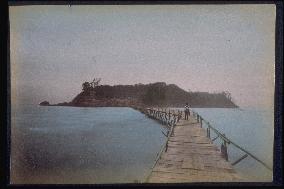
Taken by Kozaburo Tamamura (1856-?). Same as #2148. The first time the bridge appeared in a photograph was the article in Japan Day by Day by E. S. Morse (1838-1925), who spent a summer here. An American zoologist, Morse is known for his discovery of the ancient shell site at Ohmori. At the time, he had opened a small marine biology station on the island to conduct research.==Date:unknown, Place:Enoshima, Photo:Tamamura Kozaburo, (Credit:Nagasaki University Library/Kyodo News Images) [Cabinet Number48‐96‐0]

  •  
Ueno Park

Ueno Park

The boy standing in the centre facing the camera wears a hat like those issued to students. The scenery visible behind could be Shinobazu Pond and Benten-do. This seems to have been taken from the area of present-day Ueno Seiyoken Restaurant.==Date:unknown, Place:Tokyo, Photo:Tamamura Kozaburo, (Credit:Nagasaki University Library/Kyodo News Images) [Cabinet Number48‐90‐0]

  •  
Enoshima Island and Benten Bridge

Enoshima Island and Benten Bridge

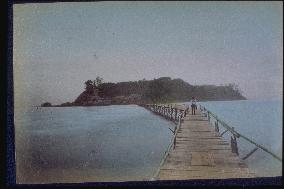
Taken by Tamamura Kozaburo (1856-?). It appears to be high tide, and the wooden bridge leads to the centre of Enoshima Island. The bridge is said not to existed during the Edo Period, nor does it appear in the photograph in the April 1st issue of The Far East (February 24th, 1872). Therefore, this photo must have been taken after that date.==Date:unknown, Place:Enoshima, Photo:Tamamura Kozaburo, (Credit:Nagasaki University Library/Kyodo News Images) [Cabinet Number48‐1‐0]

  •  
The five-story pagoda and the bell tower,Sensoji Temple

The five-story pagoda and the bell tower,Sensoji Temple

Although similar to photograph #2414, this photograph shows a well in front of the bell tower, and Benten Pond has disappeared. Since the pond was filled in on June 30, 1886, this photograph must have been taken after that date. The inscription C25 from the negative in the lower right indicates that this is a photograph sold by A. Farsari & Co. Probably taken in the latter half of the third decade of the Meiji Period (1892-1897).==Date:unknown, Place:Tokyo, Photo:unknown, (Credit:Nagasaki University Library/Kyodo News Images) [Cabinet Number47‐5‐0]

  •  
Ueno Park

Ueno Park

Shinobazu Pond is seen from the top of the stone steps at Shinobazuguchi at Toshogu. The bench of the teahouse across the road is visible along with a rickshaw. This is a part of present-day Ueno Zoo. Nakajima, site of Benten-do and the pond with lotuses, can also be seen.==Date:unknown, Place:Tokyo, Photo:unknown, (Credit:Nagasaki University Library/Kyodo News Images) [Cabinet Number47‐2‐0]

  •  
Shinobazu Pond

Shinobazu Pond

Benten-do on Nakanoshima and the path to it are seen at Shinobazu Pond. The Buddhist priest Tenkai modeled the pond after Lake Biwa and built the shrine to worship the deity Benzaiten of Chikubushima. The stone bridge was built between 1789 and 1801. Numerous dead lotus stems remain in the water, indicating that the season is winter.==Date:unknown, Place:Tokyo, Photo:unknown, (Credit:Nagasaki University Library/Kyodo News Images) [Cabinet Number47‐1‐0]

  •  
Benten-dori Street

Benten-dori Street

Bentendori is parallel to Motomachi dori, two streets away. The photo is a view of the 3 chome to the 4 chome of Bentendori. The main spot of the Bentendori is the clock tower in the center of Kawakita Naozo Shoten.==Date:unknown, Place:Yokohama, Photo:Kusakabe Kinbei, (Credit:Nagasaki University Library/Kyodo News Images) [Cabinet Number43‐25‐0]

  •  
Benten Pond,Zojoji Temple,Shiba

Benten Pond,Zojoji Temple,Shiba

Benten or the Benzaiten is also the God of Water, so many of the lakes and marshes in Japan are named Bentenike. This is one of them.==Date:unknown, Place:Tokyo, Photo:Suzuki Shin-ichi, (Credit:Nagasaki University Library/Kyodo News Images) [Cabinet Number41‐24‐0]

  •  
Hirakata Bay from Kyurantei

Hirakata Bay from Kyurantei

A view of Hiragata Bay, from the Kyurantei. In the center is the Benten of Biwa Island, and further on is Seto Shrine. A photo of the area around Hiragata Bay.==Date:unknown, Place:Yokohama, Photo:Suzuki Shin-ichi, (Credit:Nagasaki University Library/Kyodo News Images) [Cabinet Number41‐15‐0]

  •  
The cave on Enoshima Island

The cave on Enoshima Island

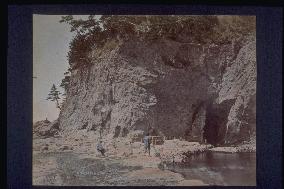
The Benten cave in the south beach of Enoshima. A man looks at the cave from the rocks leading to the cave, and to his left, a man sits on the rock.==Date:unknown, Place:Enoshima, Photo:unknown, (Credit:Nagasaki University Library/Kyodo News Images) [Cabinet Number37‐89‐0]

  •  
Hirakata Bay from Kyurantei

Hirakata Bay from Kyurantei

The view of Hiragata Bay from Kurantei. In the center is the Benten of Biwajima, and the distant one is Seto Shrine. The caption says, Tea House in Kanazawa. Photograph by F. Beato. Identical to photo No. 916 (19-32).==Date:unknown, Place:Yokohama, Photo:F. Beato, (Credit:Nagasaki University Library/Kyodo News Images) [Cabinet Number36‐17‐0]

  •  
Honmachi-dori Avenue,Yokohama

Honmachi-dori Avenue,Yokohama

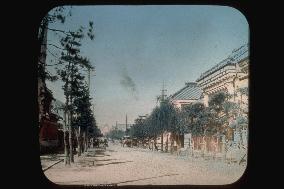
Honmachi Avenue is a street leading to the Yokohama Kaisho from Benten Bridge near Yokohama Station. Banks and corporations gathered in Honmachi dori, the centre of commerce in Yokohama.==Date:unknown, Place:Yokohama, Photo:unknown, (Credit:Nagasaki University Library/Kyodo News Images) [Cabinet Number31‐8‐0]

  •  
Kanazawa Hakkei Bentensha

Kanazawa Hakkei Bentensha

A view of Hiragata Bay, from Kurantei. The centre is the Benten of Biwajima, and further ahead is Seto Shrine. The caption says that it is a teahouse at Kanazawa. Photo by F. Beato.==Date:unknown, Place:Yokohama, Photo:F. Beato, (Credit:Nagasaki University Library/Kyodo News Images) [Cabinet Number28‐1‐0]

  •  
Bigo Tomotsu (SENMIZUSHIMA)

Bigo Tomotsu (SENMIZUSHIMA)

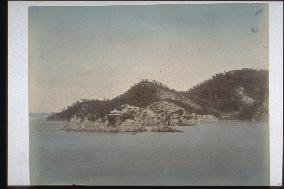
Islands big and small lie scattered around Numakuma Peninsula, making it a very picturesque landscape representative of the Seto Inland Sea. This area has been designated as a Place of Scenic Beauty by the Japanese government. This is the view from Sensui Island looking over Benten Island toward Taiga Island, evoking the natural beauty of the beach.==Date:unknown, Place:Hiroshima, Photo:unknown, (Credit:Nagasaki University Library/Kyodo News Images) [Cabinet Number19‐39‐0]

  •  
Bentenjima island at tomonotsu,bingo

Bentenjima island at tomonotsu,bingo

Tomo, located to the south of Fukuyama, prospered as an important port for sea traffic from the Nara Period. Sensui, Benten, and Kogo islands were praised as The Most Scenic Places in Japan by Korean messenger Lee Bang Eon during the Edo Period. The toba stones erected in 1271 and Benten-do are visible on Benten Island in the centre of the photograph.==Date:unknown, Place:Hiroshima, Photo:Ogawa Kazumasa, (Credit:Nagasaki University Library/Kyodo News Images) [Cabinet Number7‐38‐0]

  •  
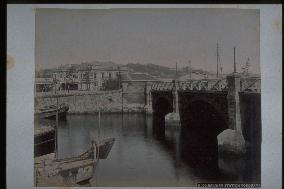
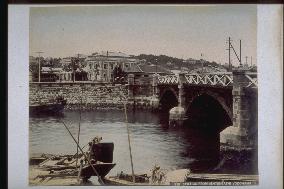
Bentenbashi bridge and YOKOHAMA station

Bentenbashi bridge and YOKOHAMA station

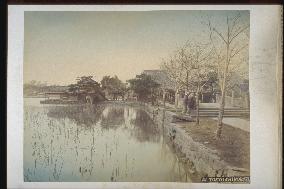
The caption reads Station from Bentenbashi, Yokohama in English. Benten Bridge is a three-arch bridge built by the Ministry of Construction in 1871. Designed by the American architect R.P.Bridgens, Yokohama Station is a twin of Shinbashi Station in Tokyo and was completed in 1872.==Date:unknown, Place:Yokohama, Photo:Ogawa Kazumasa, (Credit:Nagasaki University Library/Kyodo News Images) [Cabinet Number6‐15‐0]

  •  
Benten Pond,Eikan-do Temple

Benten Pond,Eikan-do Temple

The head temple of the Jodo Sect, Nishiyama Zenrinji, in the Eikandoji in the Sakyo district, Kyoto City. The lake is surrounded by trees in the spacious temple grounds and has a bridge. At the foot of the lake is a priest sitting, and in the fore a parked rickshaw. The rickshaw man seems to be talking with the priest.==Date:unknown, Place:Kyoto, Photo:Ogawa Kazumasa, (Credit:Nagasaki University Library/Kyodo News Images) [Cabinet Number5‐42‐0]

  •  
Niomon gate of sensoji temple

Niomon gate of sensoji temple

The Nio Gate (Hozomon) in Sensoji Temtle surrounded by trees. This photo was taken from Benten Poud (see serial photo number 4-11) to the south east. The back of the Nisonbotoke can be seen in front of the gate. The edge of Benten Pond and the bridge leading to Nakamise can be seen to the left.==Date:unknown, Place:Tokyo, Photo:Kusakabe Kinbei, (Credit:Nagasaki University Library/Kyodo News Images) [Cabinet Number4‐10‐0]

  •  
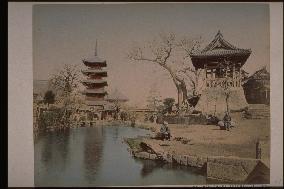
The five-story pagoda and the bell tower,Sensoji Temple

The five-story pagoda and the bell tower,Sensoji Temple

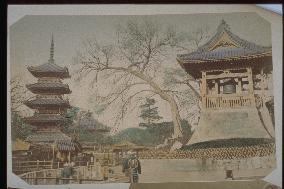
The five-story pagoda and bell tower facing north from Benten Pond. The location of the camera is further back and to the right compared to the photo numbered 4-10. To the left of the bell tower is seen the roof of the main building, and the hall for storage of scriptures to the right. The site is famous for a haiku by Basho: Hana no kumo, kane wa ueno ka asakusa ka (Clouds of flowers, which bell is preferred, the bells of Ueno or the Asakusa? )==Date:unknown, Place:Tokyo, Photo:Kusakabe Kinbei, (Credit:Nagasaki University Library/Kyodo News Images) [Cabinet Number4‐11‐0]

  • Main
  • Top
  • Editorial
  • Creative
  • About Us
  • About ILG
  • Terms of use
  • Company
  • BEHIND
  • Price List
  • Single Plan
  • Monthly Plan
  • Services
  • Shooting
  • Rights Clearance
  • Support
  • FAQ
  • How To Buy
  • Contact Us
  • Become a Partner

© KYODO NEWS IMAGES INC

All Rights Reserved.

  • Editorial
  • Olympics
  • News
  • Sports
  • Japan
  • Tech
  • Royal
  • Disaster
  • NorthKorea
  • Old Japan
  • SNS
  • Creative
  • Food
  • Japan
  • Landscape
  • Animal
  • Popular
  • #Ukraine
  • #Russia
  • #coronavirus
  • #N. Korea
  • #China
  • #Thailand
  • #Ukraine
  • #Russia
  • #coronavirus
  • #N. Korea
  • #China
  • #Thailand
  • Food
  • Japan
  • Landscape
  • Animal
  • Olympics
  • News
  • Sports
  • Japan
  • Tech
  • Royal
  • Disaster
  • NorthKorea
  • Old Japan
  • SNS