•  

Boxing: Inoue vacates 4 belts, moves up to super bantam

Undefeated Japanese boxer Naoya Inoue announced his decision Friday to relinquish all four bantamweight belts and move up to the super bantamweight division. The 29-year-old, nicknamed "Monster," completed a sweep of the WBA, WBC, WBO and IBF belts last month with an 11th-round knockout of Britain's Paul Butler, who came in as the World Boxing Organization's bantamweight champion. "The real battle starts from here," Inoue said at a press conference in Yokohama. "I'm very excited." He became the first Japanese to top the pound-for-pound rankings published by the prestigious Ring magazine in June 2022 and now has a 24-0 record, with 21 knockouts.

  •  
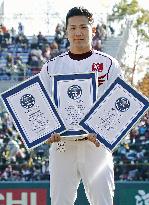
Eagles ace Tanaka

Eagles ace Tanaka

SENDAI, Japan - Rakuten Eagles ace Masahiro Tanaka holds the certificates in Sendai, northeastern Japan, on Nov. 23, 2013, that Guinness World Records issued recognizing his record-breaking season. The 25-year-old Tanaka went 24-0 this season and, coupled with his 28-game winning streak that began on Aug. 26, 2012 plus two wins in the postseason, had a 30-game winning streak.

  •  
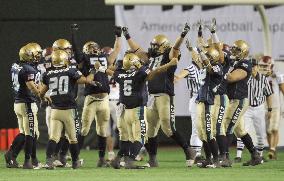
Obic blanks Ritsumeikan to win Rice Bowl

Obic blanks Ritsumeikan to win Rice Bowl

TOKYO, Japan - Members of the Obic Seagulls celebrate victory in the Rice Bowl match, the major American football title in Japan, at Tokyo Dome on Jan. 3, 2011, after beating Ritsumeikan University 24-0.

  •  
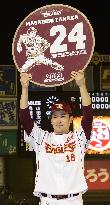
Baseball: Masahiro Tanaka in 2013

Baseball: Masahiro Tanaka in 2013

File photo taken Oct. 8, 2013, shows Rakuten Eagles pitcher Masahiro Tanaka celebrating after improving to a 24-0 record for the season with a win over the Orix Buffaloes in Sendai, Japan. Tanaka and the Eagles have agreed to a two-year contract from 2021 after the New York Yankees decided not to re-sign him.

  •  
Superstar Harvey shines in Barbarians' run to semis

Superstar Harvey shines in Barbarians' run to semis

Magali Harvey kicks a conversion for Hokkaido Barbarians during the first day of the Sapporo Women's Sevens on Sept. 23, 2016, at the Hokkaido Barbarians Club in Jozankei. The Barbarians beat Queensland 24-0. (Kyodo) ==Kyodo

  •  
Superstar Harvey shines in Barbarians' run to semis

Superstar Harvey shines in Barbarians' run to semis

Magali Harvey bangs over a conversion for Hokkaido Barbarians during the first day of the Sapporo Women's Sevens on Sept. 23, 2016, at the Hokkaido Barbarians Club in Jozankei. The Barbarians beat Queensland 24-0. (Kyodo) ==Kyodo

  •  
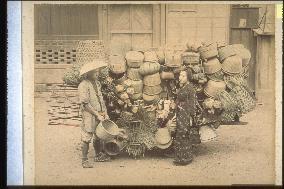
A basket vendor

A basket vendor

The basket seller sells not only baskets but also daily goods made of bamboo. Bamboo is abundant in Japan. It is easy to process and has excellent characteristics of ventilation and water resistance. The sellers went around crying out baskets and miso drainers .==Date:unknown, Place:unknown, Photo:unknown, (Credit:Nagasaki University Library/Kyodo News Images) [Cabinet Number18‐24‐0]

  •  
Soribashi bridge at Sumiyoshi Shrine

Soribashi bridge at Sumiyoshi Shrine

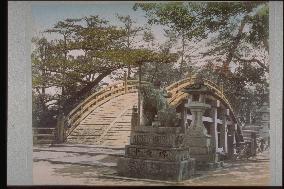
The arched bridge of Sumiyoshi Taisha is said to have been donated by Yodogimi (the photo has a caption reading Taikohashi ) and is a famous site at the Taisha.==Date:unknown, Place:Osaka, Photo:Ogawa Kazumasa, (Credit:Nagasaki University Library/Kyodo News Images) [Cabinet Number10‐24‐0]

  •  
Stirring the paddy field

Stirring the paddy field

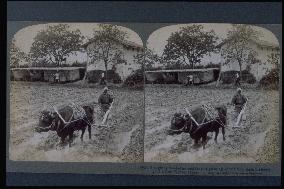
A farmer is cultivating the field using black-haired cow at a rice paddie in Uji. A rope and a plow are tied to the back of the cow and each time the cow pulls the plow, the rice paddie is cultivated. A big warehouse is behind and a small shack covered with mats is made temporarily next to it, and a farmer with a balance pole is carrying goods. The rice seedlings may be preserved in the shack. This photo could have been taken by the British photographer H. G. Ponting in 1904.==Date:1904, Place:Uji, Photo:Underwood, (Credit:Nagasaki University Library/Kyodo News Images) [Cabinet Number97‐24‐0]

  •  
A brazier and a woman (photo by Wada Nyoei,Imado,Asakusa)

A brazier and a woman (photo by Wada Nyoei,Imado,Asakusa)

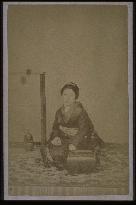
The woman has her hair in marumage style with a peony-shaped comb and seems to be wearing a black satin coat bearing her family crest. Her facial expression has the richness and depth of an older woman. A sense of warmth exudes from her shoulder line. This is a the posture of a wife of the merchant class.==Date:unknown, Place:unknown, Photo:unknown, (Credit:Nagasaki University Library/Kyodo News Images) [Cabinet Number96‐24‐0]

  •  
A girl dancing to the shamisen

A girl dancing to the shamisen

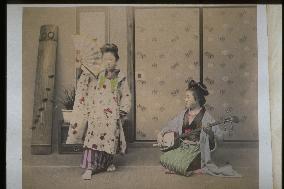
A dance performed to the accompaniment of a shamisen lute. There are Hanayanagi, Fujima and other schools of traditional Japanese dance. The women seem to be sisters. The younger is wearing a coat for outings. The older sister is wearing an apron for household activities. A koto harp is placed against the wall.==Date:unknown, Place:unknown, Photo:A. Farsari, (Credit:Nagasaki University Library/Kyodo News Images) [Cabinet Number95‐24‐0]

  •  
Nunobiki Falls

Nunobiki Falls

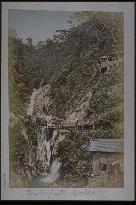
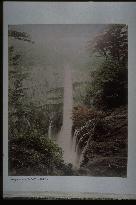
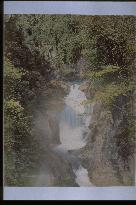
Medaki waterfall at Nunobiki Falls. The wooden bridge and teahouse have not yet been built, indicating that this photograph was taken in the first half of the Meiji Period. Although the tinting is different, this is the same as photographs #2807, #4481 and #4870. The rough tinting suggests that the photograph was produced in the latter half of the Meiji Period.==Date:unknown, Place:Kobe, Photo:unknown, (Credit:Nagasaki University Library/Kyodo News Images) [Cabinet Number92‐24‐0]

  •  
Nagasaki Harbour seen from Akunoura

Nagasaki Harbour seen from Akunoura

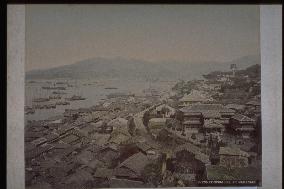
This is one of a set of four photographs of Nagasaki taken by Uchida Kuichi, who accompanied Emperor Meiji on his journey around the country in 1872. The Emperor's flagship is visible in the harbour. Although believed to be the work of Ueno Hikoma, this same photograph was found among Uchida's photographs of the 1872 trip in the Kasumi-kai collection and thus was confirmed to be Uchida's work.==Date:1872, Place:Nagasaki, Photo:Uchida Kuichi, (Credit:Nagasaki University Library/Kyodo News Images) [Cabinet Number91‐24‐0]

  •  
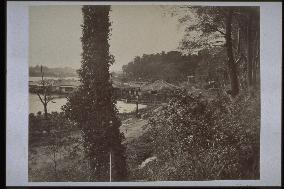
A scenery in the suburbs of Tokyo

A scenery in the suburbs of Tokyo

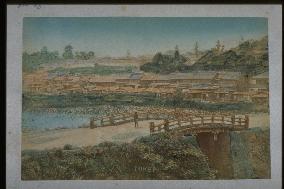
This is the earthen bridge leading to Ichigaya Gomon (gate), which was located to the left. The main residence of the Tokugawa family of Owari was located on the hill to the left. It was destroyed in 1868, and the Military Academy was built there in 1878. Ichigaya Hachiman Shrine is on the right side of the hill, and the town of Ichigaya Hachiman is visible at the foot of the hill. This photograph was carried in an 1872 issue of The Far East and later tinted.==Date:unknown, Place:Tokyo, Photo:unknown, (Credit:Nagasaki University Library/Kyodo News Images) [Cabinet Number90‐24‐0]

  •  
The first Kirifuri Fall,Nikko

The first Kirifuri Fall,Nikko

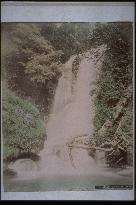
The English caption reads Ichinotaki. This is another name for Haguro Falls at Tamozawa, a tributary of Daiya River. This is downstream from Urami Falls at Arasawa, which lie above Kirifuri Falls. However, the waterfall in this photograph is identical to Jakko-Aioi Falls (Aioi Odaki Falls) on Netori River, a tributary of the Tamozawa, portrayed in the book Nikkosan Shinzu in 1886.==Date:unknown, Place:Nikko, Photo:unknown, (Credit:Nagasaki University Library/Kyodo News Images) [Cabinet Number88‐24‐0]

  •  
The Kegon Falls

The Kegon Falls

Kegon Falls is one of the three major waterfalls of Japan, along with Nachi Falls (Wakayama Prefecture) and Fukuroda Falls (Ibaragi Prefecture). It is roughly 97m high. Local resident Hoshino Gorobei built the road along the basin of the falls in 1900 and opened a teahouse. The elevator currently in service started operation in in 1930.==Date:unknown, Place:Nikko, Photo:unknown, (Credit:Nagasaki University Library/Kyodo News Images) [Cabinet Number87‐24‐0]

  •  
A girl on a jinrikisha

A girl on a jinrikisha

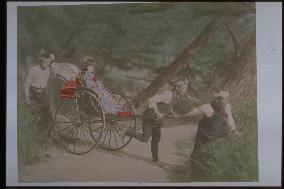
A kimono-clad woman is riding a jinrikisha (rickshaw). The rickshaw man poses with his right leg in the air. His hair is close-cropped and he is wearing a twisted head towel, long sleeve coat, stomach warmer, long underwear and straw sandals. The other man in front wears similar attire. The man in the rear pushing the hood is not wearing a stomach warmer. This was taken on a road lined with pine trees.==Date:unknown, Place:unknown, Photo:unknown, (Credit:Nagasaki University Library/Kyodo News Images) [Cabinet Number86‐24‐0]

  •  
A peony garden

A peony garden

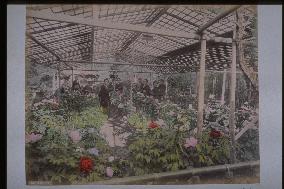
Women enjoy the peony flowers at Maruyama. The peony garden is enclosed with a bamboo structure. There are lights hanging from the centre of the ceiling. The roof seems to be made of glass as soft light is flooding from them. Red, blue, and pink peony flowers are in bloom.==Date:unknown, Place:Kyoto, Photo:unknown, (Credit:Nagasaki University Library/Kyodo News Images) [Cabinet Number85‐24‐0]

  •  
A priest and his disciples

A priest and his disciples

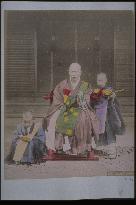
This photograph by Kashima Seibei bears the English title Buddhist Priests. The old priest is sitting on the chair performing a service, and the two young apprentices at his side are holding Buddhist utensils.==Date:unknown, Place:unknown, Photo:Kajima Seibei, (Credit:Nagasaki University Library/Kyodo News Images) [Cabinet Number84‐24‐0]

  •  
Kiga Spa

Kiga Spa

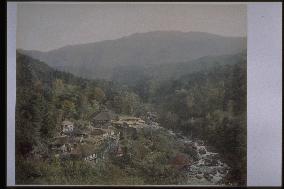
Since the new road opened in 1889 between Miyanoshita and Miyagino can not be seen, this is the spa town of Kiga prior to that time. Yakusuhido is where the torii gate is. Before that are the buildings of Kameya Inn, and Jindairo is on the right. Matsuzakaya Inn is across from it on the other side of Susawa River. The building with a white wall on the left is Chokairo of Matsuzakaya Inn. Finally the one in the foreground is Sengokuya Inn. Hayakawa is visible on the right and one of the outer mountain ranges of Hakone, Myojingadake, is visible.==Date:unknown, Place:Hakone, Photo:A. Farsari, (Credit:Nagasaki University Library/Kyodo News Images) [Cabinet Number82‐24‐0]

  •  
Mt. Fuji seen from a tea field

Mt. Fuji seen from a tea field

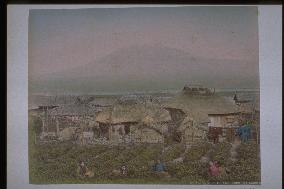
Northern view of Mt. Fuji from the tea field on the sand hill of Suzukawa, Fuji City. The hill ends at the houses with thatched roofs, and the tile-roofed houses of Suzukawa (Motoyoshiwara post town) on the Tokaido Highway are visible in the distance. Ukishimagahara field stretches into the background. The four women in the foreground are picking tea leaves.==Date:unknown, Place:Shizuoka, Photo:A. Farsari, (Credit:Nagasaki University Library/Kyodo News Images) [Cabinet Number81‐24‐0]

  •  
Teahouses at Ueno Park

Teahouses at Ueno Park

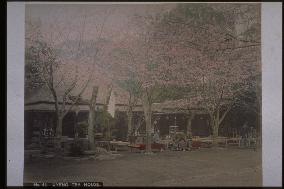
Shinobugaoka, a hill at Ueno, is viewed from the racetrack at Shinobazu Pond. The Western-style building on the right is Ueno Seiyoken Restaurant, which opened in 1876 as a branch of Kyobashi Seiyoken. It was a hotel and a restaurant frequented daily by many people.==Date:unknown, Place:Ueno, Photo:Tamamura Kozaburo, (Credit:Nagasaki University Library/Kyodo News Images) [Cabinet Number80‐24‐0]

  •  
Yokohama Station and a bridge

Yokohama Station and a bridge

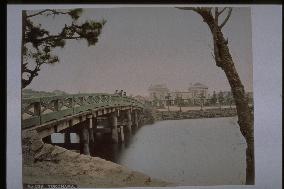
The building by Oe Bridge is the first Yokohama Railroad Station designed by R. P. Bridgens and built in 1871. The arch-shaped corridor connecting the second floors of the two station buildings was added in 1873 but destroyed by a typhoon in 1884.==Date:unknown, Place:Yokohama, Photo:Tamamura Kozaburo, (Credit:Nagasaki University Library/Kyodo News Images) [Cabinet Number79‐24‐0]

  •  
The hundred-step Otokozaka slope at Mt. Atago

The hundred-step Otokozaka slope at Mt. Atago

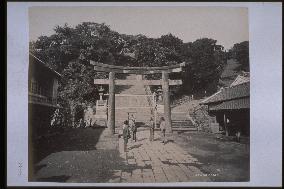
The stone stairs leading to Atago Shinto Shrine at the top of Mt. Atago. The steps in the centre, Otoko-zaka (Man Slope), are mentioned in old stories and songs as the place where Magaki Heikuro ascended and descended on horseback. The inclination of about 40 degrees seems too steep for a horse. The gently-sloping staircase on the right is Onna-zaka (Woman Slope). There was a third slope called Shin-zaka (New Slope) at the other side of the mountain. One of the photographs in the album sold by Baron Raimund von Stillfried Rathenitz, this may have been taken by Felix Beato in the early years of the Meiji Period.==Date:unknown, Place:Tokyo, Photo:R. Stillfried, (Credit:Nagasaki University Library/Kyodo News Images) [Cabinet Number78‐24‐0]

  •  
Waterfalls at Miyanoshita

Waterfalls at Miyanoshita

This is the same spot of the Jakotsu River as illustrated in the Mannen Bridge of Hakone Sokokura Yumoto(1880) by Kiyochika Kobayashi. Supposing that this was taken from Mannen Bridge, judging from the angle, this may date to between 1873, when the bridge was built, and 1889 when the bridge was gone.==Date:unknown, Place:Hakone, Photo:R. Stillfried, (Credit:Nagasaki University Library/Kyodo News Images) [Cabinet Number77‐24‐0]

  •  
Massage

Massage

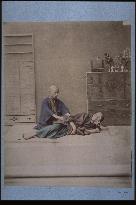
A drawer is visible next to a summer partition, and an offering has been placed on a household altar. The old woman lying on the tatami mat is receiving a massage, apparently in a living room. Massage was a common profession for the visually impaired.==Date:unknown, Place:unknown, Photo:R. Stillfried, (Credit:Nagasaki University Library/Kyodo News Images) [Cabinet Number76‐24‐0]

  •  
Western-style buildings in the Oura foreign settlement

Western-style buildings in the Oura foreign settlement

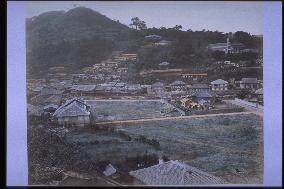
This is the second part of a set of two photos with [Cabinet Number75‐23‐0](ID 3880). This photo captures the Minamiyamate area from present-day Showakai Hospital in Higashiyamate.. This was after completion of the renovation of Oura Church from 1878 to 1879. The small western-style house under what would later be the Shimizu residence on top of the hill may be the old Walker residence. Around 1887.==Date:c1887, Place:Nagasaki, Photo:unknown, (Credit:Nagasaki University Library/Kyodo News Images) [Cabinet Number75‐24‐0]

  •  
Western-style buildings in the Oura foreign settlement

Western-style buildings in the Oura foreign settlement

This is a set of two photos with [Cabinet Number75‐24‐0](ID 3881). This photo captures the southern half of the Oura foreign settlement from present-day Showakai Hospital. The street at the bottom of the photo is Oura Sanbangai Street, the current location of the Confucius Shrine and the NTT Hospital. Until about 1868 there was a tea manufacturer and other buildings, but at the time of this photo there were many open lots. Around 1887.==Date:unknown, Place:Nagasaki, Photo:unknown, (Credit:Nagasaki University Library/Kyodo News Images) [Cabinet Number75‐23‐0]

  •  
Nagasaki Harbour and Naminohira,Minamiyamate

Nagasaki Harbour and Naminohira,Minamiyamate

This photo is a panoramic view from Kotohira Shrine at Minamiyamate of the southern tip of the foreign settlement and the Naminohira area. The big building in the right foreground is Chintei Elementary school (later Naminohira Elementary School), a newly built and renamed school at the foot of Mr. Nabekanmuri. (Formerly known as Kozone Elementary School at a different location. Someone, possibly a teacher, is standing by the entrance. There are several boys and girls on the school ground. Directly under Yongo-matsu pine tree on top of the hill is the Glover house. ==Date:unknown, Place:Nagasaki, Photo:unknown, (Credit:Nagasaki University Library/Kyodo News Images) [Cabinet Number73‐24‐0]

  •  
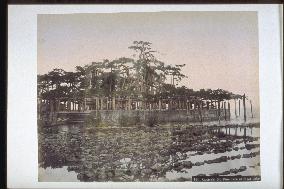
Pine trees at Karasaki,Lake Biwa

Pine trees at Karasaki,Lake Biwa

Karasaki-no-Matsu, the pine tree of Karasaki, famous for its portrayal in the ukiyoe print Karasaki-no-Yau (Night Rain of Karasaki), one of the Eight Scenes of Oumi. The tree in the photograph is the second-generation pine with an east-west width of 72 meters, a north-south width of 86 meters and a height of 10 meters. A number of splints and stone walls support the branches stretching out to the lake. This second-generation pine died in 1921, but the third-generation pine is thriving today at the same site.==Date:unknown, Place:Shiga, Photo:unknown, (Credit:Nagasaki University Library/Kyodo News Images) [Cabinet Number71‐24‐0]

  •  
Women taking a bath

Women taking a bath

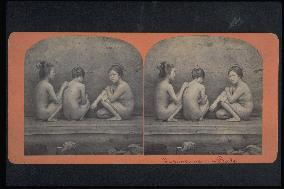
This stereograph is included in East Asian Series by Wilhelm Burger and captures young women bathing. They are scrubbing their bodies, but the scene appears to be staged.==Date:unknown, Place:unknown, Photo:Wilhelm Burger, (Credit:Nagasaki University Library/Kyodo News Images) [Cabinet Number70‐24‐0]

  •  
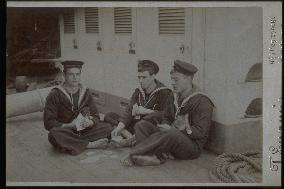
Sailors playing cards on their ship

Sailors playing cards on their ship

The sailors probably had this photograph taken to commemorate their visit to Yokohama. The mount is from the Enami Tamotsu Studio at No.9 Benten Dori 1-chome. Opened by Enami Nobukuni in 1892, the studio was located at this address until the Great Kanto Earthquake of 1923.==Date:unknown, Place:Yokohama, Photo:unknown, (Credit:Nagasaki University Library/Kyodo News Images) [Cabinet Number69‐24‐0]

  •  
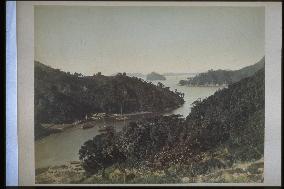
Takahoko Island

Takahoko Island

Nagasaki Harbour seen from the hillside behind Tomachi. The cove in the left foreground is Tomachi. The tip of the peninsula on the right is Kanzakibana, and the area protruding on the left is Megami. Takahoko was known as the site of Christian martyrdom in the 17th century and a landmark for foreign ships entering Nagasaki Harbour.==Date:unknown, Place:Nagasaki, Photo:unknown, (Credit:Nagasaki University Library/Kyodo News Images) [Cabinet Number66‐24‐0]

  •  
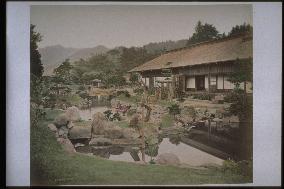
The Shoyoen,Rinnoji Temple

The Shoyoen,Rinnoji Temple

Shoyoen Garden is located on the south side of the main hall at Manganji Temple. It was destroyed by fire in 1871 during the Boshin War. Modeled after Omi-Hakkei, the Chisenkaiyu-style garden remains to this day as a representative garden of the Edo Period. The building on the right, Shiunkaku, was built on the site of Manganji Temple, previously destroyed by fire.==Date:unknown, Place:Nikko, Photo:Usui Shuzaburo?, (Credit:Nagasaki University Library/Kyodo News Images) [Cabinet Number65‐24‐0]

  •  
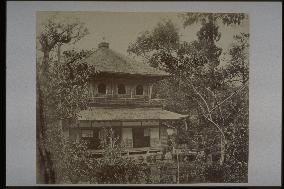
Ginkakuji Temple

Ginkakuji Temple

The Silver Pavilion at Jionji Temple seen from the western edge of Kikyo Pond, facing west. Also called Kannon-do, the pavilion was built in 1489 by order of Ashikaga Yoshimasa and restored in 1639. The building is in two-story houkei style with a kokera (thin long plank) roof. The greenery on the left is Sen'nin-shu. Yamanaseki (rock) is visible under the right bush with Bunkai Bridge behind it.==Date:unknown, Place:Kyoto, Photo:F. Beato, (Credit:Nagasaki University Library/Kyodo News Images) [Cabinet Number62‐24‐0]

  •  
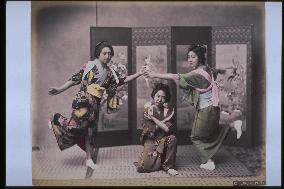
Dancing girls

Dancing girls

Women from the merchant class wearing colourful kimono perform a dance. The byobu screen at the back is illustrated with flowers and birds. The three women are dancing merrily together.==Date:1890, Place:unknown, Photo:unknown, (Credit:Nagasaki University Library/Kyodo News Images) [Cabinet Number61‐24‐0]

  •  
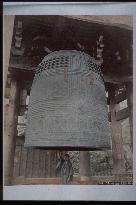
The Great Bell,Chion-in Temple

The Great Bell,Chion-in Temple

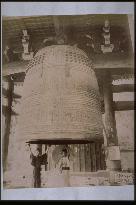
The big temple bell of Chion-in is seen from west of the bell tower, facing east. The kimono-clad man under the bell lifts his arm to touch the bell. A framed tinted photograph is attached to the pillar to the right. Also called Yoshimizu's Bell, this is the largest bronze bell cast at Sanjo-Kamanza foundry. It is 5.4m high, 2.7m in diameter, 29cm thick, and weighs 7.5 tons.==Date:unknown, Place:Kyoto, Photo:unknown, (Credit:Nagasaki University Library/Kyodo News Images) [Cabinet Number59‐24‐0]

  •  
Suma coast

Suma coast

Eastern view from what is now Sumaura Park. This scenic area is famous as the site of a decisive battle between the Genji and Heike clans in 1184. Since the Sanyo Railway Company's Hyogo-Himeji Line opened in December 1888, this photograph was probably taken between 1890 and 1910. The former Saigoku Kaido Highway (present-day National Route #2) stretches along the other side of the railroad tracks.==Date:unknown, Place:Kobe, Photo:unknown, (Credit:Nagasaki University Library/Kyodo News Images) [Cabinet Number56‐24‐0]

  •  
The approach to Benzaiten,Shinobazu Pond

The approach to Benzaiten,Shinobazu Pond

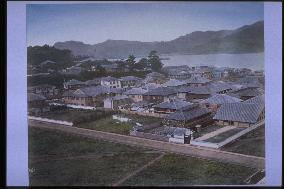
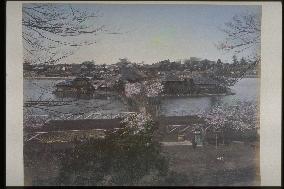
Deai-jaya (teahouses for dating) lined the approach to Nakanoshima until 1877. The circumference of Shinobazu Pond was filled in in 1868. The fact that this work is yet to be completed in this photograph indicates that it was taken before that year. The torii gate of Toshogu Shrine is visible in the centre back.==Date:unknown, Place:Tokyo, Photo:unknown, (Credit:Nagasaki University Library/Kyodo News Images) [Cabinet Number55‐24‐0]

  •  
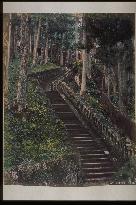
Stone steps on the approach to the Okusha,Toshogu Shrine,Nikko

Stone steps on the approach to the Okusha,Toshogu Shrine,Nikko

Visitors reach these steps after passing under the famous Nemurineko (sleeping cat) carving in the east corridor of the main hall at Nikko Toshogu and going through Sakashita Gate. At the top the stairs is the Okusha (inner shrine) containing the tomb of Tokugawa Ieyasu. Each step is made from a solid slab of stone. The Okusha is visible in the upper part of the photograph.==Date:unknown, Place:Nikko, Photo:unknown, (Credit:Nagasaki University Library/Kyodo News Images) [Cabinet Number54‐24‐0]

  •  
Shinobazu Pond

Shinobazu Pond

Shinobasu Pond and Nakanoshima, where Benten-do is located, are viewed from the top of the hill at Ueno. The area between the fences, which stretches right to left, is the racecourse. The overpass, which is the approach to Benten-do, was built between 1661 and 1673. Before that, people used boats to visit Benten-do.==Date:unknown, Place:Tokyo, Photo:unknown, (Credit:Nagasaki University Library/Kyodo News Images) [Cabinet Number53‐24‐0]

  •  
The Great Bell,Chion-in Temple

The Great Bell,Chion-in Temple

The big temple bell of Chion-in viewed from west of the bell tower, facing east. Two kimono-clad men stretch their arms under the bell. A framed tinted photograph is attached to the pillar on the right. Also called Yoshimizu's Bell, this is the largest bronze bell cast at Sanjo-Kamanza foundry. It is 5.4m high, 2.7m in diameter, 29cm thick, and weighs 7.5 tons.==Date:unknown, Place:Kyoto, Photo:unknown, (Credit:Nagasaki University Library/Kyodo News Images) [Cabinet Number52‐24‐0]

  •  
Stirring the paddy field

Stirring the paddy field

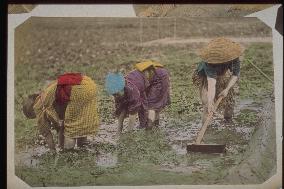
Farmers make rice paddy ridges. A man wearing a straw hat and coat is pulling up soil with a long hoe. Women in kimono are breaking up the soil by hand and pressing grass fertilizer into the mud with their feet.==Date:unknown, Place:unknown, Photo:unknown, (Credit:Nagasaki University Library/Kyodo News Images) [Cabinet Number51‐24‐0]

  •  
A woman on a jinrikisha

A woman on a jinrikisha

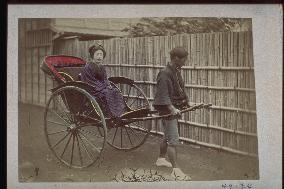
A kimono-clad woman is riding a jinrikisha (rickshaw). A short-haired man in a sacerdotal robe, long underwear and a pair of tabi socks is holding the bar. A house and bamboo fence are seen in the back. The photograph was taken outdoors.==Date:unknown, Place:unknown, Photo:unknown, (Credit:Nagasaki University Library/Kyodo News Images) [Cabinet Number49‐24‐0]

  •  
Women greeting each other

Women greeting each other

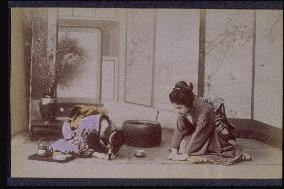
Two women in kimono are exchanging greetings, with a byobu screen visible on the right and a tsuitate partition in the back to the left. A brazier is placed in the centre, tea is served and then the women exchange greetings. The woman holding a tea tray is the host, while the woman sitting on a cushion to the right is the guest.==Date:unknown, Place:unknown, Photo:Tamamura Kozaburo, (Credit:Nagasaki University Library/Kyodo News Images) [Cabinet Number48‐24‐0]

  •  
Toshogu Shrine,Nikko

Toshogu Shrine,Nikko

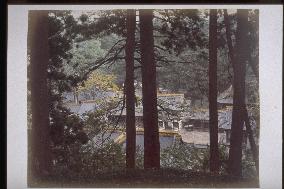
This is a view of the Hall of Worship and Yomei Gate seen from the right side of the inner shrine at Nikko Toshogu. The sacred coffin of Tokugawa Ieyasu is placed in the pagoda in the interior. The roof of the Hall of Worship is visible in the foreground. The structure with white pillars right next to the cedars in the centre is Yomei Gate. The building on the far right is Shinyo-sha.==Date:unknown, Place:Nikko, Photo:unknown, (Credit:Nagasaki University Library/Kyodo News Images) [Cabinet Number47‐24‐0]

  •  
A woman playing the shamisen

A woman playing the shamisen

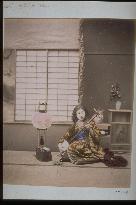
A woman with her hair loose plays a shamisen alone. Ogawa Kazuma used the same model as in the photo numbered 45-21.==Date:unknown, Place:unknown, Photo:Ogawa Kazumasa, (Credit:Nagasaki University Library/Kyodo News Images) [Cabinet Number45‐24‐0]

  •  
Party of kakubei-jishi,street-tumblers wearing a lion's mask

Party of kakubei-jishi,street-tumblers wearing a lion's mask

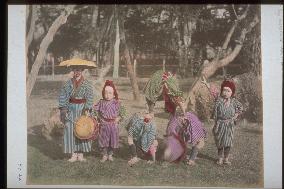
Kakubejishi is an acrobatic dance performed by children in front of houses with the headquarters in Echigo. It was called Kakubejishi in Edo. There are acts for one and for two or more people. In this photo, three children engage in an combination act.==Date:unknown, Place:unknown, Photo:Ogawa Kazumasa, (Credit:Nagasaki University Library/Kyodo News Images) [Cabinet Number44‐24‐0]

  •  
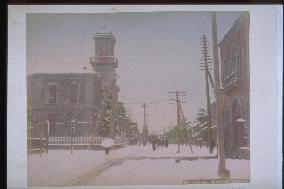
Honmachi-dori Avenue,Yokohama

Honmachi-dori Avenue,Yokohama

A photo of the snow scene in Motomachi of Yokohama. The clock tower is that of the Yokohama city office (built in 1874), and the building to the right in the fore is the postal and telecommunications office where the Yokohama city office comes later.==Date:unknown, Place:Yokohama, Photo:Kusakabe Kinbei, (Credit:Nagasaki University Library/Kyodo News Images) [Cabinet Number43‐24‐0]

  •  
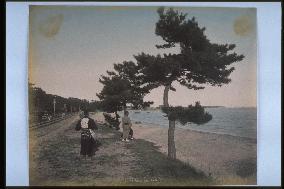
Pine trees at Karasaki,Lake Biwa

Pine trees at Karasaki,Lake Biwa

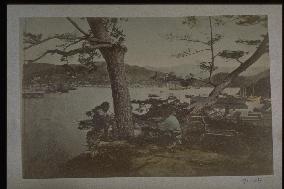
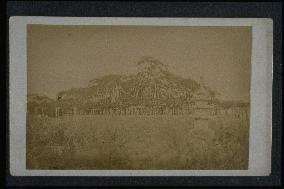
The Karasaki pine trees from Lake Biwa. Pines with branches spread out in the form of an umbrella were revered as dwellings of deities. Many torii are built facing the lake. The branches are held up by supporting poles.==Date:unknown, Place:Shiga, Photo:unknown, (Credit:Nagasaki University Library/Kyodo News Images) [Cabinet Number42‐24‐0]

  • Main
  • Top
  • Editorial
  • Creative
  • About Us
  • About ILG
  • Terms of use
  • Company
  • BEHIND
  • Price List
  • Single Plan
  • Monthly Plan
  • Services
  • Shooting
  • Rights Clearance
  • Support
  • FAQ
  • How To Buy
  • Contact Us
  • Become a Partner

© KYODO NEWS IMAGES INC

All Rights Reserved.

  • Editorial
  • Olympics
  • News
  • Sports
  • Japan
  • Tech
  • Royal
  • Disaster
  • NorthKorea
  • Old Japan
  • SNS
  • Creative
  • Food
  • Japan
  • Landscape
  • Animal
  • Popular
  • #Ukraine
  • #China
  • #coronavirus
  • #N. Korea
  • #Thailand
  • #Russia
  • #Ukraine
  • #China
  • #coronavirus
  • #N. Korea
  • #Thailand
  • #Russia
  • Food
  • Japan
  • Landscape
  • Animal
  • Olympics
  • News
  • Sports
  • Japan
  • Tech
  • Royal
  • Disaster
  • NorthKorea
  • Old Japan
  • SNS